Scan evidence first
Start with evidence strength and mechanism confidence, then decide whether weaker evidence is still acceptable for your goal.
Comparison guide context
Compare herbs and supplements side-by-side by evidence strength, mechanism, stimulation profile, safety, and dosing. Evidence-based decision support. Comparison pages are meant to clarify tradeoffs, not declare one ingredient universally better. The better choice depends on the goal, evidence quality, safety profile, dose realism, and whether the ingredient duplicates something already in a stack.
Read Herb & Supplement Comparison Center by looking for differences in mechanism, onset, tolerability, interaction risk, and product quality. A stronger evidence rating for one use case does not automatically transfer to another goal.
If both options influence the same pathway, consider simplifying rather than stacking. Reducing overlap often makes side effects easier to identify and decisions easier to reverse.
Evidence-informed comparison
Compare herbs and supplements by evidence strength, mechanism, stimulation profile, safety, and dosing. Each comparison page shows data-backed tradeoffs — not marketing claims.
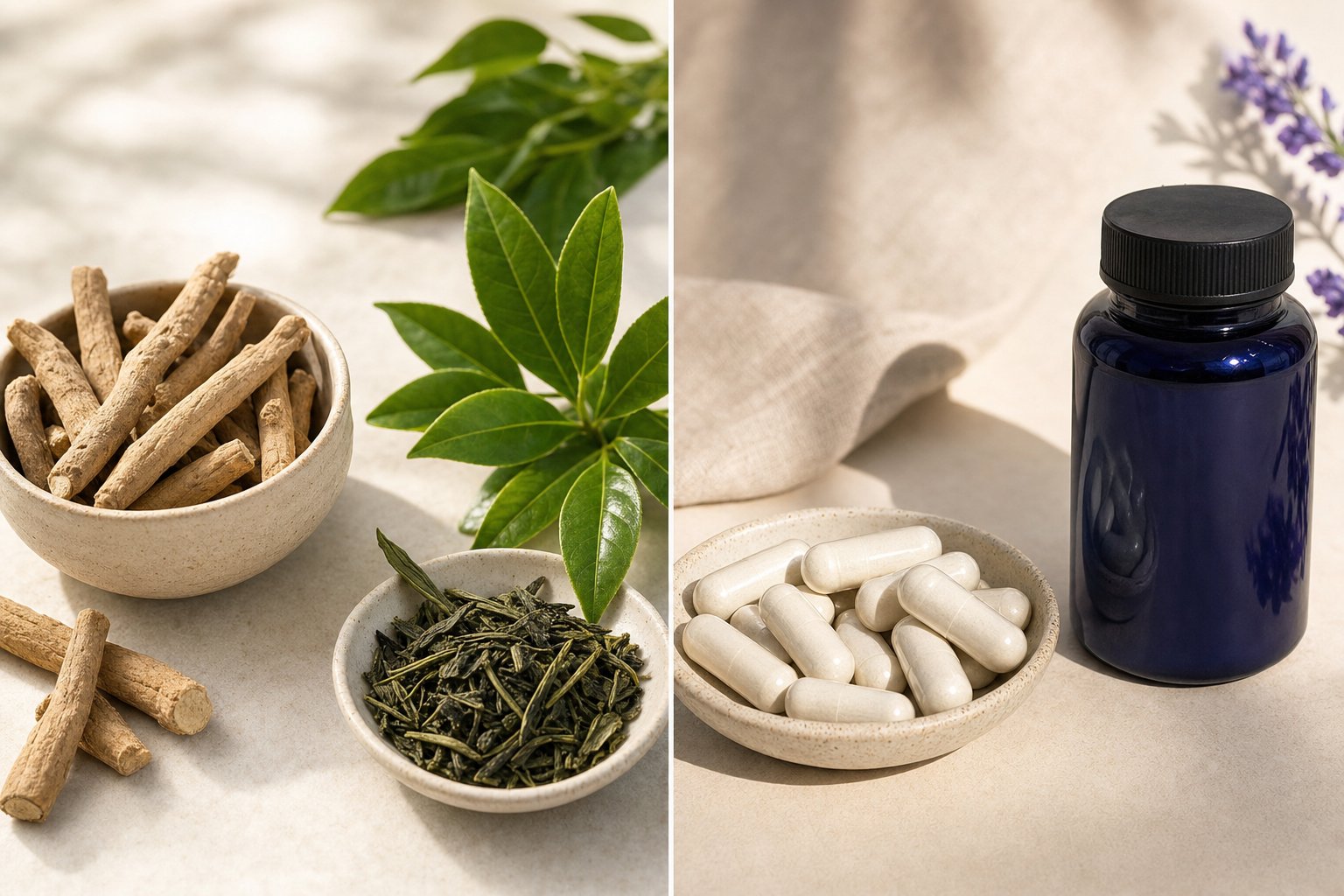
Start with evidence strength and mechanism confidence, then decide whether weaker evidence is still acceptable for your goal.
Check caution flags, stimulation or sedation profile, and tolerance risk before focusing on convenience or trend.
Compare onset, duration, and cost/value side by side. Fast effects or lower cost can come with tradeoffs in certainty or tolerability.
Start by goal
Not sure which comparison to open first? Start with the goal, then use the side-by-side page to check evidence, timing, safety, and fit.
Sleep
Compare sleep options →
Stress & calm
Compare stress support →
Focus
Compare focus options →
Calm + sleep
Compare calming options →
Inflammation
Compare inflammation options →
Performance
Compare performance options →
Browse by category
Each page covers evidence level, mechanisms, dosing, safety, and which fits your goal better.
Stress-response herbs compared by onset speed, stimulation profile, and how long each takes to build an effect.
Nootropics contrasted by mechanism — cholinergic support, neuroprotective herbs, and calm-focus amino acids work differently and are not interchangeable.
Sleep aids compared by next-day grogginess risk, dependency potential, and whether they help with falling asleep, staying asleep, or both.
Performance compounds compared by evidence strength and use case — strength and power output differ from endurance and recovery support.
Immune and general-health compounds compared by mechanism overlap, so you are not paying for two ingredients that do the same thing.
Anti-inflammatory and metabolic options compared by mechanism and drug-interaction risk, since several of these overlap with common prescriptions.
Flagship pages with the most detailed evidence breakdowns.
Use this cautiously.
This page is educational and does not replace medical advice. Evidence strength reflects research signal quality, not guaranteed outcomes, and individual response varies. Review medications, health conditions, pregnancy or nursing status, and clinician guidance before using supplements.
Decision next step
Questions
What the evidence tiers mean, and what a comparison can and cannot tell you.
Strong evidence means human clinical trials — ideally randomized and controlled — consistently support the effect. Moderate evidence has fewer or smaller human trials, limited evidence relies mostly on mechanism or small studies, and traditional or preliminary tiers rely on historical use or early-stage research rather than confirmed clinical outcomes.
Mechanism relevance shifts with the goal. Ashwagandha and rhodiola are both adaptogens, but ashwagandha leans calming and better fits evening stress or sleep-adjacent anxiety, while rhodiola is more stimulating and fits daytime fatigue. The same pair can rank differently on a sleep comparison than on a focus comparison.
Not necessarily. Price often reflects extraction method, standardization, or dose form rather than efficacy. Check the actual dose and standardized-extract percentage against what was used in supporting research before assuming a pricier product performs better.
No. Comparisons here are educational and summarize published research patterns, not individualized guidance. Review current medications, health conditions, and pregnancy or nursing status with a clinician or pharmacist before starting or combining supplements.
Comparison table
The table is meant to narrow options, not finalize a decision. Follow up by reading the individual compound pages, safety notes, and cited research context where available.