Educational Comparison · Metabolic Cluster
Berberine vs Metformin: Is "Nature's Metformin" Actually Comparable?
Both activate AMPK, both reduce hepatic glucose production, and short-term RCTs show comparable glycemic outcomes. But metformin has 60+ years of population-scale safety data and proven cardiovascular outcomes. Berberine is a legitimate OTC metabolic support option — not a pharmaceutical substitute. Neither should be switched without clinician guidance.
Berberine — Evidence Grade: BMetformin — Evidence Grade: A
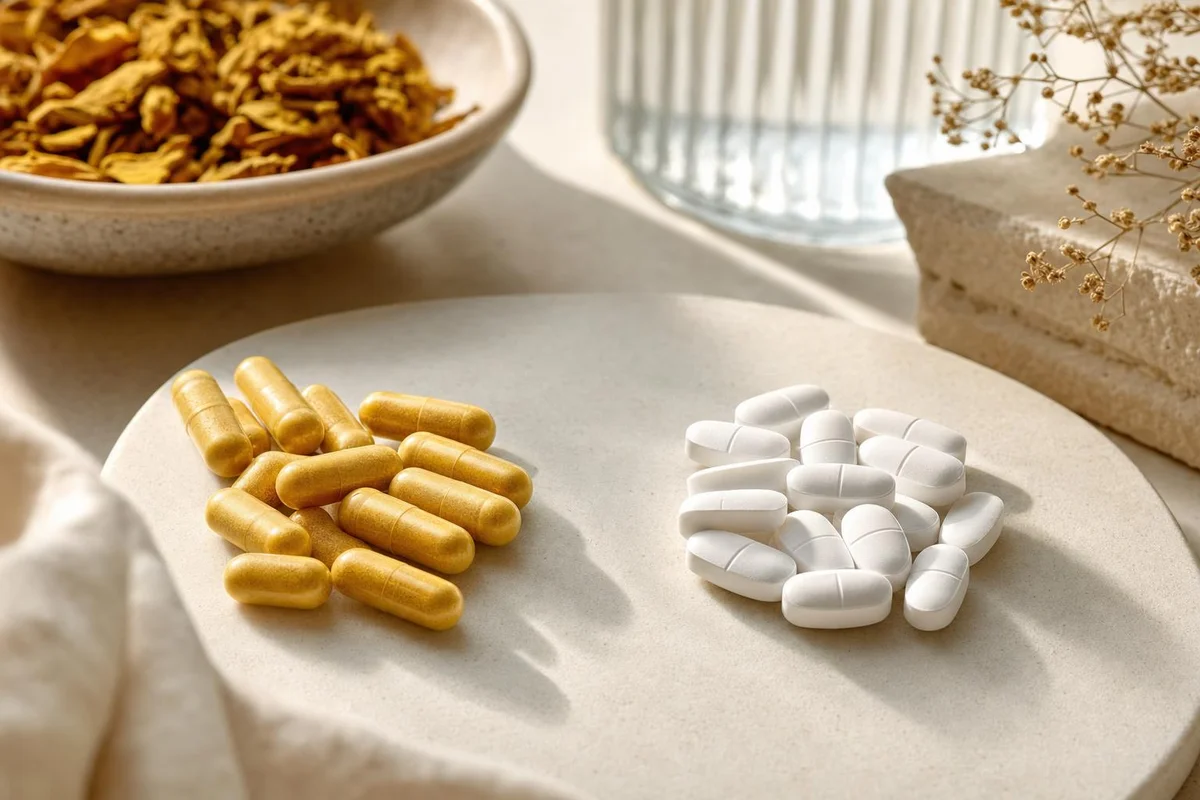
Quick answer
Berberine and metformin both activate AMPK and lower blood glucose through overlapping pathways, and short-term RCTs (13 weeks) show comparable HbA1c and fasting-glucose reductions. But metformin has 60+ years of population-scale safety data and proven cardiovascular outcome data (UKPDS), while berberine's evidence base is smaller-scale, shorter-duration studies without long-term outcome data. Berberine is a legitimate OTC metabolic-support option, not a proven substitute for prescribed metformin.
Best fit
- Berberine: OTC metabolic support for prediabetes or insulin resistance in people not on diabetes medication.
- Metformin: diagnosed type 2 diabetes, PCOS, or metabolic syndrome requiring clinician-titrated, first-line treatment.
- Neither substituted for the other: switching from prescribed metformin to berberine without clinician oversight, given berberine's lack of long-term cardiovascular outcome data.
- Evidence
- Metformin is Grade A — decades of large trials including the landmark UKPDS outcomes data. Berberine is Grade B — multiple positive RCTs and a 14-study meta-analysis, but smaller sample sizes, shorter durations (under 3 months), and no long-term cardiovascular or mortality endpoint data.
- Safety context
- Berberine inhibits CYP3A4/CYP2D6 and interacts with cyclosporine, some statins, antiarrhythmics, anticoagulants, and certain antidepressants; it is contraindicated in pregnancy. Metformin is contraindicated with eGFR under 30 mL/min and carries a rare lactic-acidosis risk with renal impairment. Anyone on diabetes medication should not add berberine without clinician oversight.
- Limitation
- This page is not claiming berberine is a safe or effective substitute for prescribed metformin.
Sources for this answer
Plant Alkaloid · OTC
Berberine
Isoquinoline alkaloid found in barberry, goldenseal, and Oregon grape. Primary action: AMPK activation — the same upstream target as metformin. Also modulates the gut microbiome, inhibits PTP1B, and upregulates GLUT4. Available OTC; typically dosed 500mg three times daily.
Explore BerberineBiguanide · Prescription
Metformin
First-line pharmacological treatment for type 2 diabetes since the 1990s. Reduces hepatic gluconeogenesis via AMPK and mitochondrial Complex I inhibition. Backed by landmark trials including the UKPDS, with proven cardiovascular outcome data over decades. Requires a prescription.
Fast Decision
Which one makes sense for you?
| Factor | Berberine | Metformin |
|---|---|---|
| Primary mechanism | AMPK activation, gut microbiome, GLUT4 upregulation | AMPK activation, hepatic gluconeogenesis inhibition |
| Evidence grade | B — multiple RCTs, smaller scale, shorter duration | A — decades of large trials, outcomes data |
| Best fit | Prediabetes, insulin resistance, metabolic support OTC | Diagnosed T2D, PCOS, metabolic syndrome (Rx) |
| Typical dose | 500mg 3×/day with meals (1,500mg/day) | 500–2,000mg/day per prescriber |
| Monthly cost | ~$20–40 OTC, no insurance coverage | ~$4–10 generic (often covered by insurance) |
| Main cautions | CYP3A4/2D6 interactions, pregnancy contraindication, GI | Renal function (lactic acidosis risk), B12 depletion, GI |
| Rx required | No | Yes |
Mechanism
How each one works
Berberine
- AMPK activation: reduces hepatic glucose output, increases peripheral uptake
- GLUT4 upregulation: promotes glucose transport into muscle cells independently of insulin
- PTP1B inhibition: increases insulin receptor sensitivity
- Gut microbiome: increases Akkermansia muciniphila, Bifidobacterium; short-chain fatty acid production supports insulin sensitivity
- GLP-1 stimulation: mild incretin-pathway activation
- Low oral bioavailability (~10%): most of berberine's effect occurs locally in the gut before systemic absorption
Metformin
- Mitochondrial Complex I inhibition: increases AMP:ATP ratio → AMPK activation
- Hepatic gluconeogenesis suppression: primary glucose-lowering mechanism
- Improved peripheral insulin sensitivity: independent of weight loss
- Gut microbiome: also increases Akkermansia muciniphila; some researchers argue gut effects explain much of its therapeutic benefit
- Possible longevity effects: TAME trial investigating metformin for healthspan extension (ongoing)
Why "nature's metformin" is an oversimplification
The AMPK mechanism is shared, but berberine's broader pharmacology (PTP1B, GLUT4, gut-first action) differs meaningfully from metformin. More importantly, mechanism similarity does not equate to outcome equivalence — that requires head-to-head long-term cardiovascular outcome data, which berberine does not have.
Evidence
What the research actually shows
Grade B
Berberine for glycemic control
- Zhang et al. 2008 (J Clin Endocrinol Metab, PMID: 18397984): Berberine 500mg 3×/day vs metformin 500mg 3×/day in newly diagnosed T2D patients (n=116) over 13 weeks. Both reduced HbA1c ~1.2%, fasting glucose ~23%, postprandial glucose ~30%. Berberine also significantly reduced triglycerides. This is the most-cited head-to-head study.
- Yin et al. 2008 (Metabolism, PMID: 18702929): Berberine 1g/day for 2 months in 84 T2D patients. Fasting glucose dropped 20%, postprandial glucose 28%, HbA1c from 8.1 to 7.3%. No placebo arm, but within-subject changes were significant.
- Dong et al. 2012 meta-analysis (14 RCTs): Berberine comparable to oral hypoglycemics including metformin for HbA1c and fasting glucose in short-term (≤3 month) comparisons. Significant heterogeneity across studies.
- Grade B rationale: Multiple RCTs with significant results, but limited by smaller sample sizes, shorter durations (<3 months), predominantly Chinese study populations, and absence of long-term cardiovascular or mortality endpoint data.
Grade A
Metformin for T2D
- UKPDS 34 (1998) (Lancet, PMID: 9742977): Landmark 10-year trial in overweight T2D patients. Metformin reduced diabetes-related complications by 32%, myocardial infarction by 39%, and all-cause mortality by 36% vs conventional diet treatment. These are the outcome data berberine lacks.
- Multiple subsequent systematic reviews, 60+ years of post-market surveillance, first-line designation in ADA/EASD/WHO clinical guidelines. Essentially the benchmark against which all other blood-glucose interventions are measured.
Dosing
Berberine
- Standard dose: 500mg with each main meal (1,500mg/day)
- Start low: 250mg 2×/day for 1–2 weeks to assess GI tolerance
- Half-life: ~4–5 hours — split dosing is essential for sustained coverage
- Cycling: Some practitioners recommend 8 weeks on, 2–4 weeks off (theoretical basis, limited evidence)
- Timing: With meals reduces GI side effects; prandial timing also aligns with postprandial glucose goals
Dosing
Metformin
- Typical range: 500–2,000mg/day; titrated by prescriber
- Starting: 500mg once or twice daily with meals; titrated up monthly
- Extended-release (ER): Significantly reduces GI side effects; often preferred
- Set by clinician: Dose individualized based on renal function, tolerability, glycemic response
Safety
Who should be cautious
Berberine cautions
- Drug interactions (significant): Berberine inhibits CYP3A4 and CYP2D6. Clinically relevant interactions with cyclosporine, some statins (simvastatin, lovastatin), antiarrhythmics, anticoagulants, and certain antidepressants. Review all medications before use.
- Hypoglycemia risk: Can potentiate insulin or sulfonylurea effect. If taking diabetes medications, do not add berberine without clinician oversight.
- Pregnancy: Contraindicated. Berberine crosses the placenta; may cause neonatal jaundice; animal reproductive toxicity data. Do not use in pregnancy or while breastfeeding.
- GI side effects: Constipation, diarrhea, and abdominal discomfort are common — especially at initiation. Split dosing and taking with meals helps.
- Long-term safety: Not characterized at population scale. Safety profile over 5+ years is not established.
Metformin cautions
- Renal impairment: Metformin is contraindicated with eGFR <30 mL/min. Dose reduction needed for eGFR 30–45. Lactic acidosis risk (rare but serious) is highest with renal impairment.
- Vitamin B12 depletion: Long-term metformin use reduces B12 absorption in 10–30% of patients. Annual monitoring recommended; supplement if needed.
- Contrast procedures: Hold metformin before and 48 hours after iodinated contrast dye procedures.
- GI side effects: Nausea, diarrhea especially at initiation; extended-release form substantially reduces this.
- Alcohol: Avoid excessive alcohol use (increases lactic acidosis risk).
Critical: Do not self-substitute berberine for prescribed metformin
If you have diagnosed type 2 diabetes and are on metformin, do not replace it with berberine without clinician oversight. Short-term glycemic equivalence in one 13-week trial does not establish clinical interchangeability. Your prescriber's dosing accounts for your specific kidney function, medication history, and long-term cardiovascular risk.
Stack Context
Where each fits in a protocol
Metabolic Support Stack
Berberine + Inositol
Commonly used for insulin resistance and PCOS. Overlapping insulin-sensitizing mechanisms. Myo-inositol + D-chiro-inositol combination has human trial support for PCOS specifically. Berberine adds AMPK/gut axis support.
Gut Health Stack
Berberine + Psyllium
Berberine's gut microbiome effects may complement psyllium's prebiotic and cholesterol-lowering actions. Both have evidence for lipid support. Timing note: space psyllium from other supplements by 1–2 hours to avoid absorption interference.
Metformin Add-On
Metformin + B12
If you're on long-term metformin, routine B12 monitoring and supplementation is warranted. Methylcobalamin 500–1,000mcg daily is commonly recommended. This is evidence-based standard practice, not optional optimization.
Berberine + Metformin combination
Some small trials have studied berberine as an add-on to metformin, with additive glycemic effects. This combination requires medical supervision — the hypoglycemia risk from two glucose-lowering agents is real, and clinician monitoring of kidney function and medication interactions is necessary.
FAQ
Common questions
Is berberine as effective as metformin for blood sugar?
In short-term head-to-head trials (notably Zhang et al. 2008), berberine 1,500mg/day produced comparable HbA1c and fasting glucose reductions to metformin 1,500mg/day over 13 weeks. However, metformin has decades of long-term outcome data — including proven reductions in cardiovascular events and all-cause mortality — that berberine lacks. Short-term glycemic comparability is not the same as long-term clinical equivalence.
Can I take berberine instead of metformin?
Not without clinician guidance. If you're prescribed metformin for diagnosed T2D, substituting berberine on your own changes your treatment plan without accounting for your full medical history. If you're interested in berberine as a complementary or alternative option, discuss it with your prescriber who can assess interactions, monitor your response, and adjust accordingly.
Who is berberine a reasonable option for?
Berberine is a reasonable OTC metabolic support option for people in the prediabetes range who want to support lifestyle changes, or those with insulin resistance seeking a supplement approach. It is not a replacement for clinical evaluation. Anyone with a blood sugar condition should be under medical care regardless of whether they use supplements or medications.
Does berberine have side effects?
Yes. GI effects (constipation, diarrhea, abdominal discomfort) are common, particularly at initiation. More importantly, berberine inhibits liver enzymes that metabolize many drugs (CYP3A4, CYP2D6), creating interaction risk. Pregnancy is a contraindication. Review all medications and health conditions with a qualified clinician before starting berberine.
Free safety checklist
Metabolic supplement research — curated, not hyped
Get evidence-graded analysis of berberine, inositol, and metabolic health supplements — including safety context, drug interactions, and what the RCTs actually show. AMPK activators compared: berberine, metformin, and the evidence gap between them • Drug interaction guide: CYP3A4/2D6 interactions, what to watch for • Prediabetes supplement framework: what's evidence-supported, what's overhyped
We use your email to send the checklist and occasional evidence-first supplement updates. Unsubscribe anytime. Privacy policy.
Explore the metabolic cluster
Dig deeper into berberine, insulin resistance, and related compounds.
Guide
Berberine Deep Dive
Full evidence profile for berberine: mechanisms, RCT data, dosing, safety, and metabolic stack context.
Comparison
Berberine vs Inositol
Compare evidence, safety, interaction burden, and metabolic fit for berberine and inositol.
Guide
Gut Health & Metabolic Goals
Map your metabolic goal to the right compounds — insulin resistance, lipids, gut health, or fat loss.
Guide
AMPK Mechanism
How AMPK works as the body's energy sensor and why it's a target for both berberine and metformin.
Guide
Metabolic Support Stack
Evidence-guided protocol for blood sugar management, insulin sensitivity, and metabolic health.
Affiliate disclosure
As an Amazon Associate I earn from qualifying purchases.
Some pages may include affiliate links. If you buy through those links, The Hippie Scientist may earn a commission at no additional cost to you. Affiliate relationships do not change evidence ratings, safety warnings, product-quality criteria, or editorial conclusions.
Read our affiliate and editorial policySourcing options
Berberine product picks
Recommendation status
Product recommendations are not shown for this profile because the current site safety and monetization policy does not permit them.
Source ledger
References
7 sources
- 01Zhang H, et al. (2008). Berberine lowers blood glucose in type 2 diabetes patients. J Clin Endocrinol Metab, 93(7): 2559-2565. PubMed →
- 02Yin J, et al. (2012). Efficacy of berberine in patients with type 2 diabetes. Metabolism, 57(5): 712-717. PubMed →
- 03UKPDS Group. (1998). Intensive blood-glucose control with metformin on complications in overweight patients with type 2 diabetes. Lancet, 352(9131): 854-865. PubMed →
- 04Lan J, et al. (2015). Meta-analysis of berberine in the treatment of type 2 diabetes. J Ethnopharmacol, 161: 69-81. PubMed →
- 05Guo Y, et al. (2012). Repeated administration of berberine inhibits cytochromes P450. Eur J Pharmacol, 685(1-3): 116-122. PubMed →
- 06Dong H, et al. (2012). Berberine in the treatment of type 2 diabetes mellitus: a systemic review and meta-analysis. Evid Based Complement Alternat Med, 2012: 591654. PubMed →
- 07Imenshahidi M, Hosseinzadeh H. (2019). Berberine and barberry: pharmacological effects and clinical uses. Phytother Res, 33(3): 504-523. PubMed →