Tongkat Ali vs Ashwagandha: Testosterone Evidence Compared
What the evidence actually shows
Direct answer
Compare human evidence for tongkat ali vs ashwagandha on testosterone and stress, including who was studied, extract-specific results, safety limits, and what we do not know about stacking. The page links 8 cited sources for verification.
The bottom line: There is no head-to-head trial showing that tongkat ali or ashwagandha is the universal "winner" for testosterone. Tongkat ali has direct human studies and a meta-analysis suggesting that some standardized extracts can raise total testosterone, with the clearest signal in men who started with low testosterone. Ashwagandha also has randomized-trial and meta-analysis evidence showing testosterone increases in men, while its evidence base for stress and cortisol is broader. Results are extract- and population-specific, and neither supplement should be treated as a substitute for evaluation of suspected hypogonadism.
At a Glance
This table scrolls horizontally on small screens. Use Tab to focus the table region, then scroll with arrow keys or touch.
| Question | Tongkat Ali | Ashwagandha |
|---|---|---|
| Human testosterone evidence | Several small trials plus a 2022 meta-analysis suggest increases in total testosterone; the signal appears strongest in men with low testosterone | Several randomized trials report increases in testosterone in specific male populations; a 2026 meta-analysis also found an increase in men |
| Stress evidence | One small placebo-controlled study in moderately stressed adults found changes in salivary cortisol/testosterone and some mood measures | Multiple randomized trials and meta-analyses support reductions in stress and cortisol for some standardized preparations |
| Who was studied? | Mostly men, including older men and men with low testosterone; one stress trial included men and women | Adults across stress, sleep, exercise, fertility, and hormonal studies; testosterone findings are mainly from male subgroups |
| Studied regimens | Common trials used specific standardized extracts around 100–200 mg/day; these results should not be generalized to every product | Trials use materially different extracts and withanolide contents, with regimens ranging from roughly 240 mg/day to 300 mg twice daily in cited studies |
| Head-to-head winner? | No direct comparison trial | No direct comparison trial |
| Evidence-based stacking protocol? | No controlled human trial establishes a tongkat-ali + ashwagandha stack, timing schedule, or cycling protocol | No controlled human trial establishes a tongkat-ali + ashwagandha stack, timing schedule, or cycling protocol |
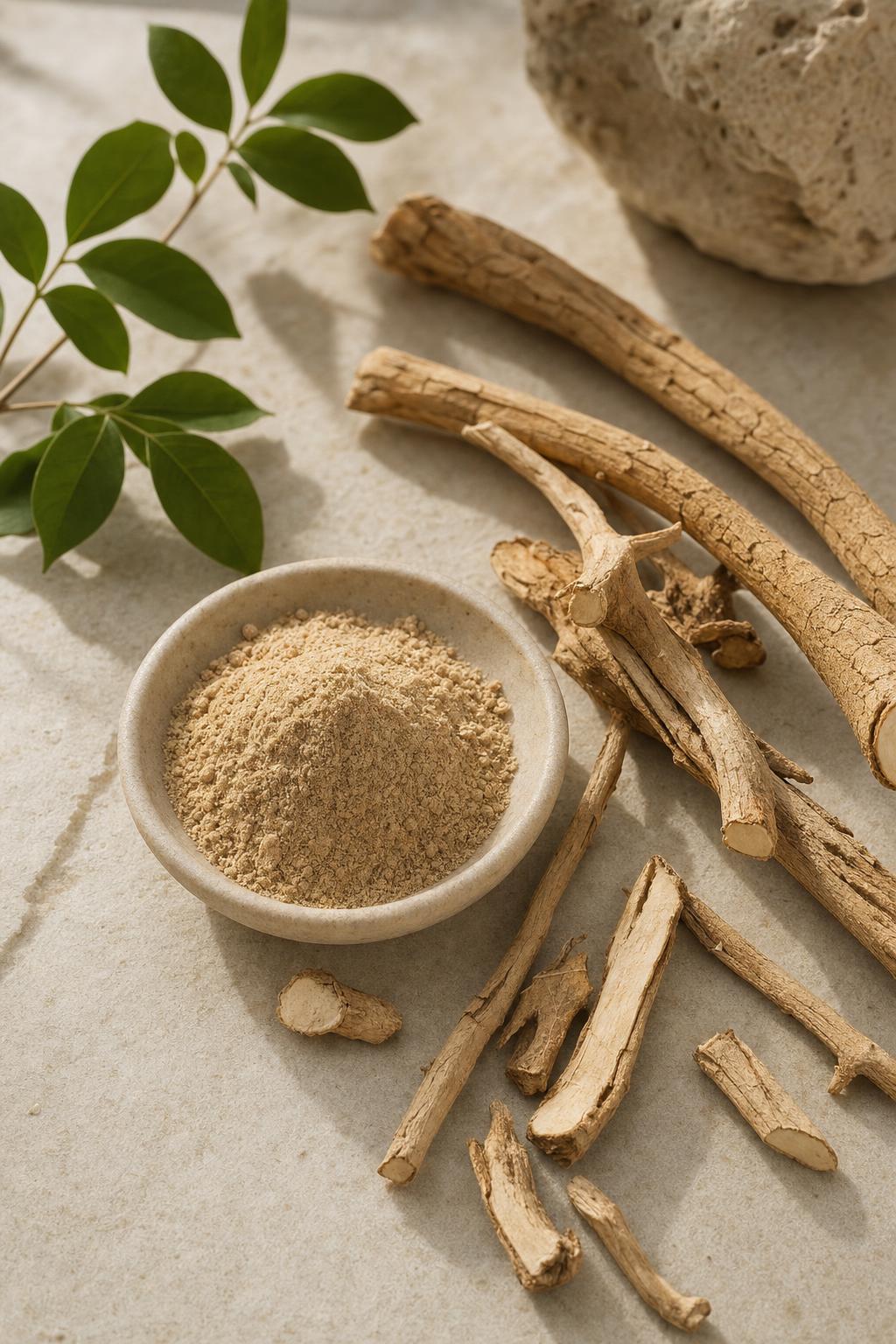
What the Human Studies Actually Show
This table scrolls horizontally on small screens. Use Tab to focus the table region, then scroll with arrow keys or touch.
| Study | What it found | Important limit |
|---|---|---|
| Tambi 2012 — tongkat ali, 76 men with late-onset hypogonadism | 200 mg/day of a standardized water extract for 1 month was associated with improved Ageing Males' Symptoms scores and higher serum testosterone | The PubMed abstract does not describe a placebo group and does not support the old claims on this page of "~30% free testosterone," a direct libido endpoint, or 9 months of treatment |
| Talbott 2013 — tongkat ali, 63 moderately stressed adults | 200 mg/day for 4 weeks improved several mood-state measures and shifted salivary cortisol/testosterone versus placebo | Small, short study in moderately stressed adults; hormone findings should not be treated as evidence for treating hypogonadism |
| Chinnappan 2021 — tongkat ali, 105 men aged 50–70 with testosterone below 300 ng/dL | In a 12-week randomized placebo-controlled trial, total testosterone increased versus placebo in the standardized-extract groups, with the clearest repeated signal at 200 mg/day | Specific branded standardized extract and selected older male population |
| Leisegang 2022 — tongkat ali systematic review/meta-analysis | Nine studies were reviewed and five RCTs entered the meta-analysis; pooled results favored higher total testosterone, particularly in hypogonadal men | Authors called for more research before routine clinical use; studies varied in population and design |
| Chandrasekhar 2012 — ashwagandha, 64 stressed adults | 300 mg twice daily of a specific root extract for 60 days reduced perceived-stress measures and serum cortisol versus placebo | Small single-center trial; it was a stress study, not a testosterone-treatment trial |
| Lopresti 2019 — ashwagandha, overweight men aged 40–70 with mild fatigue | A standardized extract produced a 14.7% greater increase in testosterone than placebo after an 8-week period | No significant between-group advantage for cortisol, fatigue, vigor, or sexual well-being; the authors called for larger studies |
| Fornalik 2026 — ashwagandha meta-analysis | Across 23 randomized placebo-controlled trials, ashwagandha reduced cortisol overall and increased testosterone in men | Heterogeneity and limited data for some hormone endpoints mean the pooled result does not prove the same effect for every extract, dose, or person |
The practical pattern: tongkat ali has unusually direct data in men with low testosterone, while ashwagandha has a broader stress/cortisol evidence base and also has a testosterone signal in men. The evidence does not justify saying that one is categorically better for testosterone across all people.
Which One Fits Which Goal?
If your concern is low testosterone
Symptoms such as low libido, fatigue, mood changes, or poor recovery are not specific to low testosterone. If low testosterone is the concern, the highest-value step is appropriate clinical testing and evaluation rather than choosing an herb from symptoms alone.
Among the two supplements, tongkat ali has more direct studies in men selected for low testosterone, including the 2012 clinical study and the 2021 randomized trial. That makes it relevant to the question, but it does not make it a proven replacement for standard evaluation or treatment.
Ashwagandha should not be dismissed as "only a cortisol herb." A 2019 randomized crossover trial found a testosterone increase in a specific group of aging, overweight men, and a 2026 meta-analysis found a pooled testosterone increase in men. Those results still do not establish a universal testosterone effect.
If your concern is stress or sleep
Ashwagandha has the clearer evidence base for stress. NCCIH notes that some preparations may help stress and insomnia, while also emphasizing that studies are often small and use different preparations. The evidence is preparation-specific rather than proof that any product labeled "ashwagandha" will perform the same way.
Tongkat ali has a small stress study, but its stress evidence is much thinner than the ashwagandha literature.
If you are thinking about taking both
There is no controlled human trial establishing that a tongkat-ali + ashwagandha combination works better than either alone, and there is no evidence-based rule requiring tongkat ali in the morning, ashwagandha at night, or a particular cycling schedule. Those protocols are common internet recommendations, not conclusions from the cited trials.
Combining supplements also combines uncertainty around product quality, adverse effects, and interactions. If you take prescription medication, have an endocrine or liver condition, are being evaluated for low testosterone, or are considering multiple hormone-active supplements, review the combination with a qualified clinician or pharmacist.
What About the Mechanisms?
Tongkat ali contains eurycomanone and other quassinoids, and several mechanisms have been proposed from laboratory and preclinical work. Human studies, however, do not establish a single confirmed pathway that explains the testosterone findings.
That distinction matters. A clinical trial showing a change in serum testosterone does not automatically prove that the supplement worked by stimulating luteinizing hormone, lowering SHBG, or "freeing" testosterone unless those mechanisms were directly measured and supported. The earlier version of this article presented those proposed pathways too confidently, so they have been removed from the decision logic here.
Safety and Side Effects
Tongkat ali
Short human trials of specific standardized extracts report tolerability data, but that does not establish long-term safety for all tongkat ali products. Extract chemistry and manufacturing quality vary. A 2021 EFSA assessment of one tongkat ali root water extract raised a genotoxicity concern and concluded that safety of that specific novel-food preparation had not been established. That finding should not be generalized to every extract, but it is a reason not to treat "natural" as synonymous with proven safe.
Ashwagandha
NCCIH says ashwagandha may be safe in the short term, up to about 3 months, but long-term safety is not established. Reported concerns include drowsiness and gastrointestinal effects, rare liver injury reports, pregnancy/breastfeeding avoidance, and cautions around thyroid or autoimmune disorders, surgery, and several medication classes.
For either supplement, product identity matters. Trial results from a standardized extract cannot automatically be transferred to an unverified product with different chemistry or contamination risk.
FAQ
Can I take tongkat ali and ashwagandha together?
There is no controlled human trial establishing the effectiveness or safety of the combination as a "stack." Taking both is not automatically unsafe, but a specific AM/PM or cycling protocol is not evidence-based from the studies cited here.
Which is better for testosterone?
There is no head-to-head trial. Tongkat ali has direct studies in men with low testosterone and a meta-analysis showing a total-testosterone signal. Ashwagandha also has randomized evidence and a 2026 meta-analysis showing a testosterone increase in men. The populations, extracts, and study designs differ too much to declare a universal winner.
Will ashwagandha increase my testosterone?
It may increase testosterone in some men, but the effect is not guaranteed and does not make ashwagandha a treatment for hypogonadism. The 2026 meta-analysis found a pooled increase in men while also reporting heterogeneity and limits in the underlying evidence.
Should tongkat ali be cycled?
The cited human trials do not establish an evidence-based cycling schedule. Schedules such as "5 days on, 2 days off" should be treated as internet protocols rather than clinical findings.
Related Articles
Source ledger
References
8 sources
- 01Standardised water-soluble extract of Eurycoma longifolia, Tongkat ali, as testosterone booster for managing men with late-onset hypogonadism? Tambi MIBM, Imran MK, Henkel RR · 2012PMID 21671978 PubMed →
- 02Effect of Tongkat Ali on stress hormones and psychological mood state in moderately stressed subjects Talbott SM, Talbott JA, George A, Pugh M · 2013PMID 23705671 PubMed →
- 03Effect of Eurycoma longifolia standardised aqueous root extract on testosterone levels and quality of life in ageing male subjects: a randomised, double-blind, placebo-controlled multicentre study Chinnappan SM, George A, Thaggikuppe P, et al. · 2021PMID 34262417 PubMed →
- 04Eurycoma longifolia (Jack) Improves Serum Total Testosterone in Men: A Systematic Review and Meta-Analysis of Clinical Trials Leisegang K, Finelli R, Sikka SC, Panner Selvam MK · 2022PMID 36013514 PubMed →
- 05A prospective, randomized double-blind, placebo-controlled study of safety and efficacy of a high-concentration full-spectrum extract of ashwagandha root in reducing stress and anxiety in adults Chandrasekhar K, Kapoor J, Anishetty S · 2012PMID 23439798 PubMed →
- 06A Randomized, Double-Blind, Placebo-Controlled, Crossover Study Examining the Hormonal and Vitality Effects of Ashwagandha in Aging, Overweight Males Lopresti AL, Drummond PD, Smith SJ · 2019PMID 30854916 PubMed →
- 07Hormonal Modulation with Withania somnifera: Systematic Review and Meta-Analysis of Randomized-controlled Trials Fornalik M, Malkiewicz A, Adamczak D, et al. · 2026PMID 41740946 PubMed →
- 08Safety of Eurycoma longifolia (Tongkat Ali) root extract as a novel food pursuant to Regulation (EU) 2015/2283 EFSA Panel on Nutrition, Novel Foods and Food Allergens · 2021PMID 34987621 PubMed →