Evidence Review · 8 References
Greens Powders: What the Evidence Actually Shows
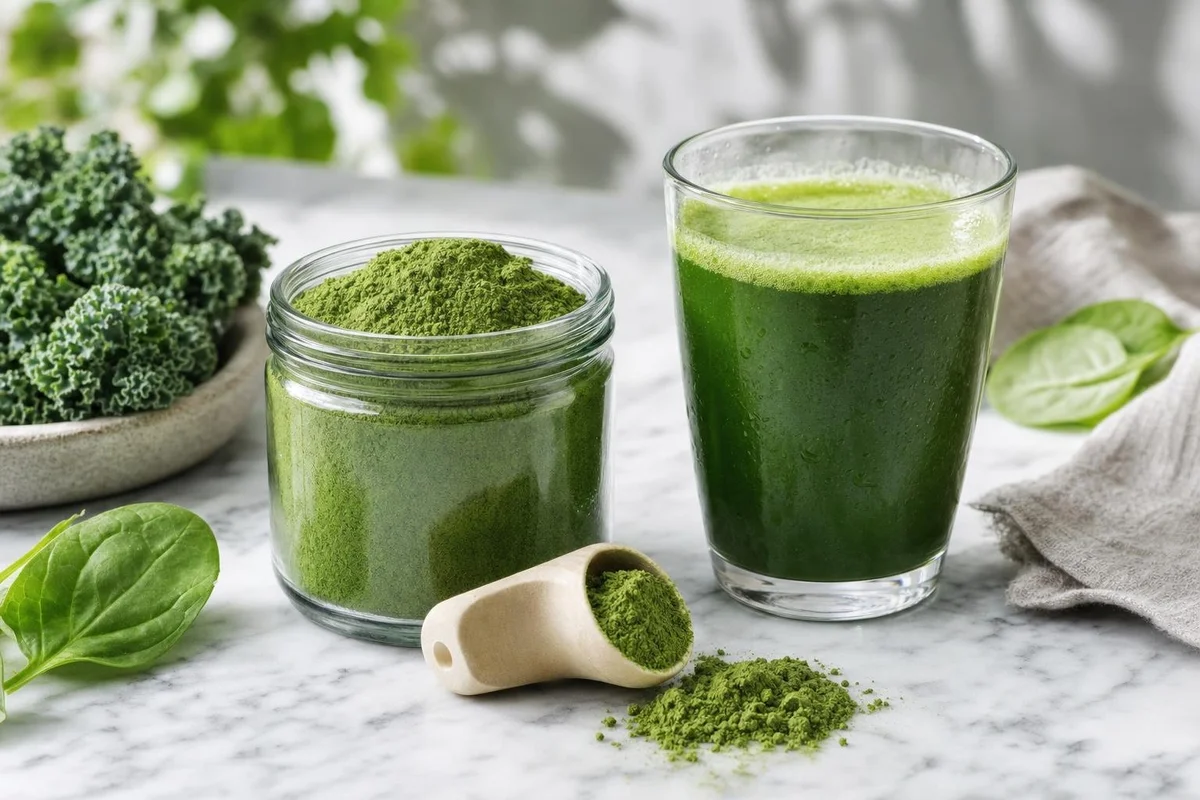
Greens powders combine vitamins, minerals, plant concentrates, and sometimes probiotics or other bioactives into one product. Human studies show that some formulations can improve short-term micronutrient intake or alter selected biomarkers, but evidence for broader claims such as sustained energy, major gut-health improvements, detoxification, or replacing vegetables is much less established. The useful question is not whether the category “works,” but which outcome a specific product has actually been shown to affect.
Quick answer
Permanent linkGreens powders can be useful as concentrated nutrient-delivery products, especially when a formulation contains vitamins or minerals that fill an actual dietary gap [1]. Trials of fruit-and-vegetable concentrates also report changes in selected oxidative-stress and inflammatory markers in specific populations [2]. But product effects are formulation-specific, the evidence base is heterogeneous, and these products should not be treated as substitutes for whole vegetables, whose fiber and food matrix carry a much broader evidence base [6].
At a Glance · Evidence by Function
| Function | What human evidence shows | Confidence | Practical interpretation |
|---|---|---|---|
| Micronutrient adequacy | Some multi-ingredient products improve nutrient intake or short-term circulating nutrient measures [1]. | Moderate for the measured nutrients | Useful when it fills a real gap; not proof of broader outcomes. |
| Energy / vitality | A Greens+ RCT found the primary vitality result marginal and a secondary energy result significant; authors called the findings positive but inconclusive [4]. | Weak / mixed | Do not generalize one formulation to the entire category. |
| Gut microbiome | Small AG1 trials report selected taxonomic changes without large global diversity shifts or clear digestive-quality-of-life benefits [5]. | Preliminary | Interesting mechanistically; clinical significance remains uncertain. |
| Replace vegetables | Powders do not reproduce the intact fiber-rich food matrix evaluated in whole-diet research [6]. | Strong reason not to equate them | Use as an addition, not a vegetable substitute. |
| “Detox” | No category-level controlled evidence establishes a clinically meaningful detoxification effect. | Unsupported as a broad claim | Treat nonspecific detox language as marketing unless a defined toxin and outcome are studied. |
Evidence by claim
Micronutrient delivery — Moderate evidence
A 2026 randomized crossover study of AG1 in 20 resistance-trained adults found that two weeks of supplementation increased the number of micronutrient Estimated Average Requirements met compared with placebo, with vitamins A, C, and E among common gaps filled [1]. A separate 2026 acute crossover study also found measurable absorption of most tested micronutrients after a single serving. These studies support nutrient delivery; they do not establish long-term reductions in disease risk or superiority to food-based dietary improvement.
Selected inflammatory / oxidative markers — Some evidence
In a randomized double-blind trial of 42 obese premenopausal women, eight weeks of a fruit/berry/vegetable juice-powder concentrate was associated with changes in selected oxidation, inflammation, and microcirculation measures [2]. That is evidence for that formulation and population, not a license to generalize to every greens powder.
Energy & vitality — Weak / mixed evidence
B vitamins are central to cellular energy metabolism, but that does not mean extra B vitamins reliably increase subjective energy in people who are already replete [3]. In the 12-week Greens+ trial, 105 women were randomized but only 63 completed treatment; the primary vitality outcome narrowly missed conventional statistical significance (p = 0.055), while a secondary energy outcome favored Greens+ (p = 0.018). The authors described the overall result as positive but inconclusive [4].
Gut health — Preliminary evidence
A 2024 randomized placebo-controlled AG1 study in 30 healthy adults found selected microbiome changes but no large global alpha- or beta-diversity shift and no clear digestive-quality-of-life advantage [5]. A 2026 crossover study similarly reported selective enrichment of several taxa while overall community structure remained relatively stable [1]. These findings are interesting, but they do not establish treatment of a gastrointestinal condition.
Why label transparency matters
Greens powders are multi-ingredient formulations, so evidence from one branded product does not automatically transfer to another. A long ingredient list can make a formula look comprehensive while still leaving the amount, standardization, or clinical relevance of individual ingredients uncertain. For consumers, the durable questions are simple: Are ingredient amounts disclosed? Has the actual finished product been tested? Does the claimed outcome match a human study of that formulation? Botanical and microalgae preparations also show meaningful variability in elemental composition and contaminant exposure, reinforcing the value of product-specific quality control [7].
Bottom line
Greens powders are best understood as optional concentrated supplements, not compressed vegetables. Their strongest defensible use is filling specific nutrient gaps when the formulation actually supplies those nutrients [1]. Evidence for energy, microbiome changes, inflammation, and other outcomes is formulation-specific and generally much thinner than category marketing implies [2,4,5]. If you already eat a varied diet rich in whole plant foods, the incremental benefit may be small. If you use a powder, choose on transparent composition, quality control, and a clearly defined goal rather than ingredient count or broad wellness claims.
References
- [1] Gonzalez AM, et al. (2026). Effect of AG1 supplementation on nutritional adequacy and gut microbial composition in trained adults. Front Nutr. Company-affiliated randomized crossover study. PubMed →
- [2] Lamprecht M, et al. (2013). Supplementation with a juice powder concentrate and exercise decrease oxidation and inflammation, and improve the microcirculation in obese women: randomized controlled trial data. Br J Nutr, 110(9):1685-1695. PubMed →
- [3] Kennedy DO. (2016). B vitamins and the brain: mechanisms, dose and efficacy — a review. Nutrients, 8(2):68. PubMed →
- [4] Boon H, Clitheroe J, Forte T. (2004). Effects of greens+: a randomized, controlled trial. Can J Diet Pract Res, 65(2):66-71. PubMed →
- [5] La Monica MB, et al. (2024). The effects of AG1 supplementation on the gut microbiome of healthy adults: a randomized, double-blind, placebo-controlled clinical trial. J Int Soc Sports Nutr, 21(1):2409682. PubMed →
- [6] Reynolds A, et al. (2019). Carbohydrate quality and human health: a series of systematic reviews and meta-analyses. Lancet, 393(10170):434-445. PubMed →
- [7] Husáková L, et al. (2024). Multi-elemental composition of botanical preparations and probabilistic evaluation of toxic metals and metalloids intake upon dietary exposure. Food Chem Toxicol. PubMed →
- [8] Booth SL. (2010). Dietary vitamin K guidance: an effective strategy for stable control of oral anticoagulation? Nutr Rev, 68(3):178-181. PubMed →
Frequently asked questions
Do greens powders work?
They can deliver absorbable micronutrients and may improve short-term nutrient adequacy, but that is narrower than proving broad health benefits. Small AG1 trials found improved micronutrient adequacy or absorption, while fruit-and-vegetable concentrate trials have reported changes in selected inflammatory or oxidative-stress markers [1,2]. These findings do not show that greens powders reproduce the health effects of eating whole vegetables.
Is AG1 worth it?
That is a value judgment rather than a clinical conclusion. AG1 now has peer-reviewed human studies showing short-term nutrient absorption, nutrient-gap filling, tolerability, and selected microbiome changes [1,5]. The studies are small and include AG1-affiliated investigators, so they should not be interpreted as proof of broad outcomes such as better immunity, energy, longevity, or disease prevention.
Can greens powders replace vegetables?
No. Whole vegetables provide intact food structure, substantial dietary fiber, water, and a broad food matrix that concentrated powders do not reliably reproduce. Higher dietary-fiber intake is associated with important health benefits across prospective studies and clinical trials [6]. A powder can supplement a diet, but it should not be treated as a one-for-one vegetable replacement.
What should I look for in a greens powder?
Prefer transparent ingredient amounts, realistic claims, and independent quality testing where available. Botanical and microalgae supplements can vary substantially in composition and contaminant burden, so product-specific quality control matters [7]. Avoid assuming that an ingredient list alone proves clinical efficacy at the amount present.
Are greens powders safe?
They are generally tolerated in short-term studies of healthy adults, but safety is product-specific. Multi-ingredient formulas can vary, botanical or algae ingredients can introduce contamination concerns [7], and products containing meaningful vitamin K can complicate warfarin management when intake changes substantially [8]. People taking medications should evaluate the actual label rather than treating all greens powders as interchangeable.
Free safety checklist
Get evidence reviews like this
Evidence-first supplement reviews with source verification.
We use your email to send the checklist and occasional evidence-first supplement updates. Unsubscribe anytime. Privacy policy.