Safety-Led Discovery
Psychedelic-Adjacent Herbs
This guide provides a conservative, evidence-based review of traditional and ritual botanicals. These herbs are not substitutes for clinical care or regulated psychedelics, and they require strict attention to dosing, pharmacological interactions, and safety thresholds.
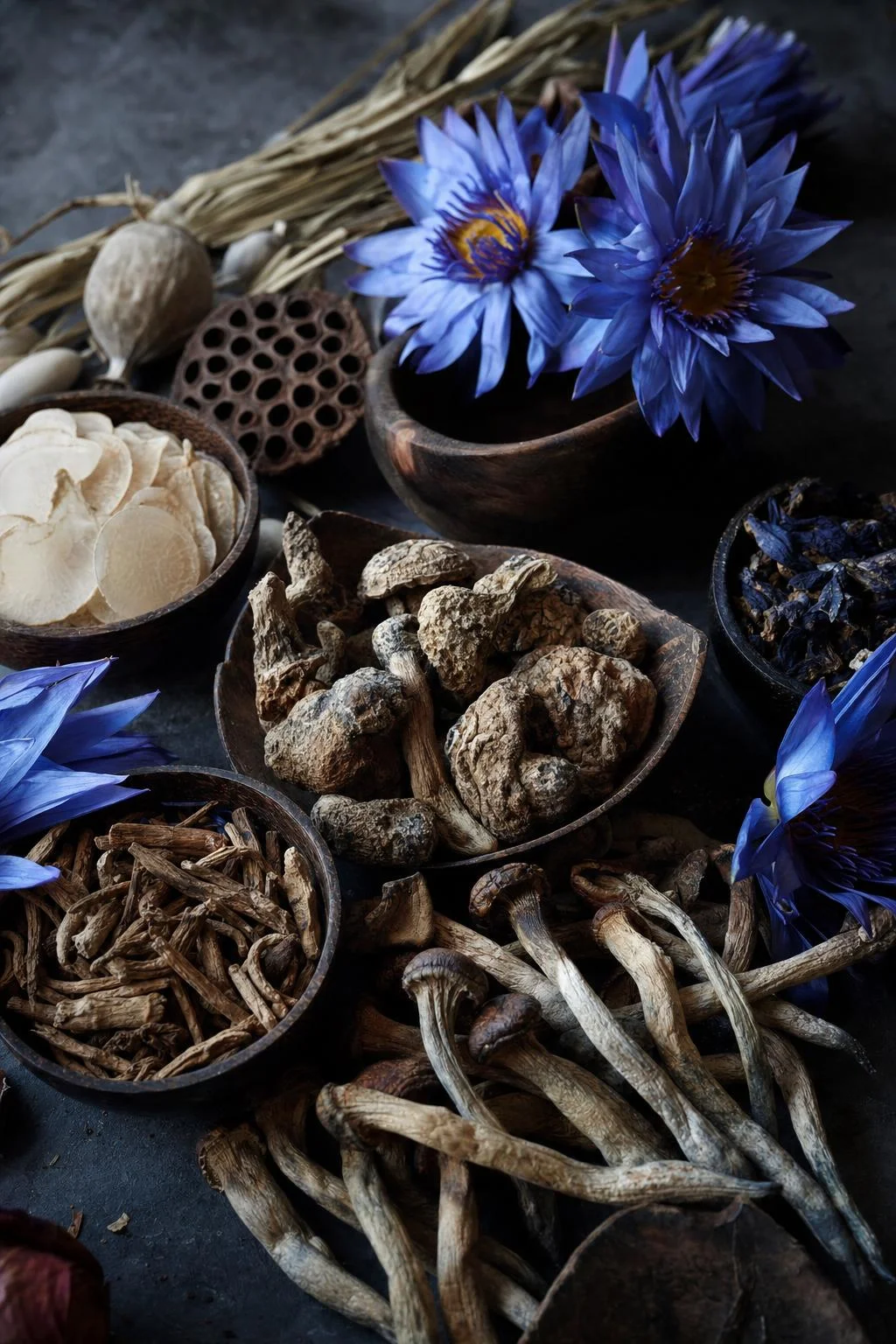
Monitored Botanical Profiles
Review traditional uses, chemical constituents, and safety limits for these herbs.
Blue Lotus (Nymphaea caerulea)
Traditional Use: Ritual and historical use is reported, but it does not establish the identity, dose, or effect of a modern extract.
- Active Constituents: Commercial descriptions often name apomorphine and nuciferine. An analytical survey found both virtually absent from authentic extracts, so those claims should not be assumed from a label [2].
- Mechanisms: No reliable human mechanism can be inferred for an unverified marketplace product. Chemical findings do not establish a predictable psychoactive effect.
- Safety Context: Higher caution. A five-patient case series reported sedation and perceptual disturbances after ingestion or inhalation. Avoid vaping, concentrated extracts, alcohol, and other sedatives [1].
Kanna (Sceletium tortuosum)
Traditional Use: Traditional mood-related use is documented, but clinical evidence remains limited and formulation-specific [3].
- Active Constituents: Mesembrine and mesembrenone alkaloids.
- Mechanisms: Laboratory studies report serotonin-transporter and PDE4 activity; these findings do not prove a clinical benefit or quantify interaction risk [5].
- Safety Context: Interaction caution. A small trial found one standardized extract tolerable in healthy adults, but that does not establish safety for other extracts or combinations. Avoid combining with serotonergic medicines unless a clinician has reviewed it [4].
Core Harm Reduction Checkpoints
1. Avoid Multi-Stacking
Combining poorly characterized extracts with each other, alcohol, or central depressants can make sedation and other effects less predictable.
2. Screen for SSRI/MAOI Conflict
Kanna has serotonergic laboratory activity, but direct interaction evidence is sparse. Treat combinations with SSRIs, MAOIs, and other serotonergic agents as an interaction concern that needs clinician review [5].
3. Respect Potency Variations
Natural extracts can differ substantially in identity and alkaloid content. Avoid products without species, plant-part, dose, and independent testing information.
Legal & Health Disclaimer
These pages are for educational and harm reduction purposes only. The Hippie Scientist does not advocate for the use of unregulated or illegal substances. Always review clinical contraindications and consult with a licensed physician before introducing any botanical supplements into your lifestyle.
Source ledger
References
5 sources
- 01Schimpf M, et al. (2023). Toxicity From Blue Lotus (Nymphaea caerulea) After Ingestion or Inhalation: A Case Series. Military Medicine, 188(7-8): e2689-e2692. PubMed →
- 02Dosoky NS, et al. (2023). Chemical Composition, Market Survey, and Safety Assessment of Blue Lotus (Nymphaea caerulea Savigny) Extracts. Molecules, 28(20): 7014. PubMed →
- 03Gericke N, et al. (2021). Sceletium tortuosum: A review on its phytochemistry, pharmacokinetics, biological and clinical activities. Journal of Ethnopharmacology, 276: 114476. PubMed →
- 04Nell H, et al. (2013). A randomized, double-blind, placebo-controlled trial of Sceletium tortuosum extract in healthy adults. Journal of Alternative and Complementary Medicine, 19(11): 898-904. PubMed →
- 05Harvey AL, et al. (2011). Pharmacological actions of Sceletium tortuosum and its principal alkaloids. Journal of Ethnopharmacology, 137(3): 1124-1129. PubMed →