Safety Review · 11 References · Reviewed September 19, 2026
Supplement Combination Safety: Screen the Risks Before the Stack
A supplement combination is not automatically safer because every ingredient is sold over the counter or described as natural. FDA notes that problems can occur when supplements are combined with each other or with medicines, and many potential combinations have never been tested directly. The useful question is not “Is this stack safe?” in the abstract; it is “What interaction signals, evidence gaps, and person-specific risks apply to these exact ingredients?”
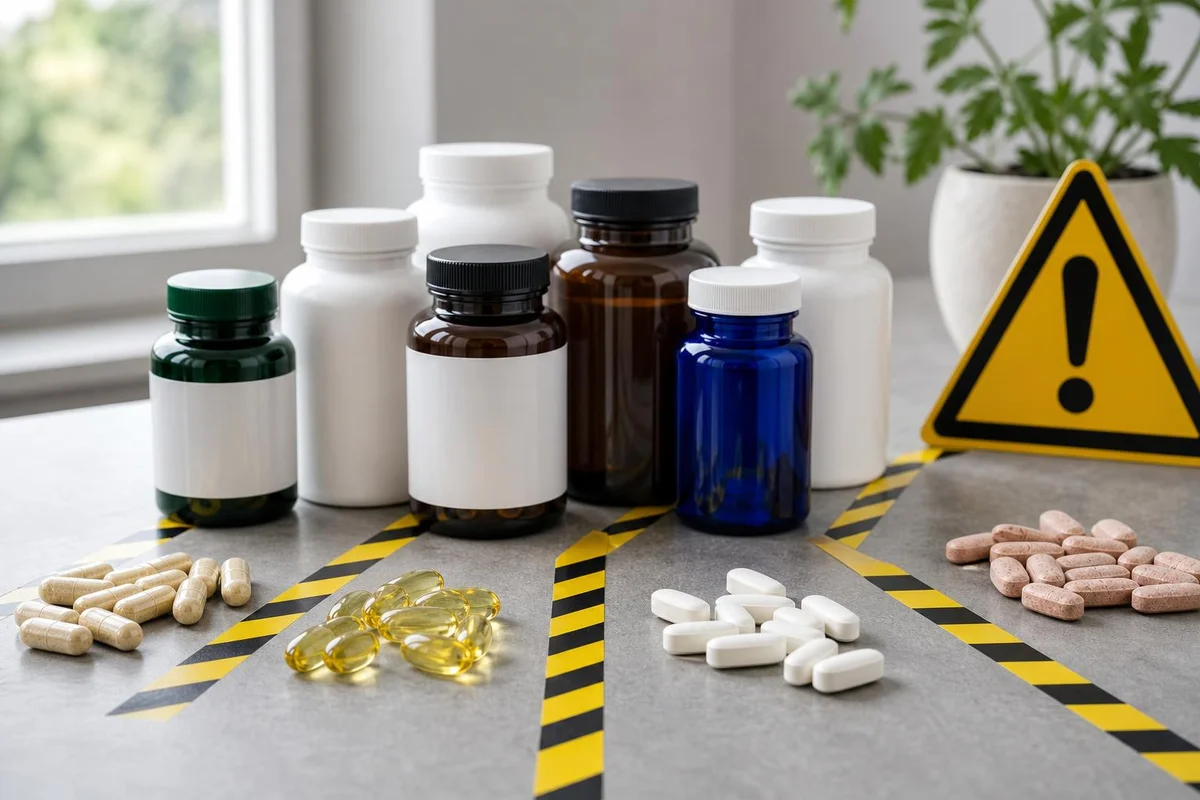
Core safety boundary
No combination gets a blanket “safe” label here. A missing interaction report can mean “not studied,” not “no interaction.” Medication use, pregnancy or breastfeeding, surgery, liver or kidney disease, cardiovascular conditions, and product quality can materially change the risk picture. FDA advises discussing supplements with a health professional, particularly when medicines are involved [1,2].
Five interaction screens that matter
1. Serotonergic overlap
St. John's wort has documented drug-interaction risk and can contribute to serious serotonin-related effects with some antidepressants [3,4,8]. A modern serotonin-toxicity review confirms that drug interactions can precipitate toxicity and that diagnosis is primarily clinical, but it does not establish a quantified risk for every unstudied supplement pair [10]. Other serotonergic supplements or medicines may create additive concerns, but mechanism alone does not prove the magnitude of a specific pairwise interaction.
Higher-priority review: antidepressants, MAO inhibitors, tramadol and other serotonergic medicines, plus supplements marketed for serotonin support.
Compare serotonergic-risk botanicals →2. Sedative overlap
Multiple sedating ingredients can increase impairment or drowsiness. NCCIH specifically advises against combining kava with substances that have sedative effects, including benzodiazepines or alcohol [5]. Similar caution is appropriate when several products independently cause sedation, even when direct trials of the exact combination are absent.
3. Cardiovascular or stimulant overlap
Ingredients that can raise heart rate or blood pressure deserve extra scrutiny when combined with other stimulants, decongestants, or prescription medicines that affect the cardiovascular system. The actual risk depends on the ingredients, dose, baseline health, and co-medications; a broad “stimulant stack” rule cannot substitute for those specifics.
4. Bleeding, glucose, or blood-pressure overlap
FDA gives examples in which supplements and medicines can combine to increase bleeding risk or alter drug effects [2]. A 2024 evidence review of food/herbal interactions with oral anticoagulants found that randomized evidence is sparse and the available literature is limited by small samples, conflicting results, and heterogeneous herbal products [9]. That supports ingredient-specific screening rather than a blanket claim that every “blood-thinning” herb predictably increases bleeding. Similar additive concerns can arise when several products affect blood glucose or blood pressure, especially when prescription anticoagulants, diabetes medicines, or antihypertensives are present.
5. Pharmacokinetic interactions
Some supplements change drug metabolism or transport rather than simply adding the same effect. St. John's wort remains a well-documented clinical example: it can lower exposure to multiple medicines by inducing drug-metabolizing enzymes and transporters [2-4,8]. A 2026 CYP450 review catalogs many additional herbal phytochemicals with enzyme effects, while also emphasizing that clinical interaction data remain scarce for many herbs [11]. That makes CYP activity a screening signal—not permission to convert an in-vitro inhibition finding into a proven human interaction.
What not to infer from missing evidence
No interaction listed ≠ interaction ruled out. Many supplement-supplement combinations lack direct clinical testing.
Same mechanism ≠ proven dangerous interaction. Mechanistic overlap is a screening signal, not proof of a clinically important interaction. In-vitro CYP inhibition or induction should not be presented as a proven human interaction without supporting clinical evidence [11]. It should prompt a closer evidence review rather than a fabricated certainty.
“Common stack” ≠ validated stack. Popularity, anecdotal use, or simultaneous sale in a product bundle does not establish combination efficacy or safety.
A fixed waiting period ≠ clearance. There is no universal one-week, two-week, or four-week rule that proves one supplement has been assessed or cleared before another is added. Pharmacokinetics and delayed effects differ substantially.
Individual ingredient evidence ≠ combination evidence. Two separately studied ingredients do not automatically produce a studied or beneficial combination.
A better combination-check workflow
1. Inventory everything. Include prescription medicines, over-the-counter medicines, supplements, energy products, and relevant substances—not only the products you think are “medications.”
2. Check each ingredient, not just the product name. Multi-ingredient blends can hide duplicate stimulants, sedatives, minerals, or botanicals.
3. Review high-consequence contexts first. Pregnancy or breastfeeding, upcoming surgery, anticoagulants, transplant medicines, seizure medicines, antidepressants, cardiovascular drugs, and diabetes medicines deserve especially careful review.
4. Separate known evidence from mechanistic caution. A documented clinical interaction should be labeled differently from a plausible additive mechanism.
5. Use a pharmacist or qualified health professional when medicines are involved. FDA and NCCIH both emphasize medication-supplement interaction review [1-4].
Bottom line
Supplement-combination safety is an evidence and interaction-screening problem, not a recipe problem. Prioritize documented medication interactions and high-consequence physiologic overlap, mark mechanism-only concerns as uncertain, and do not convert popularity or a generic waiting period into a safety claim. Recent interaction reviews reinforce both sides of that boundary: clinically important herb-drug interactions exist, but evidence quality and directness vary substantially by ingredient and medication [8,9,11]. When medication use or important health conditions are part of the picture, use a complete ingredient list for professional interaction review [1-5].
Compare serotonergic-risk botanicals →Source ledger
References
11 sources
- 01FDA. FDA 101: Dietary Supplements. Current consumer safety guidance. Source →
- 02FDA. Mixing Medications and Dietary Supplements Can Endanger Your Health. Source →
- 03NCCIH. Herb-Drug Interactions: What the Science Says. Source →
- 04NCCIH. St. John’s Wort: Usefulness and Safety. Source →
- 05NCCIH. Kava: Usefulness and Safety. Source →
- 06Izzo AA, Ernst E. Interactions between herbal medicines and prescribed drugs. Drugs. 2009;69(13):1777-1798. PubMed →
- 07Boyer EW, Shannon M. The serotonin syndrome. N Engl J Med. 2005;352(11):1112-1120. Historical clinical review retained for context. PubMed →
- 08Gurley BJ. Clinically Relevant Herb-Drug Interactions: A 30-Year Historical Assessment. J Diet Suppl. 2025;22(1):78-104. PubMed →
- 09Pharmacokinetic and Pharmacodynamic Interactions between Food or Herbal Products and Oral Anticoagulants: Evidence Review, Practical Recommendations, and Knowledge Gaps. 2024. PubMed →
- 10Management of serotonin syndrome (toxicity). Br J Clin Pharmacol. 2024. Modern review of recognition, severity assessment, and management. PubMed →
- 11Li Y, et al. A Critical Review of Cytochrome P450 Enzyme Inhibition by Herbal Phytochemicals: Implications for Drug Interaction Prediction and Herbal Safety. 2026. PubMed →
Free safety checklist
Get evidence reviews like this
Safety guides, interaction context, and evidence boundaries without stack hype.
We use your email to send the checklist and occasional evidence-first supplement updates. Unsubscribe anytime. Privacy policy.