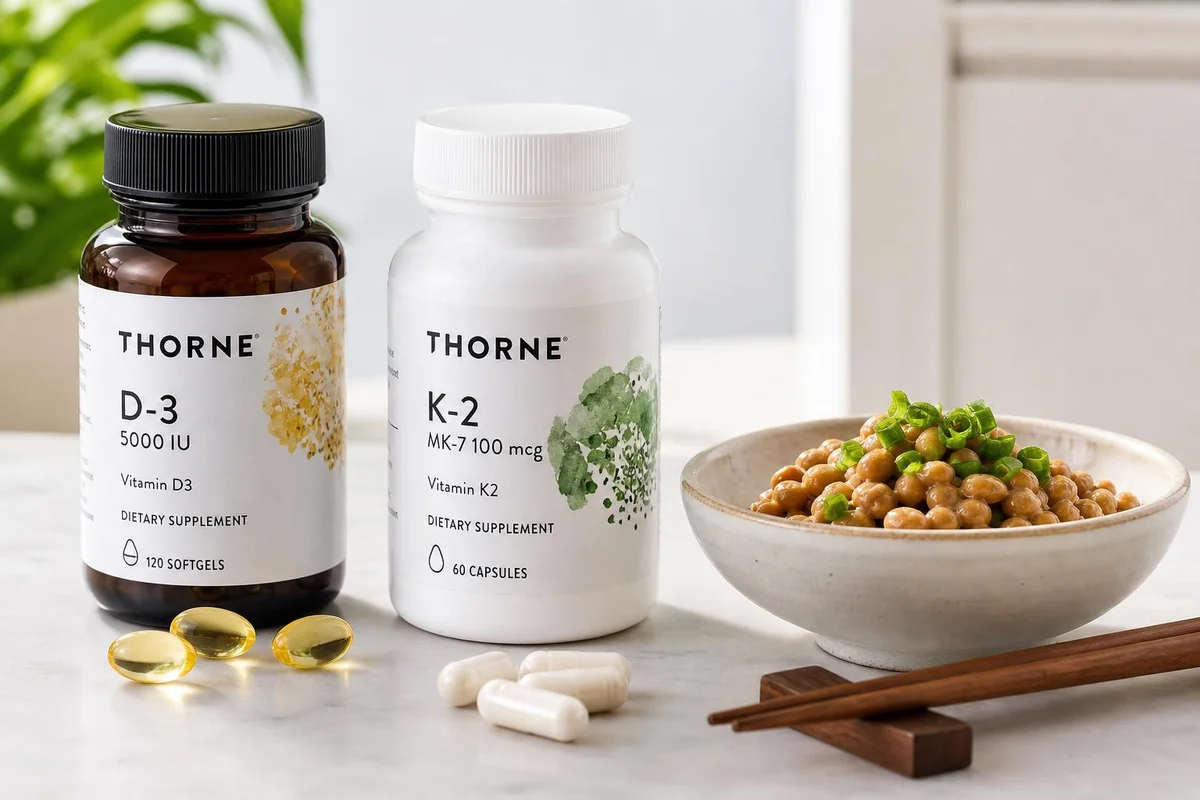
Vitamin D + K2: What the Evidence Actually Supports
Vitamin D and vitamin K participate in related bone and calcium biology, which is why D3 + K2 products are easy to market as an inseparable pair. The evidence is more nuanced. Vitamin D has established nutritional and deficiency-treatment roles, but current guidance does not support a universal high-dose protocol or a single “optimal” blood level for healthy adults. K2 has plausible bone and vascular mechanisms, but the claim that everyone taking vitamin D needs K2 to keep calcium out of the arteries goes beyond current clinical evidence.
Vitamin D and K2 are biologically related, but a combined supplement is not automatically necessary for everyone.
For generally healthy adults under 75, the 2024 Endocrine Society guideline suggests against routine vitamin D supplementation above the dietary reference intake solely for disease prevention [2]. NIH lists 600 IU daily for adults through age 70 and 800 IU after age 70 as the vitamin D RDA, while 4,000 IU is an upper intake limit for adults, not a routine target [1]. K2 is a separate question: vitamin K-dependent proteins are relevant to bone and vascular biology, but current evidence does not establish that everyone taking vitamin D needs K2 or that K2 reliably prevents arterial calcification [3].
Choose the question before choosing the supplement
Vitamin D and K2 decisions by clinical context
Context
Vitamin D decision
Vitamin K / K2 decision
Generally healthy adult under 75
Start with the dietary reference intake, food, and fortified-food context rather than assuming more is better.
Routine K2 supplementation is not established as necessary just because vitamin D is used.
Known deficiency or a condition affecting absorption
This is individualized treatment territory; dose and follow-up can differ substantially from population guidance.
Malabsorption can also affect vitamin K status, so the broader clinical context matters.
Considering K2 for cardiovascular protection
Vitamin D itself has not consistently reduced cardiovascular events in randomized trials.
Mechanistic and observational signals exist, but clinical evidence is not strong enough to promise arterial protection.
Taking warfarin or a similar anticoagulant
Review the full medication and supplement list before changing doses.
Do not casually add, remove, or sharply change vitamin K intake; consistency is important for anticoagulation control.
Vitamin D has a clear nutritional role
What it shows
Vitamin D supports calcium absorption and bone/mineral physiology. Severe deficiency can cause rickets or osteomalacia, and some people have established indications for testing or treatment.
What it does not show
That every healthy adult benefits from routine doses above the dietary reference intake, or that one serum target optimizes every health outcome.
K2 biology is interesting, but biology is not an outcome trial
What it shows
Vitamin K is required for carboxylation of proteins involved in blood clotting and bone metabolism; vitamin K-dependent matrix Gla protein is relevant to vascular-calcification research.
What it does not show
That taking K2 with vitamin D reliably prevents calcium from entering arteries or lowers cardiovascular-event risk.
A supplement upper limit is not a goal
What it shows
NIH lists 4,000 IU (100 mcg) per day as the adult tolerable upper intake level for vitamin D.
What it does not show
That 4,000 IU is the ideal daily dose. 4,000 IU is an upper intake limit for adults, not a routine target.
Dose and blood-level context
RDA context: NIH lists 600 IU (15 mcg) vitamin D daily for adults through age 70 and 800 IU (20 mcg) after age 70 [1]. These are population reference intakes, not treatment doses for a diagnosed deficiency.
Upper-limit context: the adult tolerable upper intake level is 4,000 IU (100 mcg) per day [1]. An upper limit is a safety boundary, not a dose recommendation.
Blood-level context: NIH notes that 20 ng/mL (50 nmol/L) or more is generally adequate for most healthy people, but optimal concentrations for every health outcome have not been established [1].
Testing context: the Endocrine Society suggests against routine 25(OH)D testing in generally healthy people without an established indication [2].
Vitamin K context: adult adequate intakes are based mainly on total vitamin K intake, not a proven universal MK-7 supplement target. The evidence does not establish that every vitamin D user should add K2 [3].
Safety boundary
Medication and medical context can change the answer
Warfarin and similar anticoagulants can interact seriously with vitamin K; sudden changes in vitamin K intake can change anticoagulant effect [3]. High vitamin D intake can cause hypercalcemia and other toxicity, and vitamin D can interact with some medications [1]. Known deficiency, malabsorption, kidney disease, pregnancy, osteoporosis treatment, abnormal calcium, or clinician-directed vitamin D therapy should be handled as individualized medical decisions rather than by copying a general internet dose.
Demay MB, et al. (2024). Vitamin D for the Prevention of Disease: An Endocrine Society Clinical Practice Guideline. J Clin Endocrinol Metab. doi:10.1210/clinem/dgae290. DOI →
NIH Office of Dietary Supplements. Vitamin K — Health Professional Fact Sheet. Source →
Frequently asked questions
Should everyone take vitamin D and K2 together?
No. Vitamin D and vitamin K have related roles in bone and calcium biology, but that does not establish a universal need for a combined D3 + K2 supplement. For generally healthy adults younger than 75, the 2024 Endocrine Society guideline suggests against routinely taking vitamin D above the dietary reference intake solely to prevent disease. Vitamin K supplementation has not been proven necessary whenever vitamin D is used.
How much vitamin D should a healthy adult take?
For generally healthy adults, use age-appropriate dietary reference intakes as the default context rather than treating a high supplemental dose as a universal protocol. NIH lists 600 IU (15 mcg) per day for adults through age 70 and 800 IU (20 mcg) after age 70. The adult tolerable upper intake level is 4,000 IU (100 mcg) per day; an upper limit is not a recommended target. Treatment of an established deficiency is a different clinical question.
What vitamin D blood level is optimal?
There is no universal “optimal” 25(OH)D target established for disease prevention. NIH notes that 20 ng/mL (50 nmol/L) or more is generally adequate for most healthy people, while the Endocrine Society no longer defines a single sufficiency target and suggests against routine testing in generally healthy people without a specific indication.
Does K2 keep calcium out of the arteries when taking vitamin D?
Vitamin K-dependent proteins are involved in vascular calcification biology, which makes the hypothesis plausible. But mechanistic plausibility does not prove that adding K2 to vitamin D prevents arterial calcification or cardiovascular events. NIH states that the cardiovascular role of different vitamin K forms remains unclear and more research is needed.
Who needs extra caution with vitamin K supplements?
Warfarin and similar anticoagulants can interact seriously with vitamin K. People using these medicines generally need consistent vitamin K intake and should not make supplement changes without the clinician managing anticoagulation. Malabsorption, kidney disease, pregnancy, osteoporosis treatment, and known vitamin deficiencies can also change the decision.