As an Amazon Associate I earn from qualifying purchases. We may earn a commission from qualifying links at no extra cost to you. How we stay independent.
Symmetrical comparison
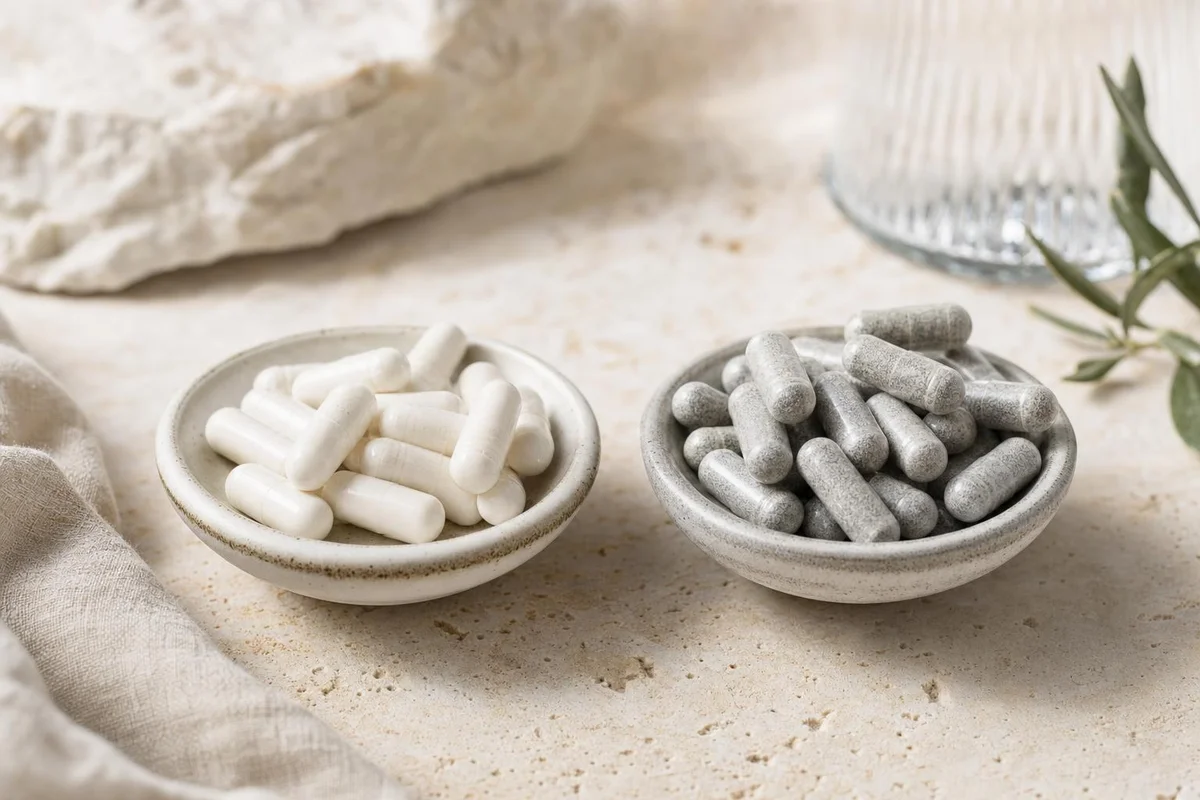
Magnesium Glycinate vs Citrate for ADHD
There is no direct ADHD head-to-head trial showing that glycinate beats citrate. The useful comparison is practical: sleep context, GI response, constipation, cost, elemental dose, and medication safety. This page keeps those tradeoffs separate from claims about treating ADHD.
Quick verdict
Glycinate for sleep-oriented fit; citrate for cost or constipation
That is a shopping shortcut, not an efficacy ranking. Glycinate has a small recent sleep signal in non-ADHD adults. Citrate has practical absorption evidence relative to oxide and a more useful laxative effect for some people. Neither has demonstrated superior control of inattention, hyperactivity, impulsivity, or executive dysfunction.
Choose glycinate when
You want a simple, sleep-oriented trial and are willing to pay more without assuming ADHD superiority.
Choose citrate when
Lower cost or constipation matters and a looser-stool effect would not be a problem.
Choose neither yet when
Kidney disease, medication interactions, unexplained symptoms, or a child’s dosing make clinical review the next step.
Side by side
Glycinate vs citrate without the marketing shortcuts
| Question | Glycinate / bisglycinate | Citrate |
|---|---|---|
| Direct ADHD evidence | No form-specific ADHD trial showing benefit or superiority | No form-specific ADHD trial showing benefit or superiority |
| Sleep evidence | One 2025 placebo-controlled trial in adults with poor sleep found a small benefit from bisglycinate; it was not an ADHD trial | No comparable ADHD or direct glycinate-vs-citrate sleep trial |
| Absorption evidence | No authoritative evidence that glycinate is uniquely best for ADHD | NIH summarizes citrate as more completely absorbed than oxide in small studies; that does not prove superiority to glycinate |
| GI fit | Often chosen by people trying to avoid a laxative-style product, but individual tolerance varies | Can loosen stools; useful when constipation is part of the picture and less useful when diarrhea is a risk |
| Cost | Usually higher | Usually lower |
| Best practical use | A simple trial when sleep or perceived GI tolerance is the main reason for the form choice | A cost-conscious repletion option or a form that may also help constipation |
| What it cannot claim | Proven calm-focus synergy or better ADHD symptom control | Proven ADHD efficacy or equal benefit at every dose |
Claim check
Four claims that need a reality check
Unsupported
“Glycinate is best for ADHD.”
No direct ADHD comparison establishes a winning form. Choosing glycinate for sleep context or tolerance is different from claiming better ADHD efficacy.
Not isolated
“The glycine creates calm-focus synergy.”
The glycine contribution has not been separated from magnesium in an ADHD trial. Mechanistic plausibility should not be presented as a demonstrated clinical effect.
Too simple
“A normal serum test means magnesium is fine.”
Serum magnesium is commonly used but does not closely reflect total-body or tissue magnesium. NIH states that no single assessment method is satisfactory.
Association, not treatment evidence
“Lower magnesium in ADHD proves supplementation works.”
Observational meta-analyses can identify group differences, but they cannot prove causation or establish that supplementation improves symptoms.
Evidence boundary
What the current research actually supports
The ADHD treatment literature remains inadequate. A systematic review found no randomized double-blind magnesium trial and no magnesium-monotherapy study for ADHD. That means neither glycinate nor citrate can be ranked as an evidence-based ADHD treatment.
The 2025 bisglycinate trial enrolled 155 adults with self-reported poor sleep, used 250 mg elemental magnesium daily for four weeks, and found a small improvement in insomnia severity. It did not recruit an ADHD population, measure core ADHD outcomes, or compare citrate.
NIH’s form discussion is narrower: more soluble forms such as citrate are absorbed more completely than oxide in small studies. It does not identify a universally superior form for ADHD, sleep, anxiety, or cognition.
Decision path
How to choose in practice
- 1
Define the actual target
Separate core ADHD symptoms from poor sleep, constipation, low dietary intake, muscle tension, or another reason for considering magnesium.
- 2
Check the elemental dose
Compare the Supplement Facts panel, not the front-label compound weight. A lower, clearly labeled serving is easier to evaluate.
- 3
Pick one form
Do not start glycinate, citrate, and a multi-ingredient ADHD blend together. One change makes benefit and side effects interpretable.
- 4
Track the matching outcome
For a sleep-oriented trial, track sleep onset and next-day function. For constipation, track stool changes. Do not redefine any vague change as improved ADHD.
- 5
Stop for poor fit
Persistent diarrhea, nausea, cramping, unusual weakness, or other concerning symptoms are reasons to stop and seek clinical advice—not to keep escalating.
Dose and safety
The form name does not remove the guardrails
- No ADHD-specific dose is established. The adult upper limit is 350 mg/day from supplements and medications unless a clinician recommends otherwise.
- Children need pediatric guidance. Supplemental upper limits vary by age, and an adult dose should not be copied for a child with ADHD.
- Kidney impairment increases risk. Reduced magnesium clearance can lead to accumulation and toxicity.
- Magnesium can interfere with medicines. It can reduce absorption of oral bisphosphonates and bind tetracycline or quinolone antibiotics. Follow pharmacist or label spacing instructions.
- Count other sources. Antacids, laxatives, multivitamins, and sleep products can already contain magnesium.
Product comparison
Compare labels after choosing the tradeoff
Use the product set to compare elemental dose, serving size, formulation, and cost. It is not evidence that any listed product treats ADHD or that glycinate is clinically superior.
Sourcing options
Product sourcing examples
Recommendation status
Product recommendations are not shown for this profile because the current site safety and monetization policy does not permit them.
Related evidence paths
Frequently asked questions
Is magnesium glycinate or citrate better for ADHD?
Neither has been proven better for ADHD. There is no direct ADHD head-to-head trial. Glycinate may be a practical fit when sleep or perceived GI tolerance matters; citrate may be a practical fit when cost or constipation matters. Those are use-case differences, not evidence of superior ADHD symptom control.
Does the glycine in magnesium glycinate make it better for focus or calm?
That claim is plausible but unproven. The effect of glycine has not been isolated in a magnesium-glycinate ADHD trial, so the combined product cannot be assumed to provide a special calm-focus effect beyond magnesium itself.
Is citrate absorbed better than glycinate?
NIH summarizes small studies showing citrate is absorbed more completely than oxide and sulfate. That is not the same as a direct citrate-versus-glycinate comparison, and it does not establish that citrate produces better ADHD or sleep outcomes.
Which form is less likely to cause diarrhea?
Citrate can have a more noticeable laxative effect, but GI response varies by dose, serving size, diet, and individual sensitivity. A lower elemental dose can matter as much as the form name.
What dose should I use for ADHD?
There is no established ADHD-specific dose for either form. Read the label for elemental magnesium rather than the total chelate weight. The NIH adult upper limit is 350 mg per day from supplements and medications unless a clinician recommends otherwise.
Should I test magnesium before choosing a form?
Clinical context can be useful, but no single magnesium test is definitive. NIH notes that serum magnesium is commonly measured yet does not closely reflect total-body or tissue status. Diet, symptoms, medical history, medications, and laboratory findings may all matter.
Source ledger
References
4 sources
- 01NIH Office of Dietary Supplements. Magnesium: Fact Sheet for Health Professionals. Source →
- 02Schuster J, et al. Magnesium bisglycinate supplementation in healthy adults reporting poor sleep: randomized placebo-controlled trial. 2025. PMID: 40918053. PubMed →
- 03Ghanizadeh A. A systematic review of magnesium therapy for treating attention deficit hyperactivity disorder. 2013. PMID: 23808779. PubMed →
- 04Huang YH, et al. Magnesium levels in children with ADHD: systematic review and meta-analysis. 2019. PMID: 30496768. PubMed →
This comparison is educational. It does not diagnose magnesium deficiency or recommend magnesium as a treatment for ADHD. Discuss pediatric use, pregnancy, kidney disease, persistent symptoms, and medication interactions with a qualified clinician or pharmacist.