Sleep-form evidence and buyer guide · Updated source ledger
Magnesium Types for Sleep: Glycinate vs Threonate vs Citrate
Last evidence review October 13, 2026
Magnesium forms now have more sleep research than they did even two years ago. That is useful—but it still does not justify the internet’s usual ranking of “glycinate first, threonate second, citrate third.” A 2025 bisglycinate trial found a small placebo-adjusted insomnia benefit, and two recent L-threonate trials reported some form-specific sleep signals.[3][4][6] None of those trials directly compared glycinate with threonate, citrate, or oxide.
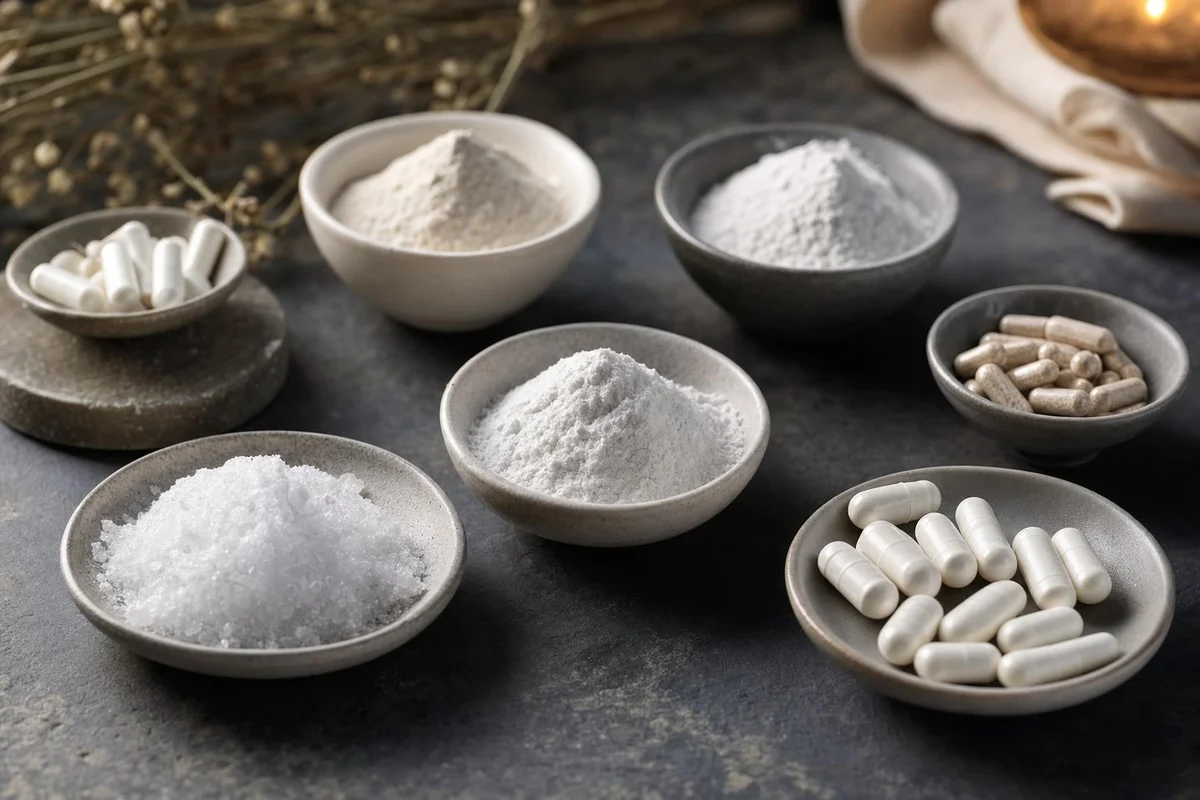
Six-form buyer comparison
At-a-glance: elemental magnesium, sleep evidence, GI effects and price
Typical elemental magnesium ranges are illustrative per-serving label amounts, not recommended doses. Price tiers ($–$$$) are relative, not live offers. No reliable head-to-head trial proves one form best; L-threonate's key trials were industry funded.[3][4][6][9][13][14]
This table scrolls horizontally on small screens. Use Tab to focus the table region, then scroll with arrow keys or touch.
| Form | Elemental / serving | Direct sleep evidence | GI tolerance | Relative price |
|---|---|---|---|---|
| Glycinate / bisglycinate | 100–200 mg | Small placebo RCT benefit | Often gentle; data limited | $$ |
| Citrate | 100–200 mg | Placebo RCT without sleep-specific benefit | Can loosen stools | $ |
| L-threonate | ~72–144 mg from 1–2 g compound | Mixed industry-funded RCTs | Often tolerated in short trials | $$$ |
| Malate | 100–200 mg | No verified malate-only sleep trial | Variable; limited direct data | $$ |
| Taurate | 50–150 mg | No verified taurate-only sleep trial | Variable; limited direct data | $$–$$$ |
| Oxide | 200–400 mg | Small older-adult insomnia RCT at ~500 mg/day | Laxative; lower fractional absorption | $ |
Bottom line
There is still no proven “best magnesium form for sleep”
Bisglycinate: now has direct placebo-controlled sleep evidence. In 155 adults reporting poor sleep, four weeks produced a statistically greater ISI reduction than placebo, but the effect was small (Cohen’s d ≈ 0.2) and the trial lacked objective sleep measurement.[3]
L-threonate: has two recent branded-product RCTs. One reported favorable subjective and wearable outcomes; another found improved sleep-related impairment but no group difference in sleep disturbance, restorative sleep, or wearable-measured sleep outcomes.[4][6]
Citrate: has better human bioavailability evidence than oxide, but a seven-week placebo-controlled trial in older adults found no magnesium-specific sleep benefit.[10][11][13]
Oxide: should not be dismissed as “useless for sleep” solely because absorption is lower; an older insomnia RCT using oxide reported positive outcomes, though the broader evidence is low certainty.[7][1]
The evidence hierarchy
What each kind of study can—and cannot—tell you
This table scrolls horizontally on small screens. Use Tab to focus the table region, then scroll with arrow keys or touch.
| Question | Best evidence | What it does not prove |
|---|---|---|
| Does magnesium help insomnia at all? | 2021 and 2024 systematic reviews + individual RCTs.[1][2] | That every form works, or that effects apply equally to all ages and baseline magnesium states. |
| Does bisglycinate beat placebo? | 2025 RCT, 155 adults, small ISI effect.[3] | That bisglycinate beats citrate, threonate, oxide, CBT-I, or another active treatment. |
| Does L-threonate beat placebo? | 2024 and 2026 branded-product RCTs.[4][6] | That it is the best sleep form, or that every subjective/wearable endpoint improves consistently. |
| Is citrate absorbed better than oxide? | Human pharmacokinetic/bioavailability comparisons.[10][11] | That citrate produces better sleep than oxide. |
| Which form is best head-to-head for sleep? | No adequate direct superiority trial located. | Marketing rankings cannot fill the missing comparison. |
Overall magnesium evidence
The older systematic evidence is still low certainty
A 2021 systematic review/meta-analysis identified only three randomized trials involving 151 older adults with insomnia. Pooled sleep-onset latency favored magnesium by about 17 minutes, while total sleep time did not improve significantly; all trials had moderate-to-high risk of bias and the certainty was low to very low.[1]
A broader 2024 systematic review found eight magnesium intervention studies with sleep outcomes. Five reported improvement in at least one sleep parameter, two were negative and one was mixed—but forms, doses, populations, durations and co-ingredients varied substantially. The authors explicitly concluded that an optimal magnesium form could not be determined.[2]
That means the newer form-specific RCTs should update confidence, not erase the heterogeneity problem.
Form-specific evidence
Glycinate / bisglycinate: finally a direct trial, but a modest signal
The 2025 double-blind placebo-controlled trial randomized 155 adults with self-reported poor sleep to magnesium bisglycinate or placebo for four weeks. ISI improved more with bisglycinate (−3.9 vs −2.3), with a borderline-significant between-group test (p=0.049) and a small effect size of d=0.2.[3]
The trial did not include objective sleep measurements, and exploratory analyses suggested larger benefit among participants with lower baseline dietary magnesium intake. That is hypothesis-generating subgroup evidence, not proof that “magnesium glycinate works best if you are deficient.”[3]
One author disclosed leadership of a contract research organization funded by nutraceutical companies and presentation honoraria from nutraceutical companies; the other authors reported no conflicts.[3] Conflict disclosure does not invalidate the result, but it belongs in a premium evidence review.
L-threonate: more studies, more endpoints—and more reason to read carefully
2024 trial: positive branded-product signal
An 80-person, 21-day randomized trial reported favorable changes in several subjective and Oura Ring-derived measures with magnesium L-threonate versus placebo.[4] The paper later received a corrigendum.[5]
The study was funded by AIDP, and several authors were AIDP employees/affiliates.[4] Its 2025 corrigendum disclosed delayed trial registration.[5] This is material because the intervention was a branded ingredient.
2026 publication: mixed sleep findings
A separate six-week trial in 100 adults found greater improvement in sleep-related impairment, but no group differences in sleep disturbance, restorative sleep, or Oura Ring sleep outcomes.[6]
It was funded by Threotech, which supplied the intellectual property/product and participated in study conceptualization; both authors had ties to the contract research organization conducting the trial.[6] An October 2026 correction clarified two-tailed statistics without changing results.[15]
Together these studies support “L-threonate is worth further study,” not “L-threonate is clinically proven to cross the brain and therefore beats glycinate for sleep.” Neither trial directly compared forms.
Citrate vs oxide
Bioavailability is useful purchasing evidence, not a sleep ranking
Human studies dating back to 1990 found magnesium citrate more soluble and/or bioavailable than magnesium oxide.[10] A 2003 randomized double-blind study also found greater absorption for citrate and an amino-acid chelate than oxide over 60 days.[11]
NIH ODS summarizes the broader pattern similarly: forms that dissolve well tend to be absorbed more completely, with citrate, aspartate, lactate and chloride generally showing higher bioavailability than oxide/sulfate in small studies.[9]
But: the 2012 older-adult insomnia RCT that reported positive outcomes used magnesium oxide.[7] That alone should stop anyone from converting “citrate absorbs better” into “oxide cannot help sleep.”
Attribution problem
Combination studies cannot identify the winning ingredient
A well-known 2011 trial in long-term-care residents found substantial sleep improvement with a combination of melatonin + magnesium + zinc versus placebo.[8] It is evidence for that combination—not clean evidence that magnesium alone caused the effect or that any specific magnesium form is superior.
This matters because many commercial sleep products contain magnesium plus glycine, L-theanine, melatonin, herbs, or B vitamins. A positive blend trial cannot be silently assigned to the magnesium carrier.
Safety and label reality
Elemental magnesium matters more than the giant compound-weight number
NIH ODS notes that the Supplement Facts panel declares elemental magnesium, not the total weight of magnesium glycinate, citrate, threonate, or another compound.[9]
For adults, the U.S. tolerable upper intake level is 350 mg/day from supplements and medications unless a health professional recommends otherwise; magnesium naturally present in food is excluded from that UL.[9]
Higher supplemental intakes can cause diarrhea, nausea and cramping. Kidney impairment increases toxicity risk because magnesium clearance is reduced. Magnesium can also interfere with absorption of some antibiotics and bisphosphonates, so medication-specific instructions matter.[9]
What would actually prove one form is better?
A strong answer would require a sufficiently large, blinded, head-to-head randomized trial comparing forms at appropriately matched elemental magnesium exposure, with prespecified insomnia outcomes, objective sleep measures, baseline magnesium status, adherence, side effects, and clinically meaningful effect thresholds.
Until then, product choice is a tradeoff among evidence, elemental amount, tolerability, price, added ingredients, kidney/medication context, and personal response—not a scientifically established podium.
Sources
- 1. Mah & Pitre (2021): Oral magnesium supplementation for insomnia in older adults — systematic review and meta-analysis — Three RCTs / 151 older adults; latency signal but low-to-very-low certainty and moderate-to-high risk of bias.
- 2. Rawji et al. (2024): Supplemental magnesium for self-reported anxiety and sleep — systematic review — Fifteen intervention studies overall; eight measured sleep. Forms, populations, doses and co-ingredients varied; the review could not identify an optimal form.
- 3. Schuster et al. (2025): Magnesium bisglycinate in adults reporting poor sleep — randomized placebo-controlled trial — 155 adults; small ISI benefit at 4 weeks (Cohen d about 0.2), no objective sleep assessment, exploratory stronger signal with lower baseline dietary magnesium.
- 4. Hausenblas et al. (2024): Magnesium L-threonate and sleep/daytime functioning — randomized trial — 80 adults with self-reported sleep problems; 21-day branded-product trial with subjective and wearable outcomes; funded by AIDP and included AIDP-affiliated authors.
- 5. Hausenblas et al. (2025): Corrigendum to the 2024 L-threonate sleep trial — Published correction linked to the 2024 Sleep Medicine X trial.
- 6. Lopresti & Smith (2026): Magnesium L-threonate cognition and sleep trial — 100 adults; improved sleep-related impairment but not sleep disturbance, restorative sleep, or wearable-measured sleep outcomes; funded by Threotech, which provided study IP/product and participated in study conceptualization.
- 7. Abbasi et al. (2012): Magnesium supplementation in older adults with primary insomnia — Small double-blind placebo-controlled study in 46 older adults; used magnesium oxide and reported several positive subjective/biochemical outcomes.
- 8. Rondanelli et al. (2011): Melatonin + magnesium + zinc in long-term-care residents — Positive multi-ingredient trial; cannot isolate magnesium as the causal ingredient.
- 9. NIH Office of Dietary Supplements: Magnesium — Health Professional Fact Sheet — Elemental-magnesium labeling, absorption, adult supplemental UL, GI effects, kidney-risk context, and medication interactions.
- 10. Lindberg et al. (1990): Magnesium citrate vs oxide bioavailability — Citrate was more soluble/bioavailable than oxide; sleep was not an endpoint.
- 11. Walker et al. (2003): Citrate, amino-acid chelate and oxide bioavailability — Randomized double-blind comparison; citrate/chelate showed greater absorption than oxide. Again, not a sleep trial.
- 12. Schuchardt & Hahn (2017): Intestinal absorption and magnesium bioavailability review — Human form-comparison literature is limited/mixed; some studies favor organic salts while others find smaller differences.
- 13. Nielsen, Johnson & Zeng (2010): Magnesium citrate in adults with poor sleep — 100 adults older than 51 enrolled (96 completed), 320 mg/day citrate vs sodium-citrate placebo for seven weeks; sleep quality improved in both groups, no magnesium-specific benefit.
- 14. 2026 systematic review: magnesium supplementation and sleep — Twelve main sleep trials; heterogeneity and low-to-very-low certainty limit form-specific conclusions.
- 15. Lopresti & Smith (2026): correction to 2026 L-threonate RCT — Clarifies two-tailed testing wording; reported results unchanged.
Frequently asked questions
What is the best magnesium type for sleep?
No form has been proven best in reliable head-to-head sleep trials. Magnesium bisglycinate and L-threonate now have form-specific randomized trials, but those studies compared each product with placebo rather than directly with citrate, oxide, or each other. Overall magnesium-and-insomnia evidence remains heterogeneous and lower certainty than marketing implies.
Is magnesium glycinate better than citrate for sleep?
There is no direct sleep trial establishing glycinate or bisglycinate as superior to citrate. A 2025 bisglycinate placebo-controlled trial found a small improvement in insomnia severity, while citrate has stronger evidence than oxide for bioavailability. Those answer different questions: placebo efficacy versus absorption.
Is magnesium L-threonate better than glycinate for sleep?
Not established. L-threonate has two recent product-specific randomized trials with some positive sleep-related findings, but the studies were industry funded and did not compare L-threonate with glycinate. One newer trial found improvement in sleep-related impairment but no group difference in wearable-measured sleep outcomes.
Does better magnesium absorption mean better sleep?
No. Citrate is generally more bioavailable than oxide in small human studies, but bioavailability is an intermediate pharmacokinetic outcome. It does not prove that citrate improves insomnia more than oxide or any other form.
How much magnesium should I take for sleep?
There is no universal evidence-based insomnia dose. Trials used different forms, elemental amounts, populations, and durations. The U.S. adult tolerable upper intake level is 350 mg per day from magnesium in supplements and medications unless a healthcare professional recommends otherwise; magnesium from food is not counted toward that supplemental limit.
Why does magnesium cause diarrhea?
Unabsorbed magnesium salts can have an osmotic effect in the intestine. The likelihood varies with dose, formulation, and individual tolerance. Kidney impairment also changes the safety calculation because magnesium clearance can be reduced.
How do I compare magnesium labels before buying?
Compare elemental magnesium per serving rather than compound weight, total daily supplements, gut tolerance, medication interactions, price per 100 mg of elemental magnesium, and independent testing evidence. Do not mistake marketing for clinical trials.
Are premium magnesium forms better for sleep?
No reliable head-to-head RCT proves an expensive form works better. L-threonate results are mixed and the key product-specific trials had commercial funding; price reflects formulation and market positioning, not proven superiority.
How to choose without marketing shortcuts
What should you check before buying magnesium for sleep?
- Read the elemental magnesium amount and serving size on Supplement Facts; it is not the same as the compound weight.[9]
- Add magnesium from supplements and medications. The NIH adult tolerable upper limit is 350 mg/day from those sources unless a clinician advises otherwise; food does not count.[9]
- Consider diarrhea, constipation, kidney disease, and antibiotic or bisphosphonate interactions before comparing price.[9]
- Compare cost per 100 mg elemental magnesium, added ingredients, independent testing evidence, and realistic return terms rather than promises of deep sleep.
- Expect gradual, small or absent effects rather than a same-night sleeping pill; magnesium has not been proven to cure chronic insomnia.[3][14]
Which form fits your shopping constraint?
For GI sensitivity, compare glycinate; for lower cost or constipation, consider citrate's stool-softening tradeoff; for L-threonate, weigh a premium against mixed, commercially funded studies. Malate and taurate lack verified form-only sleep RCTs; oxide is inexpensive but can be laxative and less efficiently absorbed. This is a shopping framework, not a prescription.
Affiliate disclosure
As an Amazon Associate I earn from qualifying purchases.
Some pages may include affiliate links. If you buy through those links, The Hippie Scientist may earn a commission at no additional cost to you. Affiliate relationships do not change evidence ratings, safety warnings, product-quality criteria, or editorial conclusions.
Read our affiliate and editorial policyNo product-specific Amazon ASIN currently meets this guide's HIGH-confidence verification gate. Direct product offers and affiliate search shortcuts are withheld until a curated set passes source and product-quality checks.
Sourcing options
Magnesium sourcing — verification pending
Recommendation status
Product recommendations are not shown for this profile because the current site safety and monetization policy does not permit them.
Free safety checklist
Get future research notes by email
Evidence-first supplement updates, safety context, and new guide announcements.
We use your email to send the checklist and occasional evidence-first supplement updates. Unsubscribe anytime. Privacy policy.
Newsletter
Continue with the newsletter archive
Short notes built for cautious supplement decisions.