Decision guide · 19-source evidence ledger
Best Supplements for Sleep: An Evidence-Ranked Shortlist
Written and edited by Willie B. Randolph III · Last evidence review September 17, 2026
This is the decision page, not the encyclopedia. It compares six commonly considered natural sleep supplements by directness of human evidence, effect size, formulation match and safety. “Best” here means “most defensible for a clearly defined question,” not “strongest sedative.”
Rankings weigh direct human evidence, effect size, formulation match, safety and relevance to the sleep question. See the research methodology for the site-wide evidence framework.
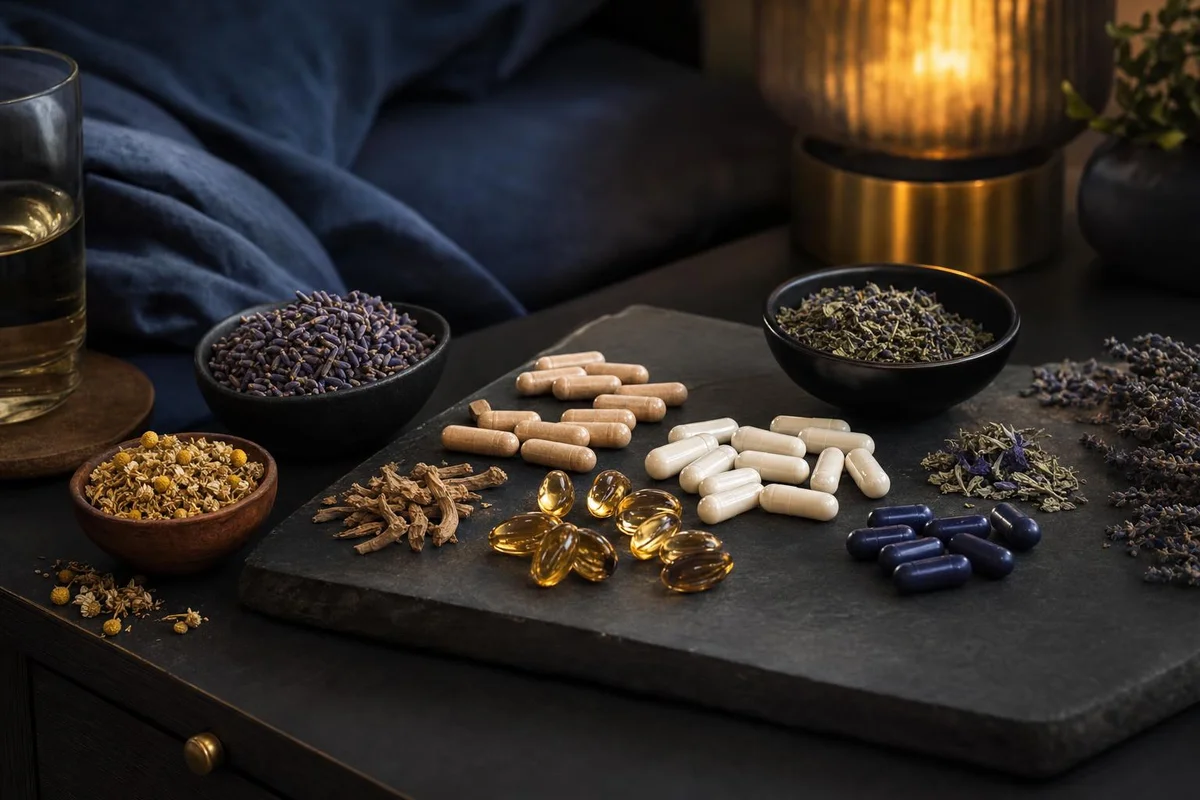
Quick answer
There is no universal “best” sleep supplement
Melatonin has the clearest role when sleep timing is shifted and has modest average benefits across some primary sleep disorders.[5][6] L-theanine has promising recent evidence for several subjective sleep outcomes, but clinical-insomnia evidence remains limited.[8][9]
Magnesium remains low-certainty overall: a 2026 systematic review of 12 randomized trials found inconsistent results and did not support routine oral magnesium treatment for insomnia, while a 2025 bisglycinate trial remains a small preparation-specific signal.[19][11] Ashwagandha has a small positive pooled sleep signal.[13] Valerian has no demonstrated efficacy for insomnia in a 2024 umbrella review,[15] while passionflower has preliminary randomized evidence.[16]
For chronic insomnia, the evidence hierarchy changes completely: CBT-I is recommended as initial treatment in major guidelines.[1][2]
Shortlist
Evidence-ranked sleep supplement comparison
This table scrolls horizontally on small screens. Use Tab to focus the table region, then scroll with arrow keys or touch.
| Option | Why it makes the shortlist | Why it is not #1 for everyone | Verdict |
|---|---|---|---|
| Melatonin | Best-defined circadian role; multiple reviews. | Chronic-insomnia evidence is not strong enough for a blanket recommendation; timing and disorder matter. | Best-defined use case |
| L-theanine | Recent systematic reviews show small sleep-quality signals. | Dose, duration, pure-product evidence and clinical-insomnia efficacy remain unsettled. | Most promising newer signal |
| Magnesium | Biologically plausible; randomized evidence includes a modest 2025 bisglycinate signal. | A 2026 systematic review found inconsistent results and low to very-low certainty; routine insomnia treatment was not supported. | Plausible, overmarketed |
| Ashwagandha | Five-trial meta-analysis found a small overall sleep benefit. | Small heterogeneous evidence base; extracts vary; long-term safety is uncertain. | Useful signal, more caveats |
| Valerian | Large historical use and review literature. | Umbrella review found no demonstrated insomnia efficacy despite subjective signals. | Not evidence-leading |
| Passionflower | Randomized insomnia trial found a total-sleep-time signal. | Small evidence base; several outcomes were not different from placebo; pregnancy warning. | Preliminary |
A 2025 scoping review of OTC insomnia products found many positive trials but still characterized the overall findings as promising rather than conclusive, which is a good summary of this category as a whole.[18]
1. Melatonin — strongest when the question is circadian timing
A meta-analysis of 19 randomized placebo-controlled studies found modest improvements in sleep latency, total sleep time and sleep quality across primary sleep disorders.[5] Another adult review found some of the clearest evidence in delayed sleep phase and circadian-related problems.[6]
The counterweight is important: the AASM chronic-insomnia pharmacologic guideline suggested against melatonin for adult sleep-onset or sleep-maintenance insomnia based on the evidence available for that indication.[4] NCCIH likewise notes insufficient evidence for recommending it as a chronic-insomnia treatment and that long-term safety is not established.[7]
Decision: shortlist melatonin when timing is plausibly part of the problem; do not treat it as the generic #1 sleeping pill.
2. L-theanine — the most interesting newer evidence signal
The 2025 meta-analysis included 19 articles and 897 participants and found statistically significant improvements in several subjective sleep outcomes, while emphasizing the shortage of pure L-theanine studies and uncertainty around dose and duration.[8] A 2026 review of 13 standalone trials found beneficial signals but still called for higher-quality trials, especially in clinical insomnia.[9]
Decision: reasonable to call promising; too early to call proven or symptom-specific.
3. Magnesium — newer evidence, still not a universal winner
A 2026 systematic review searched the literature through June 1, 2026 and included 12 randomized trials in its main synthesis of sleep, insomnia or poor sleep. Populations, formulations, treatment durations and outcome measures varied substantially; findings were inconsistent and certainty was low to very low. The authors concluded that current evidence does not support oral magnesium as a routine treatment for insomnia.[19] An earlier 2021 review of three randomized trials in 151 older adults reached a similarly low-certainty evidence boundary.[10]
Within that uncertain class-level evidence, a 2025 randomized trial tested 250 mg elemental magnesium as bisglycinate in 155 adults with self-reported poor sleep. Insomnia Severity Index scores improved more than placebo, but the effect was small (Cohen d=0.2), a separate sleep-quality measure was not significantly different, and objective sleep was not measured.[11]
The 2025 trial also deserves transparency: one coauthor led a contract research organization receiving nutraceutical-company research funding and honoraria; the study supplement was manufactured by Biogena.[11]
Safety matters too: NIH notes GI effects from supplemental magnesium and greater toxicity risk with impaired kidney function.[12]
Decision: a plausible preparation-specific signal exists, especially where low magnesium intake may be relevant, but current evidence does not support magnesium as a routine insomnia treatment or a universal “best” sleep supplement.
4. Ashwagandha — small pooled benefit with extract and safety caveats
A meta-analysis of five randomized trials containing 400 adults found a small but significant overall sleep benefit, with larger effects in some insomnia, higher-dose and longer-duration subgroups.[13] The trials used different standardized extracts, which limits transfer to generic retail powders or gummies.
NCCIH notes that some preparations may help insomnia or stress, but long-term safety is not established; pregnancy, breastfeeding, thyroid and autoimmune disorders, surgery, rare liver injury and multiple medication-interaction categories matter.[14]
Decision: legitimate sleep signal, but product matching and safety deserve more weight than “adaptogen” marketing.
5. Valerian — too inconsistent to rank near the top
A 2024 umbrella review of eight systematic reviews found no evidence of efficacy for treating insomnia, although subjective sleep-quality improvements appeared in some reviews. Objective and quantitative results were inconsistent and the underlying evidence was heterogeneous and often low quality.[15]
Decision: possible subjective benefit, not an evidence-based “best” insomnia supplement.
6. Passionflower — a real trial, but still preliminary
A randomized placebo-controlled study in 110 adults with insomnia found that total sleep time improved by about 23 minutes relative to placebo over two weeks, while between-group differences in sleep efficiency and wake-after-sleep-onset were not significant.[16]
NCCIH advises against passionflower during pregnancy because it may induce uterine contractions.[17]
Decision: enough evidence to watch; not enough to rank as an established insomnia treatment.
Why the “best stack” question is harder than the “best supplement” question
Separate studies of melatonin, magnesium, L-theanine, ashwagandha, valerian or passionflower do not prove that combining them creates synergy, works faster or remains equally safe. A stack is a new intervention. It also makes it harder to identify which ingredient helped or caused next-day impairment.
Read the sleep-stack evidence guide →Safety is part of the ranking
A “best” list should penalize uncertainty and interaction risk
Chronic insomnia changes the answer
ACP recommends CBT-I as initial treatment for adults with chronic insomnia, and AASM separately recommends multicomponent CBT-I.[1][2]
A 2026 AASM guideline on combined treatment suggested CBT-I plus medication over medication alone, but suggested against the combination over CBT-I alone.[3] That is strong context against treating a supplement ranking as the main solution for persistent insomnia.
Start with the problem
What part of sleep are you actually trying to change?
“Better sleep” is too broad for an evidence comparison. Pick the outcome that matches the complaint before comparing ingredients. This keeps sleep-onset, sleep-maintenance and circadian evidence from being mixed together.
Sleep onset
I cannot fall asleep
The useful research endpoint is sleep-onset latency: how long it takes to fall asleep. Do not assume an ingredient that changes onset will also reduce middle-of-the-night waking.
Sleep maintenance
I fall asleep, then wake up
Look for wake after sleep onset (WASO), awakenings and sleep efficiency. A supplement that improves sleep onset is not automatically a treatment for maintenance insomnia.
Circadian timing
My sleep timing is shifted
Timing is a different question from sedation. Melatonin has its clearest rationale when the problem is circadian timing rather than simply wanting a stronger sleep aid.
Nighttime stress
My mind is racing at night
If stress or racing thoughts are the main barrier, route to the dedicated nighttime-stress guide rather than assuming a generic sleep supplement is the right endpoint.
Chronic insomnia
I have persistent insomnia
Do not let a supplement ranking obscure the treatment hierarchy. For chronic insomnia, CBT-I has substantially stronger guideline support than supplement stacking.
Research note: sleep-onset latency, wake after sleep onset, total sleep time and sleep efficiency are distinct outcomes. A statistically significant change in one does not prove a broad improvement in all of them.
Decision endpoint
If a supplement still fits, choose the product by form and quality—not hype
These are optional sourcing paths after the evidence and safety checks above. A commerce action appears only when both the live ingredient record and the existing product set are currently allowed by site governance.
Melatonin
Evidence fit
Best-defined when circadian timing or sleep onset is the actual problem; not a blanket answer for chronic insomnia.
Safety check first
Review medication interactions, next-day drowsiness, autoimmune context, and the uncertainty around long-term use.
Quality signals
- • Clearly labeled amount per serving
- • Independent quality or label-accuracy verification
- • No proprietary sleep blend hiding the melatonin amount
No governed product action is shown here. Keep the decision educational until the current site policy and product data both permit commerce.
Review evidence and safety →L-Theanine
Evidence fit
Promising for subjective sleep quality and pre-sleep mental quieting, but not established as a clinical-insomnia treatment.
Safety check first
Review sedative stacking and blood-pressure context before combining it with other calming products.
Quality signals
- • Single-ingredient or transparently labeled formula
- • Clear serving-size labeling
- • Third-party quality verification when available
No governed product action is shown here. Keep the decision educational until the current site policy and product data both permit commerce.
Review evidence and safety →Magnesium
Evidence fit
Plausible for relaxation and some poor-sleep contexts, with overall evidence still limited and effects likely dependent on baseline status.
Safety check first
Kidney impairment materially changes magnesium safety; GI tolerance and total supplemental intake also matter.
Quality signals
- • Elemental magnesium amount is explicit
- • Form is named rather than hidden in a blend
- • Third-party quality verification when available
No governed product action is shown here. Keep the decision educational until the current site policy and product data both permit commerce.
Review evidence and safety →Product examples are sourcing starting points, not prescriptions. For a brand-neutral checklist, use the supplement product-quality guide.
Source ledger
References
19 sources
- 01Management of Chronic Insomnia Disorder in Adults: A Clinical Practice Guideline From the American College of Physicians Qaseem A, et al. Ann Intern Med. 2016.PMID 27136449DOI 10.7326/M15-2175 PubMed →
- 02Behavioral and psychological treatments for chronic insomnia disorder in adults: an AASM clinical practice guideline Edinger JD, et al. J Clin Sleep Med. 2021.PMID 33164742DOI 10.5664/jcsm.8986 PubMed →
- 03Combination treatment for chronic insomnia disorder in adults: an AASM clinical practice guideline AASM guideline. 2026.PMID 41975142 PubMed →
- 04Clinical Practice Guideline for the Pharmacologic Treatment of Chronic Insomnia in Adults Sateia MJ, et al. J Clin Sleep Med. 2017.PMID 27998379 PubMed →
- 05Meta-analysis: melatonin for the treatment of primary sleep disorders Ferracioli-Oda E, Qawasmi A, Bloch MH. PLoS One. 2013.PMID 23691095DOI 10.1371/journal.pone.0063773 PubMed →
- 06Evidence for the efficacy of melatonin in the treatment of primary adult sleep disorders Systematic review and meta-analysis.PMID 28648359 PubMed →
- 07Melatonin: What You Need To Know National Center for Complementary and Integrative Health. Current evidence and safety overview. Source →
- 08The effects of L-theanine consumption on sleep outcomes: A systematic review and meta-analysis Bulman A, et al. Sleep Med Rev. 2025.PMID 40056718DOI 10.1016/j.smrv.2025.102076 PubMed →
- 09Examining the effect of L-theanine on sleep: a systematic review of dietary supplementation trials Systematic review of 13 standalone L-theanine trials.PMID 41176609 PubMed →
- 10Oral magnesium supplementation for insomnia in older adults: a Systematic Review & Meta-Analysis Mah J, Pitre T. BMC Complement Med Ther. 2021.PMID 33865376DOI 10.1186/s12906-021-03297-z PubMed →
- 11Magnesium Bisglycinate Supplementation in Healthy Adults Reporting Poor Sleep: A Randomized, Placebo-Controlled Trial Schuster J, et al. Nat Sci Sleep. 2025; 155 adults, 250 mg elemental magnesium daily for 4 weeks.PMID 40918053DOI 10.2147/NSS.S524348 PubMed →
- 12Magnesium Fact Sheet for Consumers NIH Office of Dietary Supplements. Safety and supplemental upper-limit context. Source →
- 13Effect of Ashwagandha (Withania somnifera) extract on sleep: A systematic review and meta-analysis Cheah KL, et al. PLoS One. 2021; five randomized trials, 400 adults.PMID 34559859DOI 10.1371/journal.pone.0257843 PubMed →
- 14Ashwagandha: Usefulness and Safety National Center for Complementary and Integrative Health. Current safety overview. Source →
- 15Does valerian work for insomnia? An umbrella review of the evidence Valente V, et al. Eur Neuropsychopharmacol. 2024.PMID 38359657DOI 10.1016/j.euroneuro.2024.01.008 PubMed →
- 16Effects of Passiflora incarnata on polysomnographic sleep parameters in subjects with insomnia disorder Double-blind randomized placebo-controlled study in 110 adults.PMID 31714321DOI 10.1097/YIC.0000000000000291 PubMed →
- 17Passionflower: Usefulness and Safety National Center for Complementary and Integrative Health. Current safety overview. Source →
- 18Over-the-counter products for insomnia in adults: A scoping review of randomised controlled trials Scoping review of 51 randomized trials.PMID 40054227 PubMed →
- 19Magnesium Supplementation for Sleep in Adults: A Systematic Review of Randomized Controlled Trials Lopresti AL, Smith SJ, Drummond PD. J Diet Suppl. 2026;23(5):553-581. Twelve randomized trials in the main sleep/insomnia/poor-sleep synthesis.PMID 42661485DOI 10.1080/19390211.2026.2719670 PubMed →
Decision FAQ
What is the best supplement for sleep overall?
There is no evidence-based universal winner. Melatonin has the clearest role when circadian timing is the issue. L-theanine has promising recent sleep-quality data. Magnesium has low-certainty evidence plus one newer small-effect trial. Ashwagandha has a small positive pooled signal. Valerian and passionflower have weaker evidence. Chronic insomnia is better served by CBT-I than by ranking supplements.
What are the best natural supplements for sleep?
There is no universal best natural sleep supplement. Melatonin has the clearest circadian use case; L-theanine has promising newer subjective sleep data; magnesium and ashwagandha have more limited or context-dependent signals; valerian and passionflower remain weaker. The right choice depends on the sleep problem, evidence directness, safety, and product match.
Which sleep supplement has the strongest direct evidence?
For a clearly defined use case, melatonin has the most established circadian role. For chronic insomnia specifically, none of these supplements has evidence comparable with CBT-I. Evidence directness is more important than simply counting positive studies.
Is magnesium glycinate one of the best sleep supplements?
The evidence is not strong enough to call it one of the best universally. A 2025 magnesium bisglycinate trial found a statistically significant but small improvement in insomnia severity, while a prior systematic review found low to very-low certainty evidence in older adults.
Is L-theanine better than melatonin?
They answer different questions. Melatonin is a circadian signal and fits timing problems better. L-theanine has newer evidence for subjective sleep-quality outcomes but is not established as a treatment for clinical insomnia.
Should I choose valerian or passionflower?
Neither has strong evidence. Valerian has a larger review literature but a 2024 umbrella review found no demonstrated insomnia efficacy. Passionflower has a small randomized evidence base with some positive signals, including total sleep time in one trial, but remains preliminary.
Can I stack several sleep supplements?
Separate positive studies do not establish synergy when ingredients are combined. A stack is a new intervention with new interaction and attribution problems. Combining sedating products may also increase impairment.
Free safety checklist
Get future sleep research notes by email
Evidence-first supplement updates, safety context, and new guide announcements.
We use your email to send the checklist and occasional evidence-first supplement updates. Unsubscribe anytime. Privacy policy.
Newsletter
Continue with the newsletter archive
Short notes built for cautious supplement decisions.