L-Theanine: What the Evidence Supports for Focus, Stress, Anxiety, and Sleep
By Will
An evidence-first L-theanine guide updated for 2026: attention, stress, anxiety, sleep, caffeine combinations, studied doses, safety limits, and what current trials do not establish.
Evidence bottom line
L-theanine has a credible attention signal, but the evidence is much less certain for anxiety and broad “calm” claims
The July 2026 meta-analysis pooled 31 randomized trials and 1,168 participants. Its strongest short-term finding was improved choice reaction time after a single 200 mg dose studied before cognitive testing. The pooled acute-stress effect was modest and heavily influenced by higher-risk-of-bias studies, while anxiety findings were inconsistent overall.
That means “studied 30–60 minutes before a task” should not be converted into “you will feel anxiety relief in 30–60 minutes.” It also means a cognitive result should not be relabeled as proof that L-theanine treats racing thoughts, panic, or an anxiety disorder.
Direct answer
What is L-theanine?
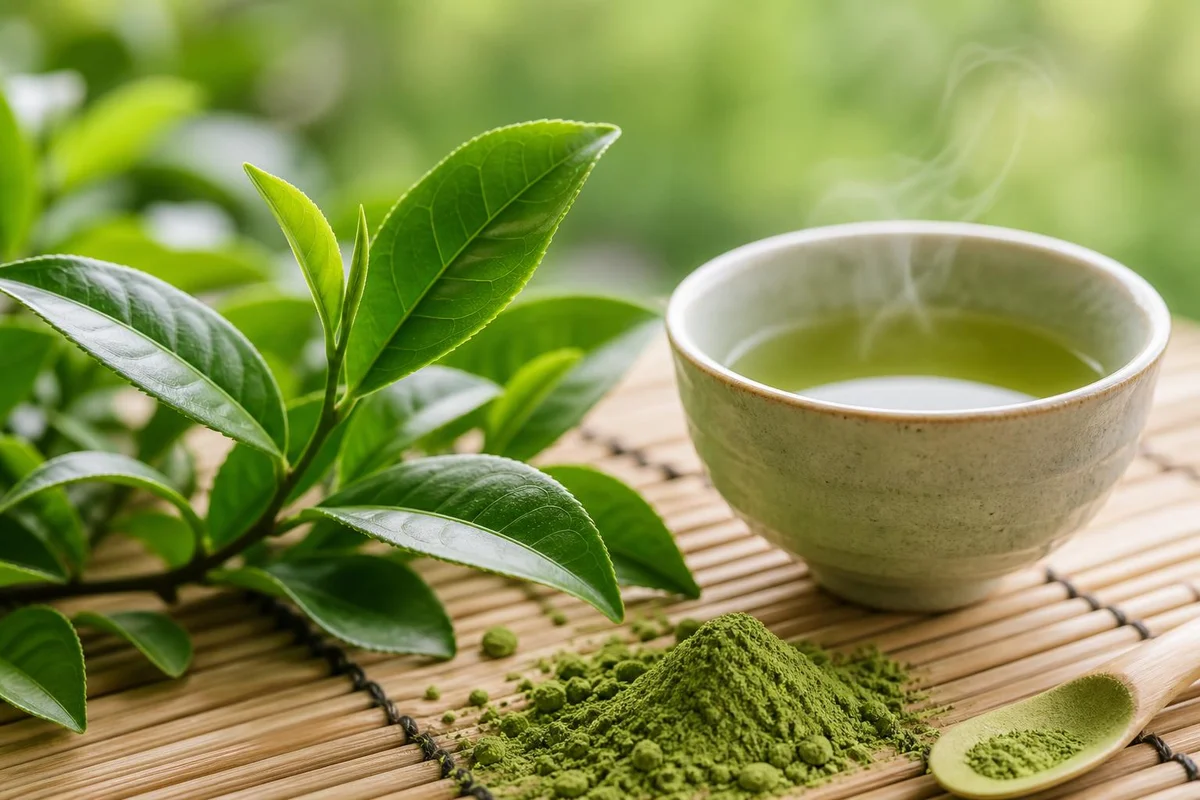
L-theanine is a non-protein amino acid found naturally in tea leaves, especially Camellia sinensis. It is studied as an isolated supplement and as one of the bioactive compounds in tea. It is chemically distinct from caffeine, and evidence for L-theanine should not be treated as evidence for every tea extract or multi-ingredient “calm” product.
The best current human evidence is outcome-specific rather than universal: short-term attention has the clearest signal, sleep research suggests small subjective benefits, acute-stress findings are modest, and anxiety results are inconsistent. L-theanine is not established as a treatment for an anxiety disorder or chronic insomnia.
| Question | Evidence-first answer |
|---|---|
| What is it? | A tea-derived non-protein amino acid commonly studied for attention, stress, anxiety, sleep, and caffeine pairing. |
| Strongest current signal | A modest short-term attention and choice-reaction-time effect in randomized human research. |
| Sleep | Small improvements in some subjective sleep outcomes; pure-L-theanine evidence and the optimal dose and duration remain limited. |
| Anxiety | Inconsistent overall; current evidence does not establish L-theanine as an anxiety treatment. |
| With caffeine | Some task-specific cognitive benefits are reported, but there is no established universal ratio or guaranteed protection from jitters or sleep disruption. |
Match the claim to the outcome
What current evidence says by goal
Attention and cognitive tasks
This is the clearest current signal. The 2026 meta-analysis found a robust short-term choice-reaction-time benefit in healthy adults, but that does not establish a broad nootropic effect across every cognitive task.
Review caffeine-free focus evidence →Stress and anxiety
Acute-stress findings are modest and study-quality-sensitive. Anxiety outcomes are inconsistent, so current pooled evidence does not establish L-theanine as a reliable acute or chronic anxiety treatment.
Read the anxiety-specific review →Sleep
The 2025 meta-analysis found small improvements in several subjective sleep outcomes. Pure-L-theanine studies were limited, and the optimal formulation, dose, and duration remain unresolved.
Read the sleep-specific review →L-theanine plus caffeine
Combination trials show task-specific cognitive and mood effects, but a 2025 meta-analysis emphasized uncertainty in direction and magnitude for many outcomes. There is no universal evidence-based ratio and no guaranteed “jitter shield.”
Compare L-theanine and caffeine →Evidence snapshots
Evidence Snapshot
Evidence: ModerateL-Theanine — Attention and acute stress
- Human evidence
- The 2026 meta-analysis included 31 randomized placebo-controlled trials with 1,168 participants across healthy and clinical populations. A single 200 mg dose studied 30–60 minutes before cognitive testing improved choice reaction time. Acute-stress reduction was modest and strongly influenced by studies at high risk of bias; anxiety effects were inconsistent overall.
- Research signal
- EEG and preclinical work offer plausible mechanisms, but mechanistic plausibility does not establish a clinical anxiety, sleep, or cognitive treatment effect.
- Safety profile
- No serious adverse events were reported in the 2026 meta-analysis. That short-trial record is reassuring but is not equivalent to unlimited long-term safety across all populations and products.
Evidence Snapshot
Evidence: LimitedL-Theanine — Sleep
- Human evidence
- A 2025 systematic review identified 19 articles and 897 participants and found small improvements in several subjective sleep outcomes. The review highlighted limited evidence using pure L-theanine and unresolved optimal dose and duration.
- Research signal
- Relaxation mechanisms are proposed, but sleep benefits should be judged from sleep outcomes rather than alpha-wave or anxiety mechanisms alone.
- Safety profile
- Sleep studies vary by product, population, dose, and co-ingredients, so findings should not be generalized to every nighttime supplement or combination.
Study context matters
What the commonly cited doses actually represent
200 mg as a single dose
In the 2026 meta-analysis, 200 mg given 30–60 minutes before cognitive testing was associated with a choice-reaction-time benefit. That is a study protocol and an attention result—not a universal anxiety dose, guaranteed onset time, or personal dosing instruction.
200 mg/day for four weeks
A small 2019 double-blind crossover trial studied 30 healthy adults without major psychiatric illness. Some stress-related, sleep, and cognitive measures improved, but the sample was small and the tablets were supplied by a company whose employees were study authors.
Sleep doses and timing
The 2025 sleep review found heterogeneous products and protocols and did not establish one optimal pure-L-theanine dose or duration. A common label schedule should not be mistaken for a settled clinical protocol.
Study doses describe research conditions. They are not individualized medical instructions, and medication, pregnancy, blood-pressure, sleep, and other health context can change the risk-benefit calculation.
Caffeine pairing
Useful research question, not a universal stack recipe
A 2025 systematic review and meta-analysis evaluated tea, L-theanine alone, and L-theanine plus caffeine in healthy participants. It found some small-to-moderate task-specific cognitive and mood differences, while confidence intervals frequently showed uncertainty about the direction or magnitude of effects.
The review also disclosed industry relationships involving Lipton and Unilever. That does not invalidate the work, but it belongs in the evidence context. The practical takeaway is narrower than “use a fixed ratio”: combination effects depend on the exact task, doses, population, and comparator, and current evidence does not prove that L-theanine reliably prevents caffeine jitters or sleep disruption.
Safety and FDA/GRAS context
Check before using
Safety summary — L-Theanine
- Short trials: The 2026 meta-analysis reported no serious adverse events, which is reassuring for the studied populations and durations.
- Long-term certainty: Short RCTs do not establish unlimited long-term safety, dependence risk, pregnancy safety, pediatric safety, or safety with every medication or supplement combination.
- FDA GRAS notices: FDA has issued “no questions” responses for specific L-theanine preparations and specified food uses. That is not blanket FDA approval of all L-theanine supplements, doses, brands, or health claims.
- Medication context: If you use prescription medication or have a medical condition, review regular supplement use with a clinician or pharmacist rather than relying on a general safety label.
- Driving and alertness: Individual responses can differ. Do not assume a supplement is impairment-free for you until you know how you respond.
If you choose to buy it
Use the label to match the product to the evidence you are reviewing
- • Prefer a label that clearly states the amount of L-theanine per serving rather than hiding it inside a proprietary blend.
- • Separate pure L-theanine evidence from combination-product evidence; caffeine, melatonin, magnesium, or herbal co-ingredients change what the product is.
- • Do not treat “Suntheanine,” “tea-derived,” “GRAS,” or a fixed theanine:caffeine ratio as proof of superior clinical efficacy.
- • Compare the exact product, dose, population, and outcome with the study you are using to justify the purchase.
Frequently asked questions
What does the best current evidence support for L-theanine?
The clearest current signal is a short-term attention effect in healthy adults. A 2026 meta-analysis of 31 randomized trials found a robust improvement in choice reaction time after a single 200 mg dose studied before cognitive testing. Acute-stress effects were modest and sensitive to study quality, while anxiety findings were inconsistent overall.
How fast does L-theanine work?
Trials often measure outcomes 30–60 minutes after a single dose, but that study timing is not a validated promise for when someone will feel calmer or whether anxiety will improve. The strongest 30–60-minute result in the 2026 meta-analysis was an attention outcome, not a reliable anxiety-relief onset.
Does L-theanine help anxiety?
Current pooled evidence does not establish L-theanine as an anxiety treatment. The 2026 meta-analysis found anxiety effects inconsistent and generally non-significant. Stress-task findings and attention improvements should not be relabeled as proof of anxiety relief.
Should L-theanine be paired with caffeine?
L-theanine plus caffeine has randomized-trial evidence for some task-specific cognitive and mood outcomes, but the size and direction of effects vary. A 2025 meta-analysis reported uncertainty across many confidence intervals, so there is no evidence-based universal ratio and no guarantee that L-theanine will prevent caffeine-related jitters, anxiety, or sleep disruption.
Does L-theanine help sleep?
A 2025 systematic review and meta-analysis found small improvements in several subjective sleep outcomes, including sleep-onset latency and overall sleep quality. The authors also highlighted the shortage of studies using pure L-theanine and said the optimal dose and duration remain unresolved.
Is L-theanine FDA approved or universally GRAS?
No blanket FDA approval or universal product-level GRAS finding should be inferred. FDA has issued “no questions” responses to specific GRAS notices for specified L-theanine preparations and intended food uses, including some uses up to 250 mg per serving. Those notices do not establish that every dietary supplement, dose, or use is FDA approved.
Is daily L-theanine proven safe long term?
Short randomized trials generally report good tolerability, and the 2026 meta-analysis reported no serious adverse events. That is reassuring but does not establish unlimited long-term safety for every person, dose, product, medication combination, pregnancy, or medical condition.
Sources and directness notes
- 1. L-theanine systematic review and meta-analysis of 31 randomized trials (2026) — 31 RCTs, 1,168 participants; robust short-term attention signal, modest bias-sensitive acute-stress effect, inconsistent anxiety findings, and no serious adverse events reported.
- 2. Tea, L-theanine, and L-theanine plus caffeine meta-analysis (2025) — Healthy participants; task-specific cognitive and mood findings with frequent uncertainty in effect direction and magnitude. Industry relationships were disclosed.
- 3. L-theanine and sleep systematic review and meta-analysis (2025) — 19 articles and 897 participants; small subjective sleep signals, with limited pure-L-theanine evidence and unresolved optimal dose and duration.
- 4. Four-week L-theanine crossover trial in healthy adults (2019) — 30 healthy adults without major psychiatric illness; 200 mg/day versus placebo for four weeks. Some stress, anxiety-trait, sleep, and cognitive outcomes improved; product-supplier employees were coauthors.
- 5. FDA GRAS Notice 209: L-theanine — Specific food-ingredient notice with intended uses up to 250 mg per serving; FDA response: “no questions.”
- 6. FDA GRAS Notice 338: tea-derived L-theanine — Specific tea-derived preparation and specified food uses up to 250 mg per serving; FDA response: “no questions.”
Sourcing options
Product sourcing examples
Recommendation status
Product recommendations are not shown for this profile because the current site safety and monetization policy does not permit them.
Free safety checklist
Get future research notes by email
Evidence-first supplement updates, safety context, and new guide announcements. No diagnosis, treatment, or personal medical advice.
We use your email to send the checklist and occasional evidence-first supplement updates. Unsubscribe anytime. Privacy policy.
Newsletter
Continue with the newsletter archive
Short notes built for cautious supplement decisions.