As an Amazon Associate I earn from qualifying purchases. We may earn a commission from qualifying links at no extra cost to you. How we stay independent.
Nighttime evidence guide
Best Herbs for Stress and Anxiety at Night
Written and edited by Willie B. Randolph III · Last evidence review August 11, 2026
Nighttime stress, racing thoughts, and insomnia overlap, but they are not the same outcome. Human trials do not support a universal “best herb” or a reliably fast supplement for bedtime anxiety. This guide separates same-night claims from repeated-dose evidence and puts chronic insomnia and persistent anxiety in the right treatment context.
Bottom line
No herb is proven to be a reliably fast treatment for nighttime anxiety
L-theanine has short-term cognitive and stress research, but the July 2026 meta-analysis found anxiety effects inconsistent overall. The often-cited 30–60-minute window describes study timing; the strongest robust result in that window was an attention outcome, not demonstrated acute anxiety relief.
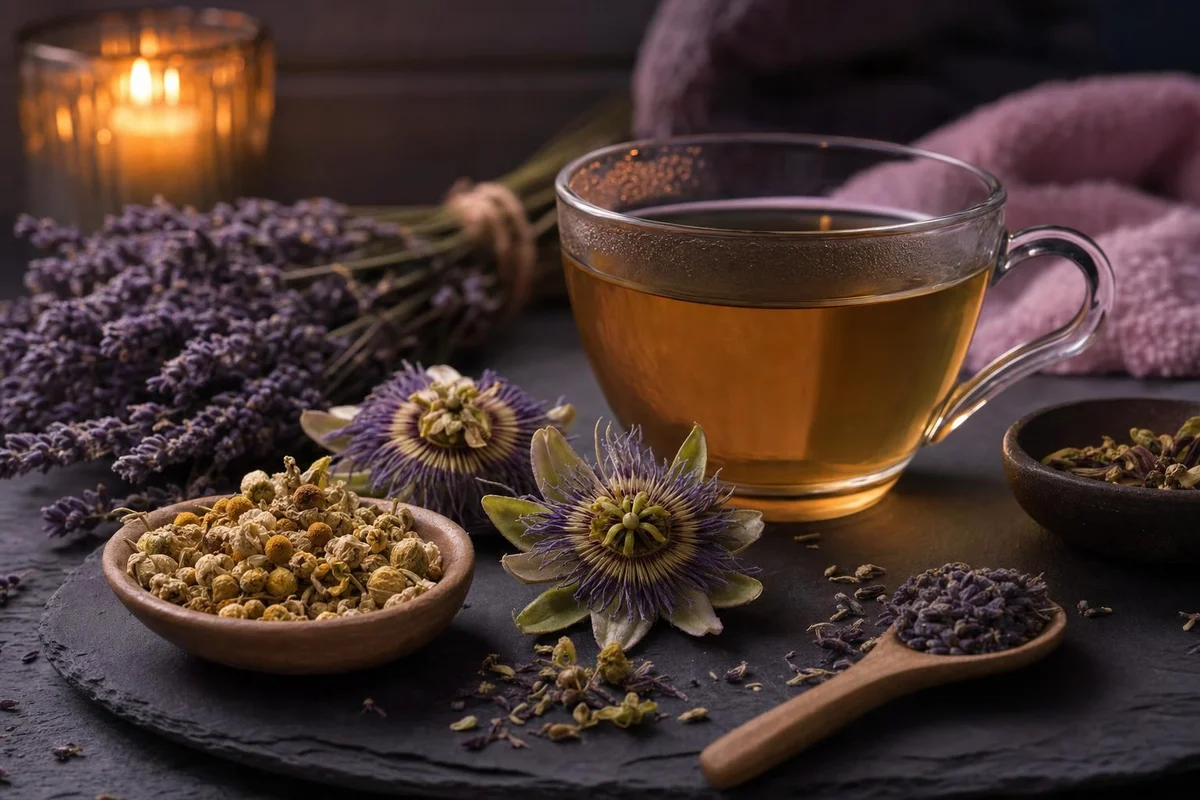
Passionflower has only a small amount of human research, and NCCIH says the conclusions about anxiety are not definite. Ashwagandha has a more substantial repeated-dose stress/anxiety signal, but that evidence comes from specific extracts studied over weeks rather than a same-night bedtime effect.
Start with the bigger question
Is the main problem occasional arousal, chronic insomnia, or persistent anxiety?
Occasional stressful evening
Avoid converting a single stressful night into a supplement stack. A predictable wind-down, lower stimulation, and protecting the sleep window are lower-complexity first steps.
Chronic insomnia
CBT-I has a strong guideline recommendation for adults with chronic insomnia. Sleep hygiene can support it, but a ranked herb list is not an evidence-equivalent replacement.
Persistent or impairing anxiety
If anxiety is frequent, escalating, causing panic, or impairing daily life, treat that as an anxiety-care question rather than a search for the strongest nighttime supplement.
Match the actual sleep pattern
Racing thoughts, sleep onset, sleep maintenance, and circadian timing are different questions
Stress can make it harder to fall asleep, but repeated or prolonged waking after sleep begins—or difficulty returning to sleep—is a maintenance problem. Brief awakenings can be normal. Feeling sleepy at the wrong clock time can instead be a circadian-timing problem. These patterns can overlap; one does not prove the others or identify a supplement.
Evidence by ingredient
What the better human evidence actually supports
L-theanine
Anxiety evidence: inconsistentThe 2026 meta-analysis included 31 randomized trials and 1,168 participants. A single 200 mg dose studied 30–60 minutes before cognitive testing improved choice reaction time; acute-stress reduction was modest and sensitive to study quality, while anxiety effects were inconsistent and generally non-significant. That does not support calling L-theanine a dependable same-night anxiolytic.
Passionflower
Evidence: sparseNCCIH says passionflower has not been studied extensively. A small amount of research suggests possible anxiety or pre-procedure benefit, but conclusions are not definite. For sleep, total sleep time may improve in some studies while sleep-onset and sleep-maintenance findings are mixed.
Safety matters: drowsiness, dizziness, and confusion are possible; passionflower can interact with anesthesia and should not be used during pregnancy because of uterine-contraction concerns.
Ashwagandha
Repeated-dose signalA 2024 meta-analysis pooled nine randomized placebo-controlled trials and 558 participants and reported reductions in stress/anxiety measures and cortisol. A representative 2026 trial enrolled 141 healthy men and women ages 18–65 with moderate stress and anxiety and randomized them for 8 weeks to 300 mg of a proprietary ashwagandha root extract twice daily, another root extract, or placebo. That is repeated-dose, formulation-specific evidence in stressed adults—not evidence of an immediate bedtime effect or a class effect for every powder, extract, or product shown below.
Valerian and other sedating herbs
Do not over-rankValerian, lemon balm, magnolia, and other calming herbs are frequently marketed for bedtime use, but direct anxiety evidence is not strong enough to build a reliable symptom-to-herb ranking. Sedation also changes the safety calculation, especially with alcohol, sleep medication, benzodiazepines, opioids, or other central-nervous-system depressants.
Lower-risk first layer
What to prioritize tonight before adding another supplement
- • Protect a consistent sleep opportunity and reduce avoidable late stimulation rather than chasing a stronger sedative effect.
- • If caffeine is contributing to evening arousal, changing caffeine timing is more direct than adding a supplement to counteract it.
- • A short written “brain dump,” relaxation exercise, or low-stimulation wind-down can be useful components of a bedtime routine.
- • If insomnia is chronic, move beyond sleep-hygiene tips and consider CBT-I, which has stronger guideline support than supplement ranking.
A bedtime routine is not a substitute for evaluation when anxiety, depression, panic, trauma symptoms, sleep apnea, restless legs, substance use, medication effects, or another condition may be driving the sleep problem.
Safety and interactions
- • Do not assume “natural” means non-sedating or interaction-free. Alcohol and prescription sedatives can compound impairment.
- • Passionflower: possible drowsiness, dizziness, and confusion; avoid during pregnancy and discuss use around surgery/anesthesia.
- • Ashwagandha: pregnancy, thyroid, autoimmune, medication, and rare liver-injury concerns deserve specific review.
- • L-theanine: short trials are generally reassuring, but that does not establish unlimited long-term safety or compatibility with every medication or condition.
- • If nighttime anxiety is frequent, severe, or impairing, supplements should not delay established mental-health or sleep care.
- • Immediate stop rule: if anxiety comes with suicidal thoughts, thoughts of self-harm, an inability to stay safe, or imminent danger, seek immediate emergency or crisis care rather than trying another supplement.
Sources and directness notes
- 1. L-theanine systematic review and meta-analysis of 31 randomized trials (2026) — 31 RCTs and 1,168 participants; robust short-term attention signal, modest bias-sensitive acute-stress effect, and inconsistent anxiety findings.
- 2. Ashwagandha stress and anxiety systematic review and meta-analysis (2024) — Nine randomized trials and 558 participants; pooled effects versus placebo using specific formulations, with heterogeneity and unresolved long-term safety.
- 3. Ashwagandha root-extract randomized trial in adults with moderate stress and anxiety (2026) — 141 healthy adults ages 18–65; 8-week three-arm trial comparing 300 mg proprietary root extract twice daily, another root extract, and placebo.
- 4. NCCIH: Passionflower usefulness and safety — Small amount of research; anxiety conclusions are not definite, sleep findings are mixed, and pregnancy/anesthesia cautions matter.
- 5. NCCIH: Anxiety and complementary health approaches — Complementary approaches can carry side effects and medication interactions and should not substitute for established care for an anxiety disorder.
- 6. American Academy of Sleep Medicine: behavioral and psychological treatments for chronic insomnia — Strong recommendation for cognitive behavioral therapy for insomnia (CBT-I) in adults with chronic insomnia disorder.
Sourcing options
Product sourcing examples
Recommendation status
Product recommendations are not shown for this profile because the current site safety and monetization policy does not permit them.
Frequently asked questions
What herb works fastest for nighttime anxiety?
Current evidence does not establish a reliably fast herbal treatment for nighttime anxiety. L-theanine is often studied 30–60 minutes before cognitive testing, but a 2026 meta-analysis found its strongest acute signal in attention while anxiety outcomes were inconsistent. Study timing should not be converted into a guaranteed anxiety-relief onset.
Is passionflower a reliable bedtime anxiety remedy?
Not based on current evidence. NCCIH describes only a small amount of human research, with conclusions about anxiety not definite and mixed findings for sleep onset and staying asleep. Passionflower can also cause drowsiness, dizziness, and confusion and should not be used during pregnancy.
Does ashwagandha have a proven immediate bedtime effect?
No immediate bedtime effect has been established. The better human evidence comes from repeated-dose trials and meta-analyses in adults with stress or anxiety symptoms using specific extracts over weeks. That does not establish an acute effect or a class effect for every ashwagandha product.
What if anxiety keeps me awake most nights?
Frequent nighttime anxiety and chronic insomnia deserve more than supplement ranking. Cognitive behavioral therapy for insomnia (CBT-I) is strongly recommended for chronic insomnia, and persistent or impairing anxiety should be evaluated rather than managed only with herbs.
Can calming herbs be combined with sleep or anxiety medication?
Do not assume they are compatible. Sedating supplements can add to alcohol, sleep medicines, benzodiazepines, opioids, anesthesia, and other central-nervous-system depressants. Medication interactions and medical conditions should be reviewed with a pharmacist or clinician before regular use.
Free safety checklist
Get the evidence-first supplement notes
Occasional research updates, practical safety context, and new guide announcements. No diagnosis, treatment, or personal medical advice.
We use your email to send the checklist and occasional evidence-first supplement updates. Unsubscribe anytime. Privacy policy.