Evidence Review · 25 Clinical Sources

Sleep Supplements for Insomnia: What Works, What Does Not

“Sleep supplement” is not one treatment category. Melatonin, minerals, amino acids, herbs and food-derived products target different pathways and have very different human evidence. This page is the comparison hub: it tells you which supplement claims are reasonably supported, which are preliminary, and which are mostly marketing.

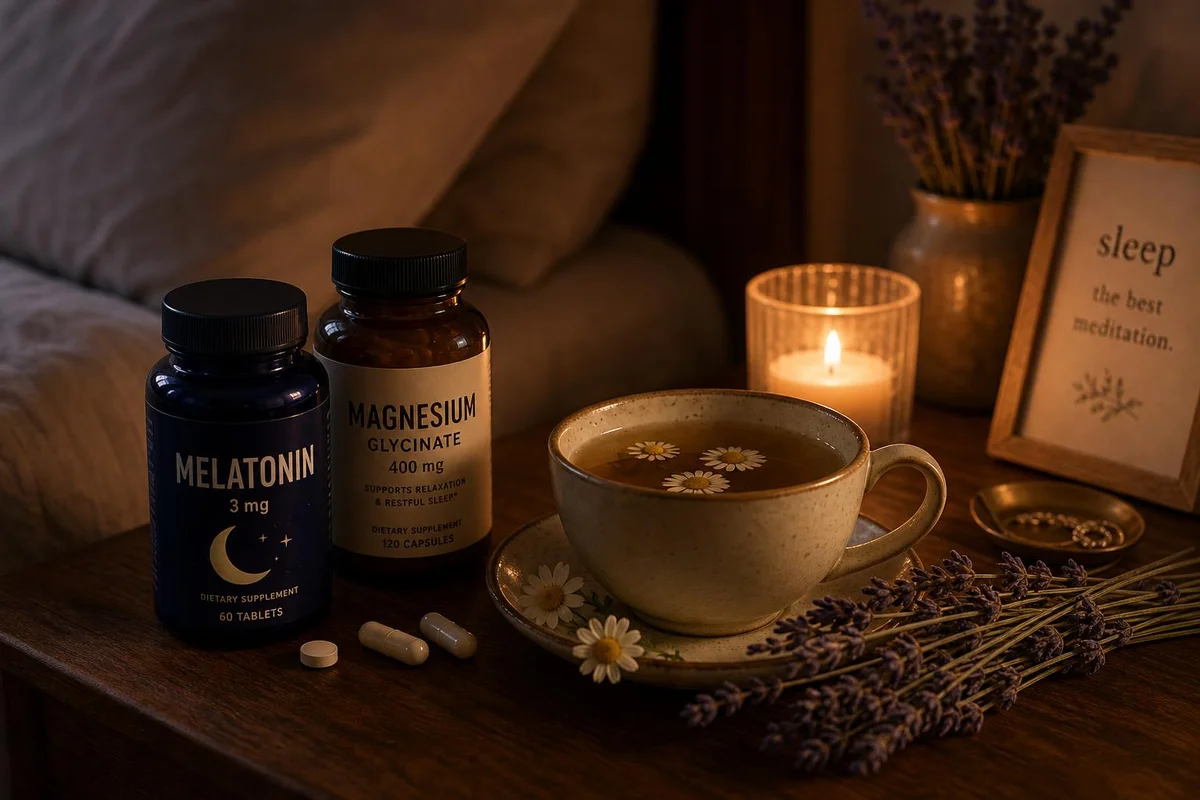
Sleep supplements beside chamomile tea and lavender
A supplement label tells you what is in the bottle; clinical evidence tells you whether that ingredient has actually improved sleep in humans.

Direct answer

What are the best supplements for insomnia?

For chronic insomnia, no supplement has the evidence base of CBT-I. Major clinical guidelines recommend CBT-I as initial treatment, and a 2024 network meta-analysis found it superior to pharmacotherapy for long-term remission.[1][2][4]

Among supplements, melatonin has the clearest role when circadian timing is involved;[9][10] L-theanine has promising recent meta-analytic evidence for subjective sleep outcomes;[11][12] and magnesium, ashwagandha, valerian, passionflower, glycine, chamomile, tryptophan and tart cherry have increasingly limited or heterogeneous evidence.[13][15][16][17][20][22][23][24]

Evidence matrix

Sleep supplements ranked by strength of evidence

The ranking reflects human sleep outcomes, not traditional use or mechanism. Reviews of complementary and OTC insomnia interventions consistently describe a mixed, heterogeneous evidence base.[6][7][8]

OptionEvidenceBest-fit claimMain limitation
MelatoninModerate / context-specificCircadian timing; modest average sleep-onset effectsNot a universal sedative; timing and disorder matter
L-theanineLow-to-moderateSubjective sleep quality; emerging evidenceClinical-insomnia and dose-duration evidence remain limited
MagnesiumLow / very lowPossible benefit in some older adults or low-status contextsSmall, low-quality insomnia trial base
AshwagandhaLow-to-moderateSleep complaints where stress may coexistSmall heterogeneous trial base; extracts vary
ValerianLow / inconclusivePossible subjective sleep-quality improvement2024 umbrella review found no demonstrated insomnia efficacy
PassionflowerLow / preliminaryShort-term sleep-quality or total-sleep-time signalSmall evidence base; pregnancy warning
GlycineLow / preliminarySubjective sleep quality and next-day fatigue signalsSmall studies; not established for insomnia
ChamomileLow-to-moderateSleep-quality signal in heterogeneous trialsObjective outcomes and product standardization remain weak
TryptophanLow-to-moderateMay reduce wake after sleep onset in some studiesEffects not consistent across all sleep outcomes
Tart cherryLow / preliminaryPossible sleep-duration or efficiency signalOnly seven interventional studies in 2025 review; heterogeneous

Melatonin: strongest when the problem is timing

A meta-analysis of 19 placebo-controlled studies found modest improvements in sleep latency, total sleep time and sleep quality across primary sleep disorders.[9] A separate adult review found especially convincing evidence around delayed sleep phase and other circadian-related problems.[10] The AASM chronic-insomnia pharmacologic guideline, however, suggested against melatonin for adult sleep-onset or sleep-maintenance insomnia based on the evidence available for that indication.[5]

Best interpretation: melatonin is a circadian tool with modest sleep effects, not a universal natural sleeping pill.

Melatonin evidence profile →

L-theanine: promising, but not established for clinical insomnia

A 2025 meta-analysis covering 19 articles and 897 participants found small improvements in subjective sleep-onset latency, daytime dysfunction and overall subjective sleep quality.[11] A 2026 review of 13 standalone L-theanine trials also found beneficial signals, while emphasizing the need for more high-quality clinical-insomnia research.[12]

Best interpretation: a legitimate emerging sleep-support ingredient, but not a validated protocol for racing thoughts or insomnia disorder.

L-theanine evidence profile →

Magnesium: evidence is much weaker than the hype

A 2021 systematic review identified only three randomized trials in 151 older adults. Sleep-onset latency improved in pooled analysis, but total sleep time did not significantly improve, and certainty was low to very low.[13]That does not establish magnesium glycinate, citrate or another form as a universal insomnia treatment.

NIH notes that supplemental magnesium can cause gastrointestinal adverse effects, and kidney function changes the risk from excess magnesium. The adult upper limit from supplements and medications is 350 mg/day unless a clinician recommends otherwise; food magnesium is not included in that limit.[14]

Magnesium for sleep →

Ashwagandha: small sleep benefit in a small evidence base

A 2021 meta-analysis of five randomized trials (400 participants) found a small but significant overall sleep effect, with larger effects in some insomnia, higher-dose and longer-duration subgroups.[15] Because the trials used particular extracts and the evidence base is small, this does not prove every ashwagandha powder or gummy works for sleep.

Ashwagandha evidence profile →

Valerian: popular, but no demonstrated insomnia efficacy

A 2024 umbrella review concluded that valerian had no demonstrated efficacy for insomnia, although some systematic reviews showed subjective sleep-quality improvement. Objective and quantitative results were inconsistent and the underlying literature was heterogeneous.[16]

Valerian evidence profile →

Passionflower: preliminary randomized evidence

A 2020 placebo-controlled trial in adults with insomnia found an increase in total sleep time of about 23 minutes relative to placebo, while between-group differences in sleep efficiency and wake-after-sleep-onset were not significant.[17] An earlier passionflower-tea study found a subjective sleep-quality signal in healthy adults.[18]

Safety: NCCIH advises against passionflower during pregnancy because it may induce uterine contractions.[19]

Passionflower evidence profile →

Glycine: interesting, but still preliminary

A 2023 systematic review concluded that glycine has been studied across several physiological outcomes, including sleep, but the human sleep evidence remains small.[20] In partially sleep-restricted healthy adults, 3 g at bedtime improved some next-day fatigue and sleepiness measures compared with placebo.[21]

Glycine for sleep →

Chamomile: some sleep-quality benefit, limited objective evidence

A 2024 systematic review and meta-analysis of ten studies (772 participants) found improved Pittsburgh Sleep Quality Index scores and some signals for sleep onset or nighttime awakenings, but no clear improvement in sleep duration, sleep efficiency or daytime functioning. Heterogeneity was high and product testing was uncommon.[22]

Best interpretation: chamomile may improve perceived sleep quality for some people, but it is not established as a treatment for insomnia disorder.

Tryptophan: a narrower signal than “helps sleep” suggests

A systematic review, meta-analysis and meta-regression found tryptophan supplementation was associated with less wake after sleep onset, while other sleep components were not consistently improved.[23] That is a more precise claim than saying tryptophan broadly treats insomnia.

Tart cherry: plausible, food-based, but still early

A 2025 systematic review identified seven interventional studies. Three reported improvements in outcomes such as sleep duration, efficiency or onset, but the review emphasized large differences in dose, duration and study populations and concluded that the evidence remained limited and heterogeneous.[24]

Why sleep hygiene is not a substitute for insomnia treatment

Better sleep habits can help, but a 2025 meta-analysis of 42 randomized trials found sleep-hygiene education was inferior to CBT-I and partial CBT-I approaches for insomnia severity.[25] This matters because supplement content often frames the choice as “fix your bedtime routine or buy a capsule,” when chronic insomnia usually needs a more structured approach.

A safer decision sequence

  1. Identify the target: sleep timing, falling asleep, repeated waking, early waking or chronic insomnia.
  2. Rule out the obvious mismatch: a circadian problem is different from sleep apnea, restless legs, pain, medication effects or anxiety-driven arousal.
  3. Match the exact product to the evidence: species, extract, form and amount should resemble what was actually studied.
  4. Avoid proprietary stacks when possible: they make evidence matching and side-effect attribution difficult.
  5. Escalate the evaluation, not the stack: persistent insomnia deserves cause-focused care and CBT-I rather than indefinite supplement accumulation.[1][2]

Safety checks that belong before a cart

  • Do not combine several sedating supplements with alcohol, prescription sedatives or antihistamines and assume the effects will remain mild.
  • Supplemental magnesium can cause GI effects and deserves extra caution with impaired kidney function.[14]
  • Passionflower should not be used during pregnancy because of the uterine-contraction warning.[19]
  • Product identity matters: evidence for one standardized extract does not automatically apply to every tea, gummy or proprietary blend.
  • Persistent insomnia, breathing pauses, severe daytime sleepiness, restless legs or safety impairment need evaluation rather than stronger supplementation.
Read the health-information disclaimer

Frequently asked questions

What are the best supplements for insomnia?

No supplement is a first-line treatment for chronic insomnia. CBT-I has stronger guideline support. Among supplements, melatonin has the clearest role when circadian timing is involved; L-theanine has promising recent evidence for subjective sleep outcomes; magnesium, glycine, valerian, passionflower, ashwagandha, chamomile, tryptophan and tart cherry have more limited, heterogeneous or population-specific evidence.

Which sleep supplement has the strongest evidence?

That depends on the target. Melatonin has the most clearly defined role for circadian timing problems and modest average effects in some primary sleep disorders. For chronic insomnia itself, CBT-I is better supported than any supplement. Newer evidence for L-theanine is encouraging but not yet strong enough to call it a proven insomnia treatment.

Does magnesium help insomnia?

Possibly for some people, but the evidence is weak. A systematic review found only three randomized trials in 151 older adults, with low to very-low certainty. That evidence does not establish magnesium glycinate as a universal insomnia treatment or prove that one magnesium form is best for sleep.

Does glycine powder help sleep?

Small human studies suggest bedtime glycine may improve subjective sleep quality and some next-day fatigue measures, but the evidence base is much smaller than for established insomnia treatments. It is best described as promising and preliminary.

Is valerian a natural sleeping pill?

Valerian is widely marketed for sleep, but a 2024 umbrella review found no demonstrated efficacy for treating insomnia, despite some subjective sleep-quality signals. Calling it a proven natural sleeping pill would overstate the evidence.

Can sleep supplements be combined?

Do not assume a stack is more effective because each ingredient has a plausible mechanism. Multi-ingredient trials test specific formulas and cannot prove that every pair is synergistic. Combining sedating products can also increase impairment and make side effects harder to identify.

Are sleep supplements safe every night?

Nightly safety varies by ingredient, dose, duration, medications, kidney function, pregnancy status and product quality. Short-term tolerability in a trial is not proof of indefinite use. Persistent insomnia should trigger cause-focused evaluation rather than an ever-larger supplement stack.

When should insomnia be evaluated instead of treated with supplements?

Evaluation is important when insomnia is persistent, causes daytime impairment, or occurs with loud snoring or breathing pauses, restless legs, severe sleepiness, mood deterioration, pain, medication changes, or safety problems such as drowsy driving.

Related reading

Sourcing options

Magnesium sourcing examples—only when magnesium fits

Recommendation status

Product recommendations are not shown for this profile because the current site safety and monetization policy does not permit them.

References

25 sources

  1. 01
    Management of Chronic Insomnia Disorder in Adults: A Clinical Practice Guideline From the American College of Physicians Qaseem A, et al. Ann Intern Med. 2016;165(2):125-133.
  2. 02
    Behavioral and psychological treatments for chronic insomnia disorder in adults: an AASM clinical practice guideline Edinger JD, et al. J Clin Sleep Med. 2021.
  3. 03
    Combination treatment for chronic insomnia disorder in adults: an AASM clinical practice guideline AASM guideline. 2026.
  4. 04
    Initial treatment choices for long-term remission of chronic insomnia disorder in adults Systematic review and network meta-analysis of CBT-I, pharmacotherapy and combination treatment.
  5. 05
    Clinical Practice Guideline for the Pharmacologic Treatment of Chronic Insomnia in Adults Sateia MJ, et al. J Clin Sleep Med. 2017.
  6. 06
    Identifying complementary and alternative medicine recommendations for insomnia treatment and care Systematic review of clinical practice guidelines.
  7. 07
    Over-the-counter products for insomnia in adults: A scoping review of randomised controlled trials Review of 51 randomized controlled trials.
  8. 08
    Dietary Supplement Interventions and Sleep Quality Improvement: A Systematic Review and Meta-Analysis Meta-analysis of 28 randomized trials.
  9. 09
    Meta-analysis: melatonin for the treatment of primary sleep disorders Ferracioli-Oda E, Qawasmi A, Bloch MH. PLoS One. 2013.
  10. 10
    Evidence for the efficacy of melatonin in the treatment of primary adult sleep disorders Systematic review and meta-analysis.
  11. 11
    The effects of L-theanine consumption on sleep outcomes: A systematic review and meta-analysis Bulman A, et al. Sleep Med Rev. 2025;81:102076.
  12. 12
    Examining the effect of L-theanine on sleep: a systematic review of dietary supplementation trials Systematic review of 13 standalone L-theanine trials.
  13. 13
    Oral magnesium supplementation for insomnia in older adults: a Systematic Review & Meta-Analysis Mah J, Pitre T. BMC Complement Med Ther. 2021.
  14. 14
    Magnesium Fact Sheet for Consumers NIH Office of Dietary Supplements.
  15. 15
    Effect of Ashwagandha (Withania somnifera) extract on sleep: A systematic review and meta-analysis Cheah KL, et al. PLoS One. 2021.
  16. 16
    Does valerian work for insomnia? An umbrella review of the evidence Valente V, et al. Eur Neuropsychopharmacol. 2024.
  17. 17
    Effects of Passiflora incarnata on polysomnographic sleep parameters in subjects with insomnia disorder Double-blind randomized placebo-controlled study.
  18. 18
    A double-blind, placebo-controlled investigation of Passiflora incarnata herbal tea on subjective sleep quality Ngan A, Conduit R. Phytother Res. 2011.
  19. 19
    Passionflower: Usefulness and Safety National Center for Complementary and Integrative Health.
  20. 20
    The effect of glycine administration on physiological systems in human adults: a systematic review Systematic review including sleep outcomes.
  21. 21
    The effects of glycine on subjective daytime performance in partially sleep-restricted healthy volunteers Bannai M, et al. Front Neurol. 2012.
  22. 22
    Effects of chamomile on sleep: A systematic review and meta-analysis of clinical trials Kazemi A, et al. Complement Ther Med. 2024.
  23. 23
    The impact of tryptophan supplementation on sleep quality: a systematic review, meta-analysis, and meta-regression Sutanto CN, Loh WW, Kim JE. Nutr Rev. 2022.
  24. 24
    The Effect of Tart Cherry on Sleep Quality and Sleep Disorders: A Systematic Review Systematic review of seven interventional studies.
  25. 25
    Effects of sleep hygiene education for insomnia: A systematic review and meta-analysis Systematic review of 42 randomized trials.

Free safety checklist

Get evidence reviews like this

Sleep supplements, melatonin, magnesium — evidence over marketing.

We use your email to send the checklist and occasional evidence-first supplement updates. Unsubscribe anytime. Privacy policy.

Editorial reading context

How to read Sleep Supplements for Insomnia: What Works, What Does Not

Evidence-ranked sleep supplements for insomnia: melatonin, magnesium, L-theanine, glycine, valerian, passionflower, ashwagandha, chamomile, tryptophan… This guide is intended to help readers make sense of evidence, safety, and practical fit without turning supplement research into a one-size-fits-all checklist. Use it alongside the linked herb and compound profiles for deeper mechanism and safety details.

For Sleep Supplements for Insomnia: What Works, What Does Not, focus on whether the evidence matches the exact outcome you care about, whether the dose discussed is realistic, and whether the safety profile fits your medical context. Strong marketing language should carry less weight than human evidence and transparent product quality.

When a page discusses dependence-forming substances, restricted compounds, or high-risk contexts, treat it as harm-reduction education only. It is not a buying guide, dosing instruction, or substitute for professional care.