As an Amazon Associate I earn from qualifying purchases. We may earn a commission from qualifying links at no extra cost to you. How we stay independent.
Evidence Guide · Rhodiola Hub
Rhodiola Extract vs Powder
What Human Studies Tested — and What Form Alone Cannot Tell You
Human studies have mostly evaluated named or characterized rhodiola extracts rather than retail root powder. That makes some extracts easier to compare with the research, but it does not establish that extracts work better than powder—and the overall clinical evidence for rhodiola remains limited.
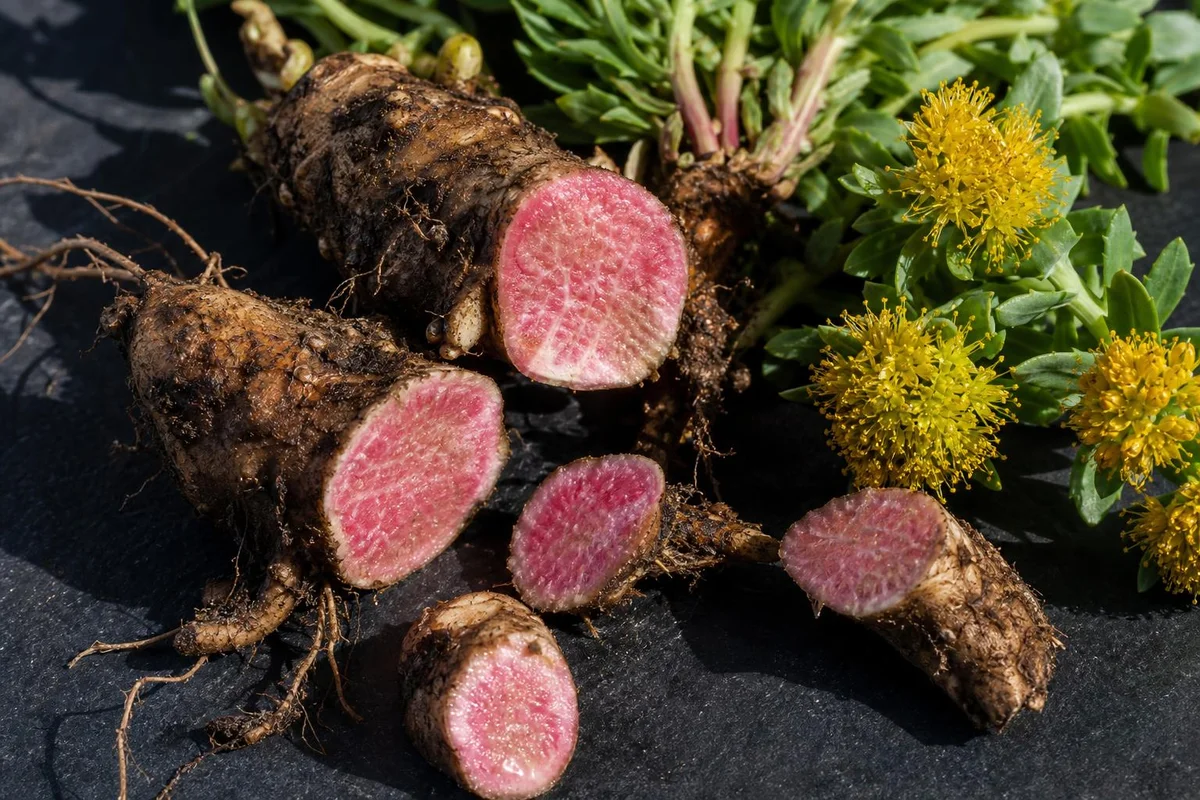
Quick Comparison
Characterized Extract
1 of 2- Product definition
- May declare extract ratio or marker compounds
- Human evidence
- Several named extracts studied; overall evidence remains limited
- Dose comparison
- Compare only with the specific extract studied
- What the form tells you
- Potentially better traceability to a specific study intervention
- What the form does not prove
- Clinical effectiveness or equivalence to another extract
Root Powder
2 of 2- Product definition
- Ground root/rhizome with natural batch variation
- Human evidence
- Little direct outcome evidence located
- Dose comparison
- No reliable milligram-for-milligram conversion from extract trials
- What the form tells you
- A whole-root format
- What the form does not prove
- Clinical superiority or inferiority to an extract
What the Research Actually Used
The human trials are not interchangeable. Their participants, preparations, comparators, durations, and outcomes differ enough that a positive result should stay attached to the exact intervention studied.
- Stress-related fatigue: a 2009 randomized double-blind trial enrolled 60 adults ages 20–55 who met Swedish criteria for fatigue syndrome. Thirty received the proprietary SHR-5 extract at 576 mg/day and 30 received placebo for 28 days. Some fatigue, attention, and cortisol outcomes favored SHR-5, while several symptom measures improved in both groups.
- Night-duty physicians: a 2000 double-blind crossover trial studied 56 young, healthy physicians during night shifts. Participants used a repeated low-dose SHR-5 regimen for a two-week treatment period versus placebo, with a washout and crossover; the primary signal was improved performance on a composite of mental-fatigue tests during the first treatment period.
- Shift-work nursing students: a later randomized placebo-controlled trial enrolled 48 nursing students ages 18–55. The rhodiola group used 364 mg at the start of the wakeful period, with up to one additional capsule within four hours, for 42 days. On the study's fatigue outcomes, the placebo group did better—an important reminder that the clinical literature is not uniformly positive.
The European Medicines Agency's current assessment is an important reality check: its conclusion for temporary relief of stress symptoms such as fatigue and weakness is based on long-standing traditional use, not sufficient clinical-trial evidence. The agency notes that the clinical studies it reviewed were small and had several shortcomings.
Named or characterized extracts
Specific extracts have been tested in small human trials, but the broader evidence base is not strong enough to treat standardization as proof of clinical effectiveness. Results apply most directly to the preparation studied.
Retail whole-root powder
Direct human outcome evidence for retail whole-root powder was not identified in the sources reviewed for this page. That is an evidence gap, not evidence that powder is ineffective.
How Trial Doses Translate
This table scrolls horizontally on small screens. Use Tab to focus the table region, then scroll with arrow keys or touch.
| Form | Typical Range | Notes |
|---|---|---|
| SHR-5 extract | Study-specific | Trials used specific SHR-5 regimens; those amounts do not automatically apply to another extract |
| Other characterized extracts | Study-specific | Check the exact extract, preparation, and study before comparing milligram amounts |
| Root powder | No evidence-based equivalent | Do not convert an extract trial dose to powder from capsule weight alone |
Rhodiola preparations are not interchangeable by milligram weight. Trial amounts describe the exact preparation studied; they are not a universal rhodiola dose or personal treatment recommendation.
How to Read a Rhodiola Label
- Confirm the botanical and plant part — look for Rhodiola rosea root/rhizome rather than an unspecified rhodiola species.
- Read the preparation details — an extract ratio, solvent, or declared marker compounds can make the product easier to characterize.
- Look for transparent testing — credible independent certification or a lot-specific certificate of analysis can support identity and contaminant checks.
- Be cautious with proprietary blends — they can make it impossible to determine how much rhodiola a serving actually contains.
Check before using
Rhodiola safety and interaction checks
- NCCIH describes rhodiola as possibly safe for up to 12 weeks; longer-term safety remains uncertain.
- Reported effects can include dizziness, headache, insomnia, and dry mouth or excess saliva.
- Ask a clinician or pharmacist before combining rhodiola with prescription medicines; supplement-drug interaction data are incomplete.
- Pregnancy and breastfeeding safety data are insufficient. Persistent fatigue, mood, or sleep symptoms deserve evaluation rather than self-treatment with a supplement.
Source ledger
References
7 sources
- 01Panossian A, et al. (2010). Rhodiola rosea: traditional use, composition, and clinical trials. Phytomedicine, 17(7): 481-493. PubMed →
- 02Olsson EM, et al. (2009). Rhodiola rosea for stress-related fatigue. Planta Med, 75(2): 105-112. PubMed →
- 03Darbinyan V, et al. (2000). Rhodiola rosea in stress-induced fatigue. Phytomedicine, 7(5): 365-371. PubMed →
- 04Ishaque S, et al. (2012). Rhodiola rosea for physical and mental fatigue: a systematic review. BMC Complement Altern Med, 12:70. PubMed →
- 05Duncan J, et al. (2014). Rhodiola rosea for mental and physical fatigue in nursing students: a randomized controlled trial. PLoS One, 9(9):e108416. PubMed →
- 06European Medicines Agency. Rhodiola rosea L., rhizoma et radix: European Union herbal monograph and public assessment summary, revision 1 (updated 2024). Source →
- 07National Center for Complementary and Integrative Health. Rhodiola: usefulness and safety. Source →
FAQ
Common Questions About Rhodiola Forms
Free safety checklist
Get the evidence-first supplement notes
Occasional research updates, practical safety context, and new guide announcements. No diagnosis, treatment, or personal medical advice.
We use your email to send the checklist and occasional evidence-first supplement updates. Unsubscribe anytime. Privacy policy.