Related Guides
Goal and condition context for deciding what to read next.
Herb Profile
Rhodiola rosea
Rhodiola rosea is a stimulating adaptogen best matched to stress related fatigue and mental stamina, not bedtime calming.
Use extra caution — Short term human studies often report few/no obvious adverse reactions, but trial reporting quality is weak and interaction data are incomplete. Details
Bottom line
Safety: Can be over-stimulating and disrupt sleep if taken late; discuss with a clinician if you have a bipolar-spectrum condition or take stimulants or antidepressants.
On the evidence: Several human trials for fatigue and stress, but heterogeneous extracts and small samples.
Best for
Not ideal for
Why not higher
Why not lower
Practical takeaway: Reasonable to try for stress-driven fatigue, taken earlier in the day. Treat it as mild support, not a primary treatment for a mood or anxiety condition.
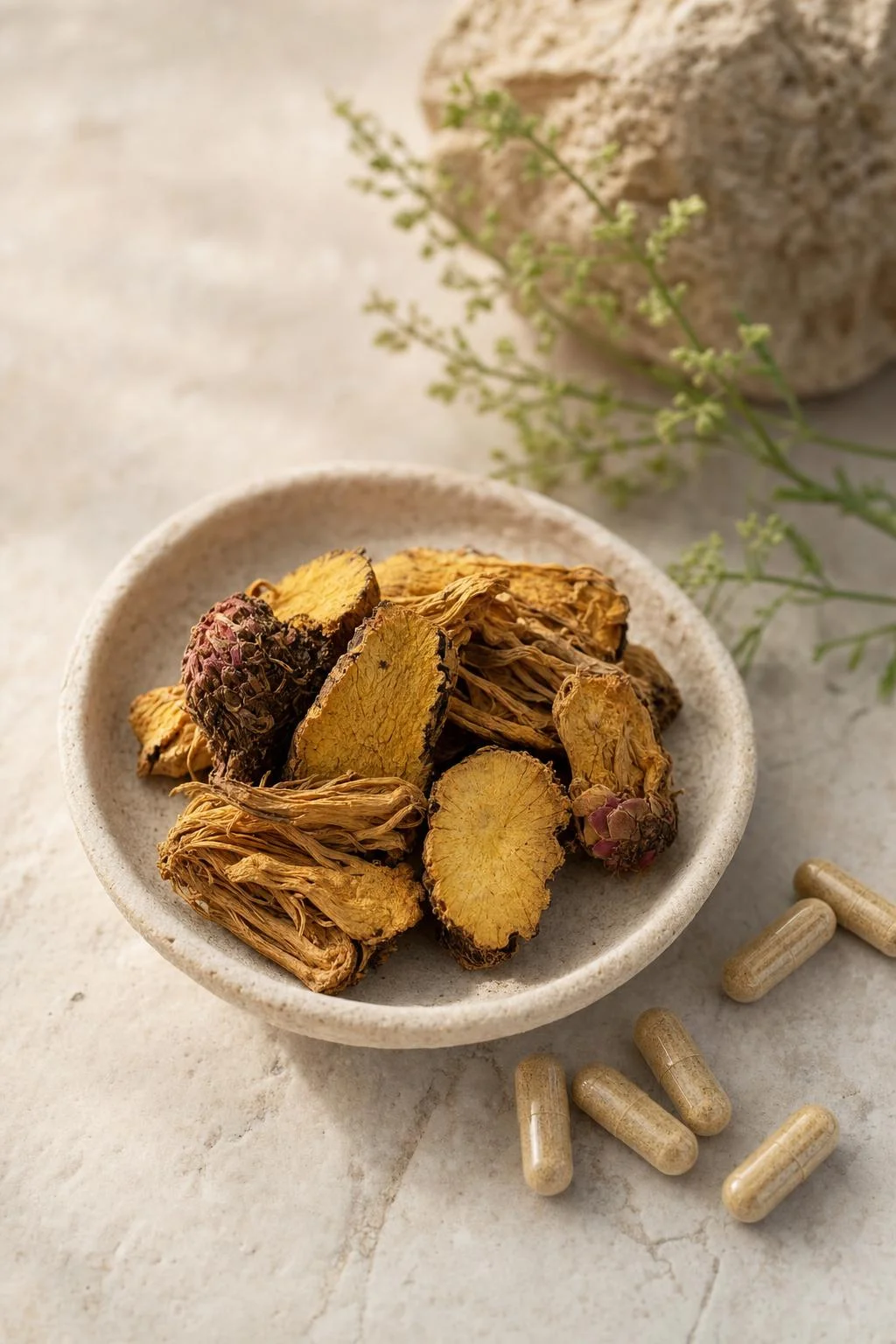
Informational to commercial: understand what Rhodiola rosea can plausibly support — stress-related fatigue, burnout, and mental/physical endurance — while choosing a standardized extract and respecting an activating, evidence-limited profile.
| Use case | Evidence | Best fit | Typical range | Safety context |
|---|---|---|---|---|
| Stress-related fatigue and burnout | Preliminary to moderate | Adults with low-drive, stress-linked tiredness rather than a sleep or medical cause | 200-400 mg/day standardized extract, usually earlier in the day | Can feel activating; avoid late dosing and review stimulant and bipolar context. |
| Mental fatigue and endurance | Preliminary / mixed | Short-term mental stamina under stress or fatigue | Study doses commonly 200-600 mg/day standardized extract | Trials are small and inconsistent; expect a subtle effect, not stimulation. |
| Physical/endurance performance | Preliminary | Training-adjacent fatigue experiments | Acute and short-term dosing varies by study | Evidence is limited and not a substitute for training, sleep, or recovery. |
| Mood and low-mood symptoms | Preliminary | Mild stress-linked low mood, not a treatment for depression | Trial-specific extracts over weeks | Not a replacement for mental-health care; seek evaluation for persistent symptoms. |
Safety
Short term human studies often report few/no obvious adverse reactions, but trial reporting quality is weak and interaction data are incomplete. Potential activating effects should be acknowledged.
High caution
Caution level: High. Multiple caution categories apply, or the record uses avoid/contraindication language.
Evidence-based safety
Severity and certainty are shown separately. A high-priority caution can still be theoretical: these pairings are screened from shared contraindication mechanisms and are not automatically documented clinical interactions. Provenance identifies the source fields that produced each flag; it does not upgrade the certainty of the pairwise claim.
Serotonergic activity
Representative pairings are shown below. Large mechanism groups are intentionally summarized to keep profiles focused and crawl-efficient.
Data provenance recorded for 26 of 26 pairings in this mechanism group.
+14 more pairings share this mechanism. Use the Safety Checker to review a specific combination.
Evidence
Read as directional context, not settled clinical proof.
Human clinical evidence: Present in source signals
Mechanistic / preclinical: Mechanism mapped — Neurotransmitter Modulation · Stress Response Modulation · AMPK Signaling
Research maturity: Emerging research — Long Term Human Evidence May Be Limited.
Safety boundary: Safety note available — Short term human studies often report few/no obvious adverse reactions, but trial reporting quality is weak and interaction data are incomplete.
This profile cites 25 human studies.
Evaluation of methodological rigor, population reach, and evidence alignment.
Each grade reflects the strength and consistency of published human evidence — not marketing claims. Grades are based on study count, design quality, effect size, consistency, and recency.
Filter by study class
Showing 24 of 24 studies.
What the evidence actually shows
This table contains 24 structured sources, including 13 human evidence sources; 6 are human trials. Across 1 human evidence source with a reported sample size, the approximate participant total is 60; overlapping publications may include some of the same people.
| Study | Design | N | Dose | Duration | Population | Outcome | Result & magnitude | Source |
|---|---|---|---|---|---|---|---|---|
Plant Adaptogens-History and Future Perspectives Todorova V et al. · Nutrients · 2021 Background | Meta-analysis Statistically combines results from multiple eligible studies; confidence still depends on the quality, consistency, and directness of those studies. | — | — | — | — | — | — | PubMed → |
Background | Meta-analysis Statistically combines results from multiple eligible studies; confidence still depends on the quality, consistency, and directness of those studies. | — | — | — | — | — | Rhodiola improved VO2max (ES 0.32), time to exhaustion (ES 0.38), and time-trial performance (ES -0.40); antioxidant markers improved and creatine kinase/lactate decreased. | PubMed → |
Rhodiola rosea for physical and mental fatigue: a systematic review 2012 Background | Systematic review Uses a predefined method to find and evaluate relevant studies, but may or may not pool their results statistically. | — | — | — | — | — | — | DOI → |
2023 Background | Systematic review Uses a predefined method to find and evaluate relevant studies, but may or may not pool their results statistically. | — | — | — | — | — | — | DOI → |
Effects of Rhodiola Rosea Supplementation on Exercise and Sport: A Systematic Review 2022 Background | Systematic review Uses a predefined method to find and evaluate relevant studies, but may or may not pool their results statistically. | — | — | — | — | — | — | DOI → |
Background | Systematic review Uses a predefined method to find and evaluate relevant studies, but may or may not pool their results statistically. | — | — | — | — | — | Rhodiola studies reported possible benefits across stress, depressive symptoms, sleep, and cognition over roughly 3–16 weeks. | PubMed → |
Background | Systematic review Uses a predefined method to find and evaluate relevant studies, but may or may not pool their results statistically. | — | — | — | — | — | A systematic review found mixed physical-performance results with Rhodiola rosea. Trained status, preparation, exposure duration, and outcome choice materially affected interpretation. | PubMed → |
PubMed · Planta Med · 2009 Background | Randomized controlled trial Randomly assigns participants to interventions or controls, reducing many sources of bias when the trial is conducted well. | n=60 | — | — | — | — | — | PubMed → |
Rhodiola Rosea for Mental and Physical Fatigue in Nursing Students: A Randomized Controlled Trial 2014 Background | Randomized controlled trial Randomly assigns participants to interventions or controls, reducing many sources of bias when the trial is conducted well. | — | — | — | — | — | — | PubMed → |
Quality Evaluation of Randomized Controlled Trials of Rhodiola Species Li et al. · Evidence-Based Complementary and Alternative Medicine · 2021 Background | Randomized controlled trial Randomly assigns participants to interventions or controls, reducing many sources of bias when the trial is conducted well. | — | — | — | — | — | — | Source → |
Background | Randomized controlled trial Randomly assigns participants to interventions or controls, reducing many sources of bias when the trial is conducted well. | — | — | — | — | — | Low-dose Rhodiola improved several bench-press outcomes; both low and high doses improved leg-press 1RM, and Stroop performance improved across Rhodiola conditions. | PubMed → |
Background | Randomized controlled trial Randomly assigns participants to interventions or controls, reducing many sources of bias when the trial is conducted well. | — | — | — | — | — | The main findings indicated only trivial-to-small effects of Rhodiola on mental fatigue, visuocognitive processing, and perceived exertion. | PubMed → |
Background | Randomized controlled trial Randomly assigns participants to interventions or controls, reducing many sources of bias when the trial is conducted well. | — | — | — | — | — | Rhodiola improved Yo-Yo IR2 versus placebo (p=0.046), improved mean repeated-sprint time, reduced post-exercise lactate, and improved reaction time and decision accuracy under fatigue. | PubMed → |
Ivanova Stojcheva E et al. · Molecules · 2022 Background | Narrative review Summarizes selected literature without the full prespecified search and selection methods of a systematic review. | — | — | — | — | — | — | PubMed → |
Herbal medicine for sports: a review Sellami M et al. · J Int Soc Sports Nutr · 2018 Background | Narrative review Summarizes selected literature without the full prespecified search and selection methods of a systematic review. | — | — | — | — | — | — | PubMed → |
PubMed · Phytomedicine · 2010 Background | Narrative review Summarizes selected literature without the full prespecified search and selection methods of a systematic review. | — | — | — | — | — | — | PubMed → |
Perspective on Roseroot (Rhodiola rosea) Studies 2009 Background | Other / unclear The study design is not yet classified clearly enough to infer its place in the evidence hierarchy. | — | — | — | — | — | — | PubMed → |
Salidroside and exercise performance in healthy active young adults Schwarz et al. · Journal of the International Society of Sports Nutrition · 2024 Background | Other / unclear The study design is not yet classified clearly enough to infer its place in the evidence hierarchy. | — | — | — | — | — | — | Source → |
Rhodiola rosea as an adaptogen to enhance exercise performance Tinsley et al. · British Journal of Nutrition · 2023 Background | Other / unclear The study design is not yet classified clearly enough to infer its place in the evidence hierarchy. | — | — | — | — | — | — | Source → |
The effects of Rhodiola Rosea supplementation on depression, anxiety and mood Konstantinos; Heun · Global Psychiatry · 2020 Background | Other / unclear The study design is not yet classified clearly enough to infer its place in the evidence hierarchy. | — | — | — | — | — | — | Source → |
Adaptogenic Botanicals with Emphasis on Rhodiola rosea and Withania somnifera Machín et al. · European Journal of Medicinal Plants · 2023 Background | Other / unclear The study design is not yet classified clearly enough to infer its place in the evidence hierarchy. | — | — | — | — | — | — | Source → |
The Effectiveness of Rhodiola rosea Preparations in Alleviating Life-Stress Symptoms Stojcheva; Quintela · Molecules · 2022 Background | Other / unclear The study design is not yet classified clearly enough to infer its place in the evidence hierarchy. | — | — | — | — | — | — | Source → |
Effects of Rhodiola Rosea Supplementation on Exercise and Sport Lu et al. · Frontiers in Nutrition · 2022 Background | Other / unclear The study design is not yet classified clearly enough to infer its place in the evidence hierarchy. | — | — | — | — | — | — | Source → |
Background | Other / unclear The study design is not yet classified clearly enough to infer its place in the evidence hierarchy. | — | — | — | — | — | Clinical-trial synthesis suggests a possible fatigue benefit in selected stress- or fatigue-related populations, but small samples, heterogeneous methods, and preparation differences limit confidence. | PubMed → |
Simplified mechanism pathway based on preclinical and pharmacological evidence. Does not confirm clinical efficacy.
Mechanism Pathway — How Rhodiola Works
Key constituents studied in Rhodiola, with full pharmacology and safety profiles.
Explore botanicals with similar chemistry, effects, or safety considerations in the Botanical Activity Atlas.
Compare side-by-side tradeoffs or verify active marker guidelines.
Sourcing options
Product recommendations are not shown for this profile because the current site safety and monetization policy does not permit them.
When sourcing Rhodiola, verify the label for:
Safety first · Harm reduction
This information is educational and not medical advice. Start low, avoid risky combinations, and consult a licensed clinician before making health decisions—especially if you use medications, have diagnosed conditions, or are pregnant/breastfeeding.
Learn how we evaluate confidence, safety, and intensity on the methodology page.
Founder & Head Researcher · Oak Ridge, TN · Last reviewed August 2026
Checked against primary sources, cited evidence, and contraindication language before publication. Evidence claims, safety language, and affiliate modules are reviewed independently. Not personal medical advice.
Help improve this profile
These controls record only the page and the structured choice you make when analytics consent is enabled. Please don’t include personal medical information in research requests.
Was this evidence summary clear?
Did you find what you were researching?
Free safety checklist
Evidence summaries, dosing context, and safety updates for this herb — straight to your inbox.
We use your email to send the checklist and occasional evidence-first supplement updates. Unsubscribe anytime. Privacy policy.