Herb Profile
Ginkgo
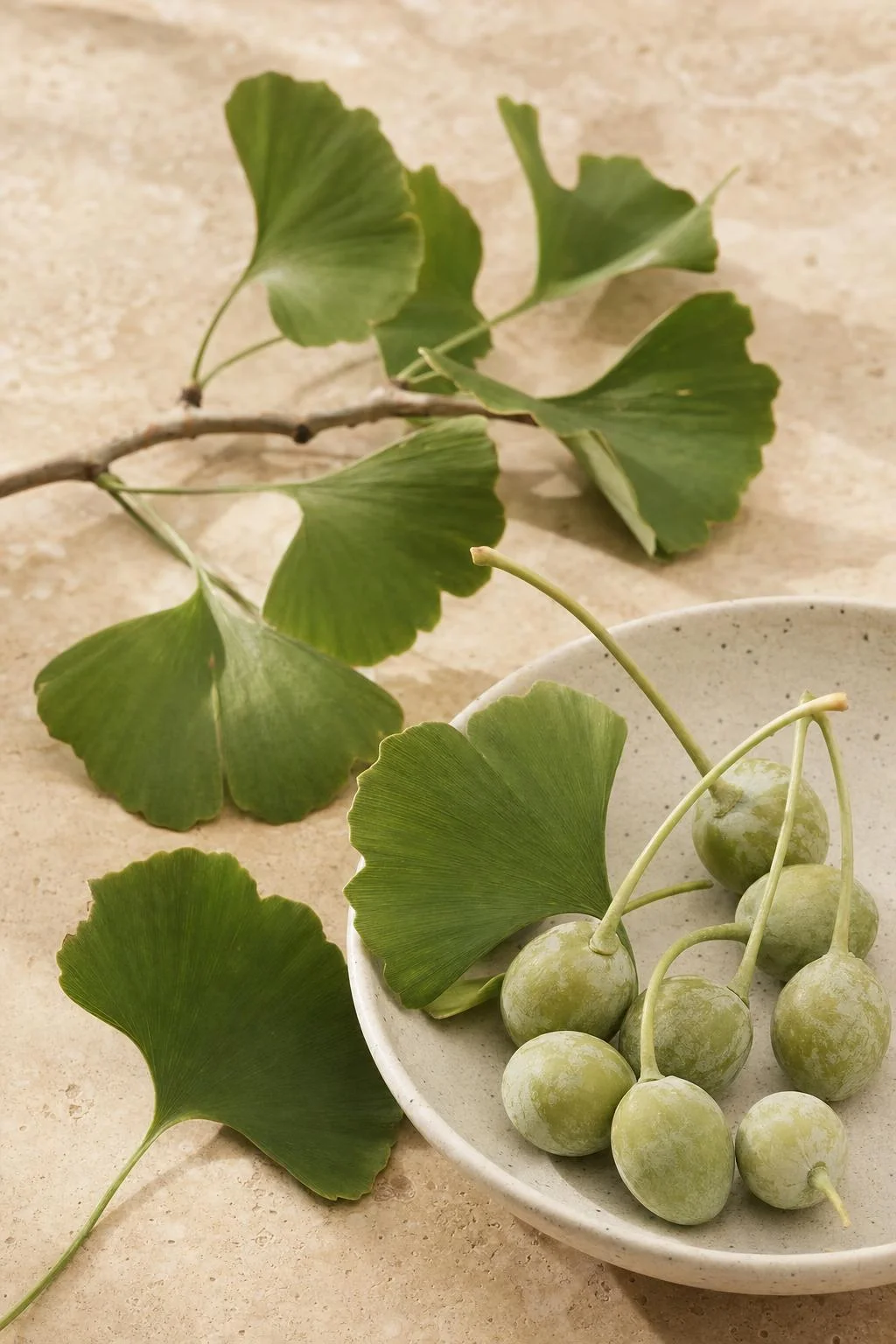
Ginkgo biloba
Ginkgo biloba is one of the oldest surviving tree species; standardized leaf extracts such as EGb 761 supply flavonoid glycosides and terpene lactones and are marketed for memory and circulation.
Last reviewed: •3 sources citedReport a correctionProfile-wide ·B Moderate
Use extra caution — Raises bleeding risk when combined with anticoagulants, antiplatelets, or NSAIDs (aspirin, clopidogrel); may lower the seizure threshold and reduce the effectiveness of seizure medication, so avoid combining with anti seizure drugs. Details
- Evidence
- Moderate Evidence
- Typical onset
- Varies by prep
- Safety rating
- High caution
- Best for
- Cognitive, Cardiovascular, Neuroprotective
- Avoid / review if
- Anticoagulants, SSRIs
Verdict: GinkgoMaybe
Bottom line
One of the most-studied botanicals in cognition, and the results are genuinely mixed: standardized EGb 761 shows modest benefit where impairment already exists, while large prevention trials in healthy older adults found nothing. Bleeding risk makes the extract a real decision, not a casual one.
- Evidence confidence
- Moderate — a large trial base with a clearly negative result for prevention
- Expected onset
- Slow — 8–12 weeks
- Give it
- 12–24 weeks
Safety: Ginkgo raises bleeding risk, so it warrants clinician review with anticoagulants, antiplatelets, or upcoming surgery. It may lower the seizure threshold. Raw or roasted ginkgo seeds are toxic and are not the same thing as leaf extract.
On the evidence: Large randomized trials support modest benefit in existing cognitive impairment; the major dementia-prevention trials in healthy adults were negative.
Best for
- Existing cognitive impairment, where standardized extract shows modest benefit
- Age-related memory complaints, with realistic expectations
Not ideal for
- Preventing dementia in healthy adults — the large prevention trials were negative
- Anyone on anticoagulants or antiplatelets, or heading into surgery
- People with seizure disorders
How strong is the evidence?Moderate (mixed by population)
Why not higher
- Large, well-run prevention trials in healthy adults found no benefit
- Results vary substantially by population and by extract
- Benefits, where present, are modest
Why not lower
- The trial base is unusually large and long by botanical standards
- Standardized EGb 761 shows reproducible benefit in cognitive impairment
- Mechanisms and tolerability are well characterized
Practical takeaway: Reasonable to trial as standardized extract when cognitive complaints already exist and bleeding risk has been cleared. Not a sensible dementia-prevention strategy for a healthy adult.
Safety
Safety & Cautions
Raises bleeding risk when combined with anticoagulants, antiplatelets, or NSAIDs (aspirin, clopidogrel); may lower the seizure threshold and reduce the effectiveness of seizure medication, so avoid combining with anti seizure drugs. Discontinue at least two weeks before elective surgery; raw or roasted ginkgo seeds contain ginkgotoxin and are a distinct seizure risk from the extract.
High caution
Caution level: High. Multiple caution categories apply, or the record uses avoid/contraindication language.
- Interaction-AwareMedication or interaction context is explicitly noted.
- Anticoagulant CautionBleeding or anticoagulant-adjacent caution language is present.
Detailed safety fields
Pregnancy, breastfeeding, and contraindications
- Anticoagulants
- SSRIs
Safety classifications
- Interaction-Aware: Medication or interaction context is explicitly noted.
- Anticoagulant Caution: Bleeding or anticoagulant-adjacent caution language is present.
Full safety note
- Raises bleeding risk when combined with anticoagulants, antiplatelets, or NSAIDs (aspirin, clopidogrel); may lower the seizure threshold and reduce the effectiveness of seizure medication, so avoid combining with anti seizure drugs. Discontinue at least two weeks before elective surgery; raw or roasted ginkgo seeds contain ginkgotoxin and are a distinct seizure risk from the extract.
Safety labels
- Interaction-Aware
- Anticoagulant Caution
Evidence-based safety
Caution when combined
Severity and certainty are shown separately. A high-priority caution can still be theoretical: these pairings are screened from shared contraindication mechanisms and are not automatically documented clinical interactions. Provenance identifies the source fields that produced each flag; it does not upgrade the certainty of the pairwise claim.
High-Priority Caution
173 flagged pairingsSerotonergic activity · Bleeding / anticoagulant risk
High-Priority Caution
173 flagged pairingsSerotonergic activity · Bleeding / anticoagulant risk
Representative pairings are shown below. Large mechanism groups are intentionally summarized to keep profiles focused and crawl-efficient.
Serotonergic activityCertainty: Theoretical
Data provenance recorded for 26 of 26 pairings in this mechanism group.
- 5-HTP — Theoretical interaction certainty
- Caffeine — Theoretical interaction certainty
- crocetin — Theoretical interaction certainty
- crocin — Theoretical interaction certainty
- Crocus Sativus — Theoretical interaction certainty
- Damiana — Theoretical interaction certainty
- DMT — Theoretical interaction certainty
- Panax Red Ginseng — Theoretical interaction certainty
- Panax White Ginseng — Theoretical interaction certainty
- Harmaline — Theoretical interaction certainty
- Harmine — Theoretical interaction certainty
- Kanna — Theoretical interaction certainty
+14 more pairings share this mechanism. Use the Safety Checker to review a specific combination.
Bleeding / anticoagulant riskCertainty: Theoretical
Data provenance recorded for 147 of 147 pairings in this mechanism group.
- aescin — Theoretical interaction certainty
- Aged Garlic Extract — Theoretical interaction certainty
- ajoene — Theoretical interaction certainty
- Ajwain — Theoretical interaction certainty
- Allicin — Theoretical interaction certainty
- Garlic — Theoretical interaction certainty
- American Ginseng Extract — Theoretical interaction certainty
- Andrographis — Theoretical interaction certainty
- Angelica Archangelica — Theoretical interaction certainty
- Angelica Dahurica — Theoretical interaction certainty
- Angelica Pubescens — Theoretical interaction certainty
- Angelica Root — Theoretical interaction certainty
+135 more pairings share this mechanism. Use the Safety Checker to review a specific combination.
Evidence
Evidence Summary
Evidence lens
Useful signal, but study design, dose, and population still matter.
ModerateModerate Evidence
Human clinical evidence: Present in source signals
Mechanistic / preclinical: Mechanism mapped — Vascular Function Support · Neuroprotective Activity
Research maturity: Established research — Long Term Human Evidence May Be Limited.
Safety boundary: Safety note available — Raises bleeding risk when combined with anticoagulants, antiplatelets, or NSAIDs (aspirin, clopidogrel); may lower the seizure threshold and reduce the effectiveness of seizure medication, so avoid combining with anti se
This profile cites 3 human studies.
Study design details
Evidence Grade
Grade B: Moderate Evidence
Evaluation of methodological rigor, population reach, and evidence alignment.
- Design Match
- Meta-analysis
- Risk of Bias
- Low
- Consistency
- Consistent
Strongest recorded design is a meta-analysis, drawn from 10 recorded studies, 8 in people. No disagreement is recorded across them.
How evidence grades work
Each grade reflects the strength and consistency of published human evidence — not marketing claims. Grades are based on study count, design quality, effect size, consistency, and recency.
- Strong
- Multiple RCTs, consistent direction, adequate effect size
- Moderate
- Some RCTs or consistent observational data in humans
- Preliminary / Mixed
- Animal or in-vitro only, or conflicting human data
- Traditional / Theoretical
- Traditional use only; no controlled human trials
Clinical Study Summaries (10)7 human evidence sources · 2 human trials · Participant totals not consistently reported · Consistency not yet classifiable
Filter by study class
Showing 10 of 10 studies.
What the evidence actually shows
This table contains 10 structured sources, including 7 human evidence sources; 2 are human trials.
| Study | Design | N | Dose | Duration | Population | Outcome | Result & magnitude | Source |
|---|---|---|---|---|---|---|---|---|
Background | Meta-analysis Statistically combines results from multiple eligible studies; confidence still depends on the quality, consistency, and directness of those studies. | — | — | — | — | — | Pooled randomized data favored EGb 761 for cognition, activities of daily living, and global clinical impression. | PubMed → |
Background | Meta-analysis Statistically combines results from multiple eligible studies; confidence still depends on the quality, consistency, and directness of those studies. | — | — | — | — | — | EGb 761 240 mg/day favored cognition, global impression, activities of daily living, and quality of life. | PubMed → |
Warfarin and food, herbal or dietary supplement interactions: A systematic review Tan CSS et al. · Br J Clin Pharmacol · 2021 Background | Systematic review Uses a predefined method to find and evaluate relevant studies, but may or may not pool their results statistically. | — | — | — | — | — | — | PubMed → |
Plant-derived nootropics and human cognition: A systematic review Lorca C et al. · Crit Rev Food Sci Nutr · 2023 Background | Systematic review Uses a predefined method to find and evaluate relevant studies, but may or may not pool their results statistically. | — | — | — | — | — | — | PubMed → |
Background | Systematic review Uses a predefined method to find and evaluate relevant studies, but may or may not pool their results statistically. | — | — | — | — | — | Systematic evidence finds inconsistent cognitive effects across dementia populations and preparations. Standardized-extract identity and diagnosed-dementia context should remain explicit rather than implying a broad memory benefit. | PubMed → |
Background | Randomized controlled trial Randomly assigns participants to interventions or controls, reducing many sources of bias when the trial is conducted well. | — | — | — | — | — | Health Benefits of a Standardized Ginkgo biloba Extract Associated With Phosphatidylserine in Alleviating Mental Stress and Cognitive Performance: Results From Two Exploratory Randomized Trials | PubMed → |
Show 4 more studies
Background | Randomized controlled trial Randomly assigns participants to interventions or controls, reducing many sources of bias when the trial is conducted well. | — | — | — | — | — | Randomized evidence in healthy adults did not establish meaningful broad cognitive enhancement with ginkgo. This negative evidence should remain visible as a counterweight to disease-specific or domain-specific findings. | PubMed → |
Singh SK et al. · Neurotherapeutics · 2019 Background | Narrative review Summarizes selected literature without the full prespecified search and selection methods of a systematic review. | — | — | — | — | — | — | PubMed → |
Ginkgo biloba for cognitive impairment and dementia Background | Narrative review Summarizes selected literature without the full prespecified search and selection methods of a systematic review. | — | — | — | — | — | For dementia, low-certainty evidence suggested small-to-moderate benefits; for MCI, ginkgo had little or no clear effect. | PubMed → |
Background | Narrative review Summarizes selected literature without the full prespecified search and selection methods of a systematic review. | — | — | — | — | — | Clinical review evidence documents plausible and reported bleeding concerns with ginkgo, especially during anticoagulant or antiplatelet co-use. Causality is not uniform across reports, but the interaction concern warrants explicit safety visibility. | PubMed → |
Dosing & Timing
- No standardized dose
- EGb 761 extract specifically; clinical mild NCD context. Separate EGb 761 dosing from generic ginkgo products.
How Ginkgo works
Simplified mechanism pathway based on preclinical and pharmacological evidence. Does not confirm clinical efficacy.
Mechanism Pathway — How Ginkgo Works
CompoundTarget / ReceptorMechanismEffect / Outcome
Mechanisms & biological pathways (preclinical)
- Vascular Function Support
- Neuroprotective Activity
Active Compounds
Key constituents studied in Ginkgo, with full pharmacology and safety profiles.
Compare related active botanicals
Explore botanicals with similar chemistry, effects, or safety considerations in the Botanical Activity Atlas.
Compare & Sourcing
Compare side-by-side tradeoffs or verify active marker guidelines.
Sourcing options
Ginkgo Biloba product picks
Recommendation status
Product recommendations are not shown for this profile because the current site safety and monetization policy does not permit them.
Product form & quality guidelines
When sourcing Ginkgo, verify the label for:
- Standardized extract: Confirm active content percentages on the supplement facts panel (e.g. standardized to specific marker compounds) rather than simple raw herb weights.
- Third-party testing: Look for independent purity labels (USP, NSF, ConsumerLab, or Eurofins) to ensure the product is free from heavy metals, solvents, and contaminants.
- Form bioavailability: Ensure the form matches evidence-supported configurations (e.g. standardized active extracts like bacosides, withanolides, or curcuminoids) for optimal onset and digestion tolerance.
Safety first · Harm reduction
This information is educational and not medical advice. Start low, avoid risky combinations, and consult a licensed clinician before making health decisions—especially if you use medications, have diagnosed conditions, or are pregnant/breastfeeding.
Learn how we evaluate confidence, safety, and intensity on the methodology page.
Founder & Head Researcher · Oak Ridge, TN · Last reviewed August 2026
Editorial Review
Checked against primary sources, cited evidence, and contraindication language before publication. Evidence claims, safety language, and affiliate modules are reviewed independently. Not personal medical advice.
Help improve this profile
Was this useful for your research?
These controls record only the page and the structured choice you make when analytics consent is enabled. Please don’t include personal medical information in research requests.
Was this evidence summary clear?
Did you find what you were researching?
Free safety checklist
Get the Ginkgo research notes
Evidence summaries, dosing context, and safety updates for this herb — straight to your inbox.
We use your email to send the checklist and occasional evidence-first supplement updates. Unsubscribe anytime. Privacy policy.