Anxiety Supplement Stacks: Evidence, Interactions, and Safer Combination Rules
An evidence-first anxiety stack guide: what current research actually supports for L-theanine, ashwagandha, and magnesium, why ingredient evidence does not validate a named stack, and how to reduce avoidable combination risk.
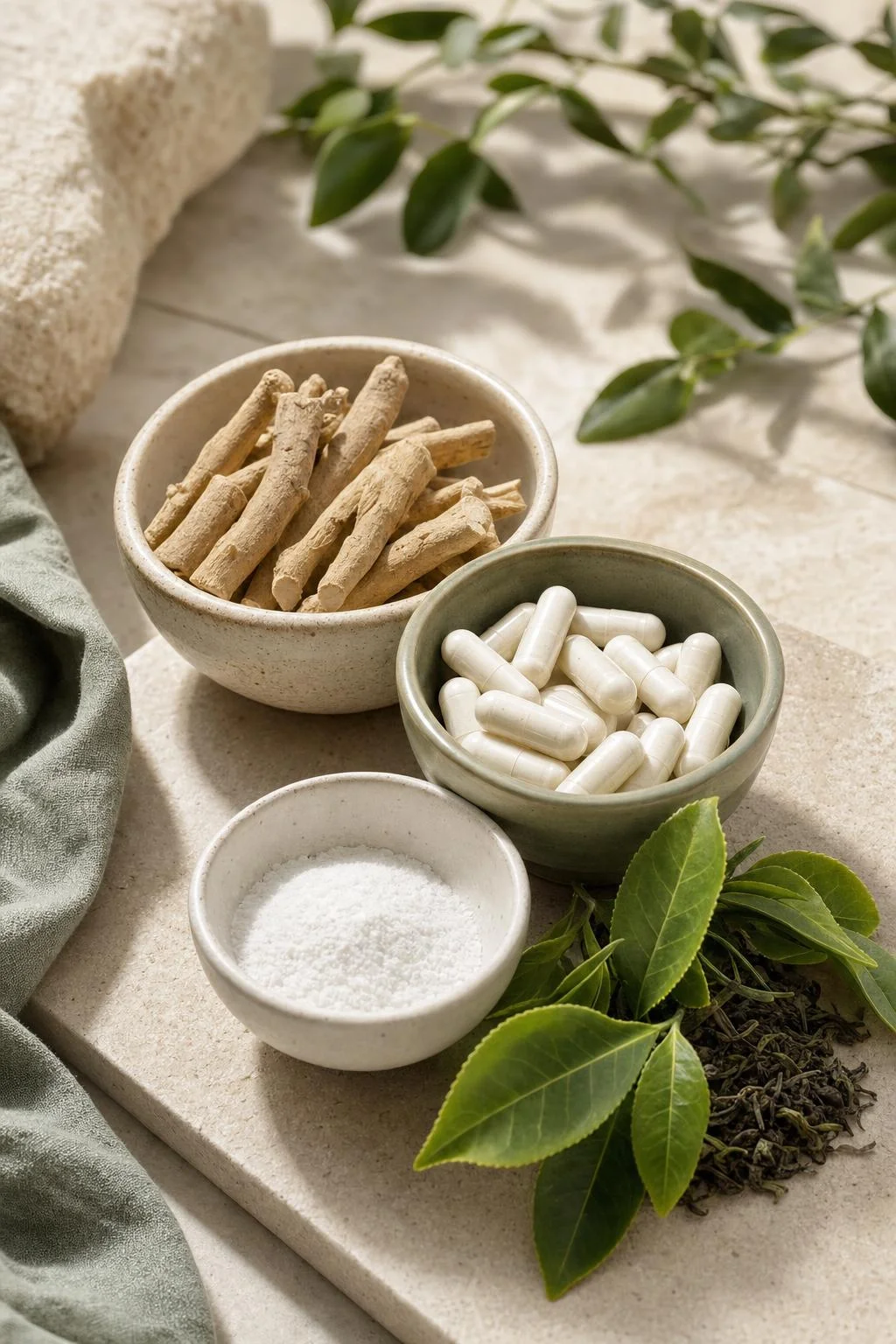
Evidence bottom line
Ingredient evidence does not validate a named anxiety stack
The old page presented several recipe-style combinations as if they were validated protocols. A positive trial for one ingredient does not tell us whether adding a second or third ingredient improves the outcome, adds nothing, or mainly adds side effects and interaction complexity.
A more defensible approach is to separate what was studied directly from what is only a combination hypothesis. If someone still chooses to combine supplements, changing one variable at a time is easier to interpret than starting a multi-ingredient regimen all at once.
What current evidence actually covers
Three popular ingredients, three different evidence boundaries
This table scrolls horizontally on small screens. Use Tab to focus the table region, then scroll with arrow keys or touch.
| Ingredient | Studied directly | Key limit | What it does not prove |
|---|---|---|---|
| L-theanine | 31 placebo-controlled RCTs across healthy and clinical populations; robust short-term choice-reaction-time signal. | Acute stress effect was modest and bias-sensitive; anxiety findings were inconsistent overall. | No reliable acute-anxiety onset and no proof that adding magnesium or ashwagandha creates a better anxiety treatment. |
| Ashwagandha | Nine placebo-controlled RCTs / 558 participants in the 2024 meta-analysis. A representative 2026 trial enrolled 141 healthy adults ages 18–65 with moderate stress/anxiety for 8 weeks and compared 300 mg proprietary root extract twice daily, another root extract, and placebo. | Repeated-dose, formulation-specific evidence in stressed adults; long-term safety remains less certain. | No immediate calming promise, no class effect for every ashwagandha product, and no validation of an ashwagandha-plus-magnesium combination. |
| Magnesium | 15 interventional studies in the 2024 review; seven measured anxiety-related outcomes. | Populations, salts, doses, durations, baseline status, and co-ingredients varied substantially. | No universal anxiety dose/form and no way to assign a combination benefit to magnesium when several actives change together. |
Why stacking changes the question
More ingredients mean more uncertainty, not automatically more benefit
Attribution gets harder
If symptoms change after three new supplements start together, you cannot tell which ingredient helped, which did nothing, or which caused an adverse effect.
Interactions compound
Sedation, blood-pressure effects, GI effects, medication absorption, thyroid effects, liver concerns, and kidney function can matter differently for each ingredient.
Dose logic does not transfer automatically
A dose studied alone is not automatically the right dose when combined with other active ingredients, and a product label is not a validated anxiety protocol.
The underlying problem may be misclassified
Panic, persistent anxiety, medication effects, sleep disorders, substance effects, thyroid disease, and other conditions are not solved by escalating supplement complexity.
If supplementation is still being considered
A lower-complexity decision sequence
- 1. Define the outcome. “Anxiety” can mean laboratory stress, racing thoughts, panic, chronic generalized anxiety, sleep disruption, or physical tension. The evidence is not interchangeable across those outcomes.
- 2. Check whether the ingredient evidence matches that outcome. Use the dedicated evidence reviews rather than a stack label: L-theanine, ashwagandha, and magnesium forms.
- 3. Review medications and health conditions first. A pharmacist or clinician can catch interaction, kidney, liver, thyroid, pregnancy, sedation, or absorption issues that a generic stack chart cannot.
- 4. Avoid changing several variables together. If supplementation is appropriate, one change at a time makes response and side effects easier to interpret.
- 5. Reassess rather than automatically adding another ingredient. If the first approach does not address the problem, the answer may be a different diagnosis or treatment—not a larger stack.
Safety and stop rules
Check before using
Combination safety matters more as complexity rises
- Ashwagandha: pregnancy, thyroid, autoimmune, medication, and rare liver-injury concerns require ingredient-specific review.
- Magnesium: kidney disease can increase risk, and magnesium can interfere with absorption of some medications when taken too close together.
- L-theanine: short trials are generally reassuring, but they do not establish unlimited long-term safety or compatibility with every medication and condition.
- Multiple sedating substances: alcohol, sleep medications, benzodiazepines, opioids, antihistamines, and sedating supplements can compound impairment.
- Do not use stack escalation as a substitute for care: persistent, worsening, panic-level, or functionally impairing anxiety deserves professional evaluation.
- Immediate stop rule: suicidal thoughts, thoughts of self-harm, inability to stay safe, or imminent danger require immediate emergency or crisis care.
Frequently asked questions
What is the best anxiety supplement stack?
Current evidence does not establish a universal best stack. L-theanine, ashwagandha, and magnesium have been studied mostly as individual interventions or in heterogeneous formulations. Evidence for one ingredient cannot be assumed to prove that a named multi-supplement combination is more effective or safer.
Can I combine ashwagandha and L-theanine?
The combination is commercially common, but ingredient-level evidence does not validate the pair as a treatment. Ashwagandha evidence is primarily repeated-dose and formulation-specific, while a 2026 L-theanine meta-analysis found inconsistent anxiety effects. Adding both together also makes benefit, side effects, and interactions harder to attribute.
Can I combine magnesium with anxiety supplements?
Magnesium is often included in combination products, but the 2024 systematic review found heterogeneous populations, formulations, doses, durations, and some multi-ingredient trials. That makes it difficult to infer what magnesium contributes to a specific stack. Kidney disease and medication timing can also materially change magnesium safety.
How fast should an anxiety stack work?
There is no evidence-based onset time for an anxiety stack. L-theanine is often studied 30–60 minutes before cognitive testing, but its robust acute signal was attention rather than reliable anxiety relief. Ashwagandha evidence is generally repeated-dose over weeks, while magnesium studies vary widely in duration and population.
Is starting several supplements at once a good way to test a stack?
Starting several new ingredients together makes it harder to identify what helped or caused a side effect and increases interaction complexity. If a clinician or pharmacist agrees that supplementation is reasonable, changing one variable at a time is easier to interpret than beginning a multi-ingredient regimen all at once.
When is a supplement stack the wrong tool for anxiety?
Persistent, worsening, panic-level, or functionally impairing anxiety deserves established mental-health care rather than supplement escalation. Suicidal thoughts, thoughts of self-harm, inability to stay safe, or imminent danger require immediate emergency or crisis care.
Sources and directness notes
- 1. L-theanine systematic review and meta-analysis of 31 randomized trials (2026) — 31 RCTs and 1,168 participants; robust short-term attention signal, modest bias-sensitive acute-stress effect, and inconsistent anxiety findings.
- 2. Ashwagandha stress and anxiety systematic review and meta-analysis (2024) — Nine randomized trials and 558 participants; pooled stress/anxiety signals versus placebo using specific formulations, with long-term safety still less certain.
- 3. Ashwagandha root-extract randomized trial in adults with moderate stress and anxiety (2026) — 141 healthy adults ages 18–65; 8-week three-arm trial comparing 300 mg proprietary root extract twice daily, another root extract, and placebo.
- 4. Magnesium anxiety and sleep systematic review (2024) — 15 interventional studies, seven with anxiety outcomes; heterogeneity in populations, formulations, doses, durations, and co-ingredients limits firm conclusions.
- 5. NIH Office of Dietary Supplements: Magnesium fact sheet for health professionals — Safety, tolerable upper-intake context for supplemental magnesium, kidney-risk considerations, and medication interactions.
Related evidence guides
Optional sourcing examples
Neutral product coverage for all three compared ingredients
The sourcing module below includes ashwagandha, L-theanine, and magnesium examples from the same shared product registry. Inclusion is for label/form comparison and affiliate convenience; it does not rank one ingredient above another or validate a combination.
Sourcing options
Product sourcing examples
Use these as sourcing starting points, not medical recommendations. Product quality, dose, and fit still need review.
As an Amazon Associate I earn from qualifying purchases. We may earn a commission from qualifying links at no extra cost to you. How we stay independent.
Newsletter
Read the newsletter archive
Short evidence-first notes on supplement safety, sourcing, and research interpretation.
Free safety checklist
Get the evidence-first supplement notes
Occasional research updates, practical safety context, and new guide announcements. No diagnosis, treatment, or personal medical advice.
We use your email to send the checklist and occasional evidence-first supplement updates. Unsubscribe anytime. Privacy policy.