Compound Profile
Coenzyme Q10
Coenzyme Q10 has human evidence in specific contexts, but effects are not uniform: Q SYMBIO reported a chronic heart failure event signal, pooled fatigue evidence is modest, depression findings vary by scale, anxiety data are limited and not statistically significant, and exercise performance effects are small and inconsistent.
Last reviewed: •12 sources citedReport a correctionProfile-wide ·D Preliminary
Use extra caution — Preserve medication interaction screening, especially with warfarin or other vitamin K antagonists and blood pressure or glucose lowering therapies. Details
- Evidence
- Preliminary evidence
- Typical onset
- Varies by prep
- Safety rating
- Use extra caution: Interaction risk
- Best for
- Mitochondrial ETC, Oxidative Stress Pathways, Mitochondria
- Avoid / review if
- Pregnancy Or Breastfeeding Without Clinician Guidance Due To Limited Safety Data
Forms
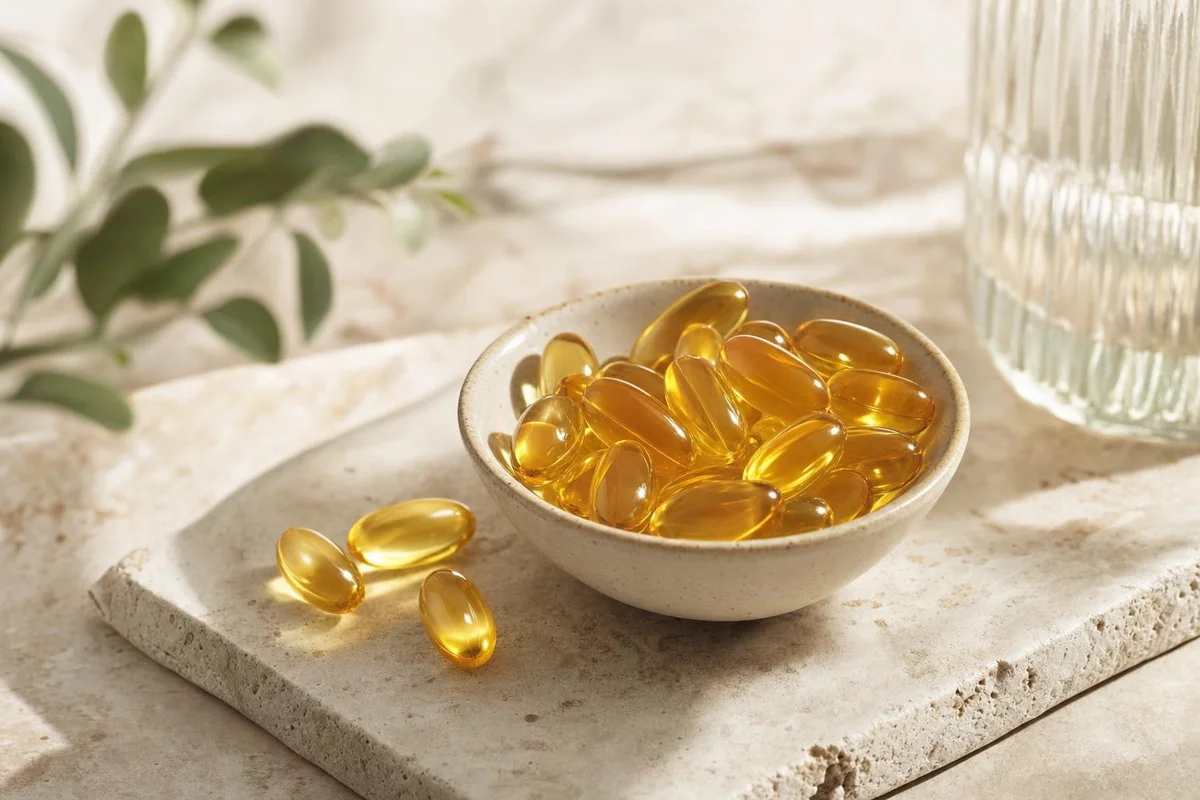
CoQ10 products commonly appear as ubiquinone or ubiquinol. Ubiquinone is the oxidized form, while ubiquinol is the reduced form; both point back to the same CoQ10 decision context.
- Ubiquinone: common CoQ10 form used in many standard products.
- Ubiquinol: reduced CoQ10 form often marketed for absorption-focused formulas.
Safety
Safety & Cautions
Preserve medication interaction screening, especially with warfarin or other vitamin K antagonists and blood pressure or glucose lowering therapies. The reviewed efficacy evidence does not establish a universal consumer dose, formulation, or long term safety profile.
High caution
Caution level: High. Multiple caution categories apply, or the record uses avoid/contraindication language.
- Interaction-AwareMedication or interaction context is explicitly noted.
- Anticoagulant CautionBleeding or anticoagulant-adjacent caution language is present.
- Pregnancy/Breastfeeding CautionPregnancy or breastfeeding caution language is present.
Interaction research is incomplete. The source record includes medication cautions; shared warning keywords do not establish an interaction between two ingredients. Review the safety notes with a pharmacist before combining products.
Evidence Summary
Profile-wide ·D PreliminaryEvidence lens
Early signal that needs stronger human replication before practical claims.
PreliminaryPreliminary evidence
Human clinical evidence: Present in source signals
Mechanistic / preclinical: Mechanism mapped — Oxidative Stress Modulation · Mitochondrial Support · Metabolic Regulation
Research maturity: Preliminary research — Early findings are not treated as established consumer benefit.
Safety boundary: Safety note available — Preserve medication interaction screening, especially with warfarin or other vitamin K antagonists and blood pressure or glucose lowering therapies.
This profile cites 12 publications; study designs and human evidence are counted below.
Evidence Strength
Confidence estimate based on the design quality and consistency of published clinical trials.
Coenzyme Q10 has a preliminary evidence rating.
AdaptogenStress & MoodRecoveryLongevity
Citation density
3.0
Sources
12
Effects
4
Research recency
Mixed recency
Evidence Grade
Grade D: Preliminary / Theoretical Evidence
Evaluation of methodological rigor, population reach, and evidence alignment.
- Design Match
- Meta analysis
- Risk of Bias
- Consistency
- Not assessed
Strongest recorded design is a meta analysis, drawn from 10 design classified publications, 10 classified as human evidence.
How evidence grades work
Each grade reflects the strength and consistency of published human evidence — not marketing claims. Grades are based on study count, design quality, effect size, consistency, and recency.
- Strong
- Multiple RCTs, consistent direction, adequate effect size
- Moderate
- Some RCTs or consistent observational data in humans
- Preliminary / Mixed
- Animal or in-vitro only, or conflicting human data
- Traditional / Theoretical
- Traditional use only; no controlled human trials
Cited Research Publications (12)7 human evidence sources · 1 human trial · Unique participant total not established · Consistency not yet classifiable
Filter by study class
Showing 12 of 12 studies.
What the evidence actually shows
This table contains 12 structured sources, including 7 human evidence sources; 1 is a human trial. Sample sizes describe individual publications. A unique participant total is not established; reviews and reports may include the same trials or people.
| Study | Design | Result & magnitude | Source |
|---|---|---|---|
Background | Meta-analysis Statistically combines results from multiple eligible studies; confidence still depends on the quality, consistency, and directness of those studies. | Flow-mediated dilation improved, while VCAM and ICAM biomarkers did not clearly change. | PubMed → |
Background | Meta-analysis Statistically combines results from multiple eligible studies; confidence still depends on the quality, consistency, and directness of those studies. | CoQ10 modestly reduced systolic blood pressure, while diastolic pressure and heart rate were not clearly changed. | PubMed → |
Background | Meta-analysis Statistically combines results from multiple eligible studies; confidence still depends on the quality, consistency, and directness of those studies. | A 2026 review of 20 randomized trials reported pooled improvements in triglycerides, fasting glucose, HbA1c, HOMA-IR, C-reactive protein, and HDL cholesterol with CoQ10, while total cholesterol, LDL cholesterol, blood pressure, and malondialdehyde were not significantly changed. | PubMed → |
Background | Meta-analysis Statistically combines results from multiple eligible studies; confidence still depends on the quality, consistency, and directness of those studies. | A 2026 meta-analysis of 64 randomized trials in metabolic disorders found small pooled improvements across several lipid, glycemic, and inflammatory biomarkers with CoQ10, including triglycerides, LDL cholesterol, HbA1c, fasting glucose, CRP, TNF-alpha, and IL-6. | PubMed → |
Background | Meta-analysis Statistically combines results from multiple eligible studies; confidence still depends on the quality, consistency, and directness of those studies. | A 2026 meta-analysis of 39 randomized trials found small pooled changes in fasting glucose, HbA1c, and fasting insulin with CoQ10, with effects more apparent in diabetes populations. | PubMed → |
Background | Meta-analysis Statistically combines results from multiple eligible studies; confidence still depends on the quality, consistency, and directness of those studies. | A 2026 synthesis of 14 randomized studies found lower malondialdehyde and creatine kinase after exercise with CoQ10, while blood lactate and maximal oxygen uptake were not significantly changed. | PubMed → |
Show 6 more studies
Background | Randomized controlled trial Randomly assigns participants to interventions or controls, reducing many sources of bias when the trial is conducted well. | A 2026 umbrella review found fasting-glucose improvement was the most consistent CoQ10 glycemic signal, while conclusions for HbA1c, HOMA-IR, and insulin varied depending on the analytic scale used. | PubMed → |
Svend A Mortensen, Franklin Rosenfeldt, Adarsh Kumar, Peter Dolliner, Krzysztof J Filipiak, Daniel Pella, Urban Alehagen, Günter Steurer, Gian P Littarru, Q-SYMBIO Study Investigators · JACC Heart Fail · 2014 Background | Other / unclear The study design is not yet classified clearly enough to infer its place in the evidence hierarchy. | — | PubMed → |
I-Chen Tsai, Chih-Wei Hsu, Chun-Hung Chang, Ping-Tao Tseng, Ke-Vin Chang Background | Other / unclear The study design is not yet classified clearly enough to infer its place in the evidence hierarchy. | — | PubMed → |
Rami Akwan, Muhammad M Elsharkawy, Azzam Zrineh, Areen Amleh, Bashar Douden, Mays Alhouseini, Layla Alsaeed, Mohamed Eldesouki Background | Other / unclear The study design is not yet classified clearly enough to infer its place in the evidence hierarchy. | — | PubMed → |
Pedro Lucas Machado Magalhães, Anderson Matheus Pereira da Silva, Mariana Letícia de Bastos Maximiano, João Vitor Andrade Fernandes, Dillan Cunha Amaral, Alice de Aquino Tavares Fortes, Helvécio Neves Feitosa Filho, Luiza de Oliveira Silva, Beatriz Dias da Silva Teixeira, Eryvelton de Souza Franco, Maria Bernadete de Sousa Maia Background | Other / unclear The study design is not yet classified clearly enough to infer its place in the evidence hierarchy. | — | PubMed → |
Hengzhi Deng, Tianyu Song, Mingyue Yin, Kai Xu, Yuming Zhong, Norsyazmi Bin Mohd, Mohamed Nashrudin Bin Naharudin, Ashril Yusof, Xiaohan Fan Background | Other / unclear The study design is not yet classified clearly enough to infer its place in the evidence hierarchy. | — | PubMed → |
How Coenzyme Q10 Works
Simplified mechanism pathway based on preclinical and pharmacological evidence. Does not confirm clinical efficacy.
Mechanism Pathway — How Coenzyme Q10 Works
CompoundTarget / ReceptorMechanismEffect / Outcome
Dosing
- No standardized dose
- No standardized dose is established for this ingredient in our source data. Preparations differ widely, so follow the standardization on the product you actually have and speak to a clinician before starting.
Mechanisms & biological pathways
Preclinical mechanism details from scientific profiles; these represent plausible pathways but do not guarantee clinical efficacy in humans.
- Oxidative Stress Modulation
- Mitochondrial Support
- Metabolic Regulation
- Vascular Function Support
- Stress Response Modulation
- Neuroprotective Activity
Botanical Context
Source botanicals and comparison guides related to Coenzyme Q10.
Compare & Sourcing
Compare side-by-side tradeoffs or verify active marker guidelines.
Sourcing options
CoQ10 product picks
Recommendation status
Product recommendations are not shown for this profile. Review the evidence limitations, safety notes, and medication concerns before considering a product.
Product form & quality guidelines
When sourcing Coenzyme Q10, verify the label for:
- Standardized Extract: Confirm active content percentages on the supplement facts panel (e.g. standardized to specific marker compounds) rather than simple raw herb weights.
- Third-Party Testing: Look for independent purity labels (USP, NSF, ConsumerLab, or Eurofins) to ensure the product is free from heavy metals, solvents, and contaminants.
- Form Bioavailability: Ensure the form matches evidence-supported configurations (e.g. chelated bisglycinate/glycinate for magnesium, micronized monohydrate for creatine) for optimal onset and digestion tolerance.
Safety first · Harm reduction
This information is educational and not medical advice. Start low, avoid risky combinations, and consult a licensed clinician before making health decisions—especially if you use medications, have diagnosed conditions, or are pregnant/breastfeeding.
Learn how we evaluate confidence, safety, and intensity on the methodology page.
Founder & Head Researcher · Oak Ridge, TN
Editorial Review
Source citations and evidence limitations are provided for readers to inspect. A named clinical or pharmacist review is shown only when documented for the specific page. This byline does not certify independent clinical review. Not personal medical advice.
Help improve this profile
Was this useful for your research?
These controls record only the page and the structured choice you make when analytics consent is enabled. Please don’t include personal medical information in research requests.
Was this evidence summary clear?
Did you find what you were researching?
Research notes and safety resources
Get the Coenzyme Q10 evidence notes
Occasional research updates, safety context, and product-quality checks for supplement decisions.
We use your email to send the checklist and occasional evidence-first supplement updates. Unsubscribe anytime. Privacy policy.