Related Guides
Goal and condition context for deciding what to read next.
Herb Profile
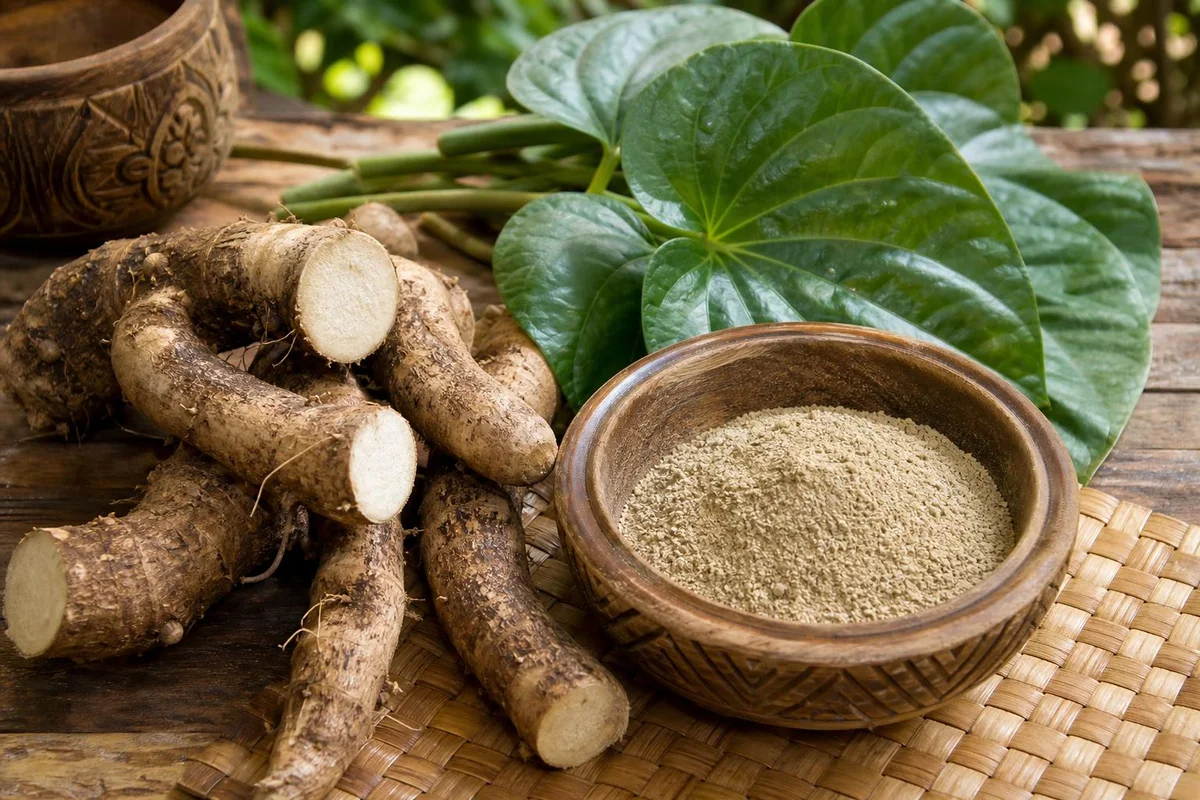
Piper methysticum
Kava is best framed for short term anxiety and relaxation research tied to kavalactone preparations, with safety screening for liver disease, alcohol use, sedatives, hepatotoxic medications, pregnancy, and prolonged daily use.
Use extra caution — hepatotoxicity risk Details
Bottom line
Safety: Rare but serious liver injury is reported. Avoid with alcohol, other sedatives, or existing liver conditions; involve a clinician.
On the evidence: Meta-analyses support short-term anxiolytic effects; safety signals limit routine use.
Best for
Not ideal for
Consider instead: L-theanine — for lower-risk everyday calm
Why not higher
Why not lower
Practical takeaway: For occasional, short-term situational anxiety with a carefully sourced product — not a daily habit. Avoid with alcohol, sedatives, or existing liver concerns, and involve a clinician.
Safety
hepatotoxicity risk
Elevated caution
Caution level: Elevated. One caution category applies — read it before use.
Evidence-based safety
Severity and certainty are shown separately. A high-priority caution can still be theoretical: these pairings are screened from shared contraindication mechanisms and are not automatically documented clinical interactions. Provenance identifies the source fields that produced each flag; it does not upgrade the certainty of the pairwise claim.
Sedation / CNS depression
Representative pairings are shown below. Large mechanism groups are intentionally summarized to keep profiles focused and crawl-efficient.
Data provenance recorded for 68 of 68 pairings in this mechanism group.
+56 more pairings share this mechanism. Use the Safety Checker to review a specific combination.
Evidence
Useful signal, but study design, dose, and population still matter.
Human clinical evidence: Present in source signals
Mechanistic / preclinical: Mechanism mapped — Neurotransmitter Modulation · Stress Response Modulation
Research maturity: Established research — Long Term Human Evidence May Be Limited.
Safety boundary: Safety note available — hepatotoxicity risk
This profile cites 3 human studies.
Evaluation of methodological rigor, population reach, and evidence alignment.
Each grade reflects the strength and consistency of published human evidence — not marketing claims. Grades are based on study count, design quality, effect size, consistency, and recency.
Filter by study class
Showing 5 of 5 studies.
What the evidence actually shows
This table contains 5 structured sources, including 2 human evidence sources; 0 are human trials.
| Study | Design | N | Dose | Duration | Population | Outcome | Result & magnitude | Source |
|---|---|---|---|---|---|---|---|---|
Sarris J et al. · World J Biol Psychiatry · 2022 Background | Meta-analysis Statistically combines results from multiple eligible studies; confidence still depends on the quality, consistency, and directness of those studies. | — | — | — | — | — | — | PubMed → |
Background | Systematic review Uses a predefined method to find and evaluate relevant studies, but may or may not pool their results statistically. | — | — | — | — | — | A Cochrane review found some evidence of anxiety-symptom reduction with kava, but the trial base was limited and safety concerns remain central. Efficacy evidence should stay preparation-specific and should not outrank hepatotoxicity context. | PubMed → |
Pharmacotherapy of Anxiety Disorders: Current and Emerging Treatment Options Garakani A et al. · Front Psychiatry · 2020 Background | Narrative review Summarizes selected literature without the full prespecified search and selection methods of a systematic review. | — | — | — | — | — | — | PubMed → |
Common Herbal Dietary Supplement-Drug Interactions Asher GN et al. · Am Fam Physician · 2017 Background | Narrative review Summarizes selected literature without the full prespecified search and selection methods of a systematic review. | — | — | — | — | — | — | PubMed → |
Background | Narrative review Summarizes selected literature without the full prespecified search and selection methods of a systematic review. | — | — | — | — | — | A safety review emphasizes rare but potentially severe liver injury associated with some kava products. The signal is uncommon and causality can be difficult to establish, but it is clinically important enough to remain prominent in any public profile. | PubMed → |
Simplified mechanism pathway based on preclinical and pharmacological evidence. Does not confirm clinical efficacy.
Mechanism Pathway — How Kava Works
Key constituents studied in Kava, with full pharmacology and safety profiles.
Explore botanicals with similar chemistry, effects, or safety considerations in the Botanical Activity Atlas.
Compare side-by-side tradeoffs or verify active marker guidelines.
Direct product recommendations and affiliate links are suppressed for this herb due to its high caution or needs-review safety classification.
Evaluate the safety checks, contraindications, and potential medication interactions above under clinician supervision before use.
Safety first · Harm reduction
This information is educational and not medical advice. Start low, avoid risky combinations, and consult a licensed clinician before making health decisions—especially if you use medications, have diagnosed conditions, or are pregnant/breastfeeding.
Learn how we evaluate confidence, safety, and intensity on the methodology page.
Founder & Head Researcher · Oak Ridge, TN · Last reviewed August 2026
Checked against primary sources, cited evidence, and contraindication language before publication. Evidence claims, safety language, and affiliate modules are reviewed independently. Not personal medical advice.
Help improve this profile
These controls record only the page and the structured choice you make when analytics consent is enabled. Please don’t include personal medical information in research requests.
Was this evidence summary clear?
Did you find what you were researching?
Free safety checklist
Evidence summaries, dosing context, and safety updates for this herb — straight to your inbox.
We use your email to send the checklist and occasional evidence-first supplement updates. Unsubscribe anytime. Privacy policy.